
Ticket-to-Invoice Time: The Service Metric That Decides Your Cash Flow
Ticket-to-invoice time is the number of days between a completed service ticket and the invoice leaving the office. Here is what a seven-day lag costs, where the days go, and the field practices that bring it under one day.

Ticket-to-invoice time is the number of days between a service ticket being marked complete in the field and the corresponding invoice being sent to the customer. It's the only segment of the collection cycle a contractor fully controls, because it runs before the customer's payment terms begin. Most commercial roofing operators estimate it at two or three days. Measured across 30 closed tickets, it typically lands between five and ten, and on tickets waiting for a photo, a timesheet or a signature it runs longer. On a service department billing $100,000 a month, a seven-day lag means roughly $23,000 is permanently sitting in "done but not billed."
Construction already carries some of the worst payment timing of any industry. Average DSO sits between 60 and 90 days against 30 to 45 in most sectors, and slow payment cost U.S. construction an estimated $280 billion in 2024, roughly 14 percent of total spending. A contractor can't shorten the customer's AP process. A contractor can eliminate the week before the invoice exists, and that week is the cheapest working capital in the business.
What Is Ticket-to-Invoice Time and How Is It Different From DSO?
DSO counts from the invoice date to payment and depends mostly on the customer. Ticket-to-invoice time counts from job completion to the invoice date and depends entirely on the contractor. Shortening the second shortens the first without asking anyone to pay faster, which is why it belongs on the service department's weekly report rather than in the year-end accounting review.
The distinction matters because the industry data shows how little of the wait is actually the customer. Billd's 2025 subcontractor survey found general contractors believe payment lands about 30 days after a pay application while subs actually wait an average of 56. Transaction data from payment platforms attributes most of that gap to document friction rather than customers holding cash. The same is true inside a roofing service department. The invoice isn't late because anyone decided it should be. It's late because it's waiting for something from the field.
Where Do the Days Go Between a Closed Ticket and an Invoice?
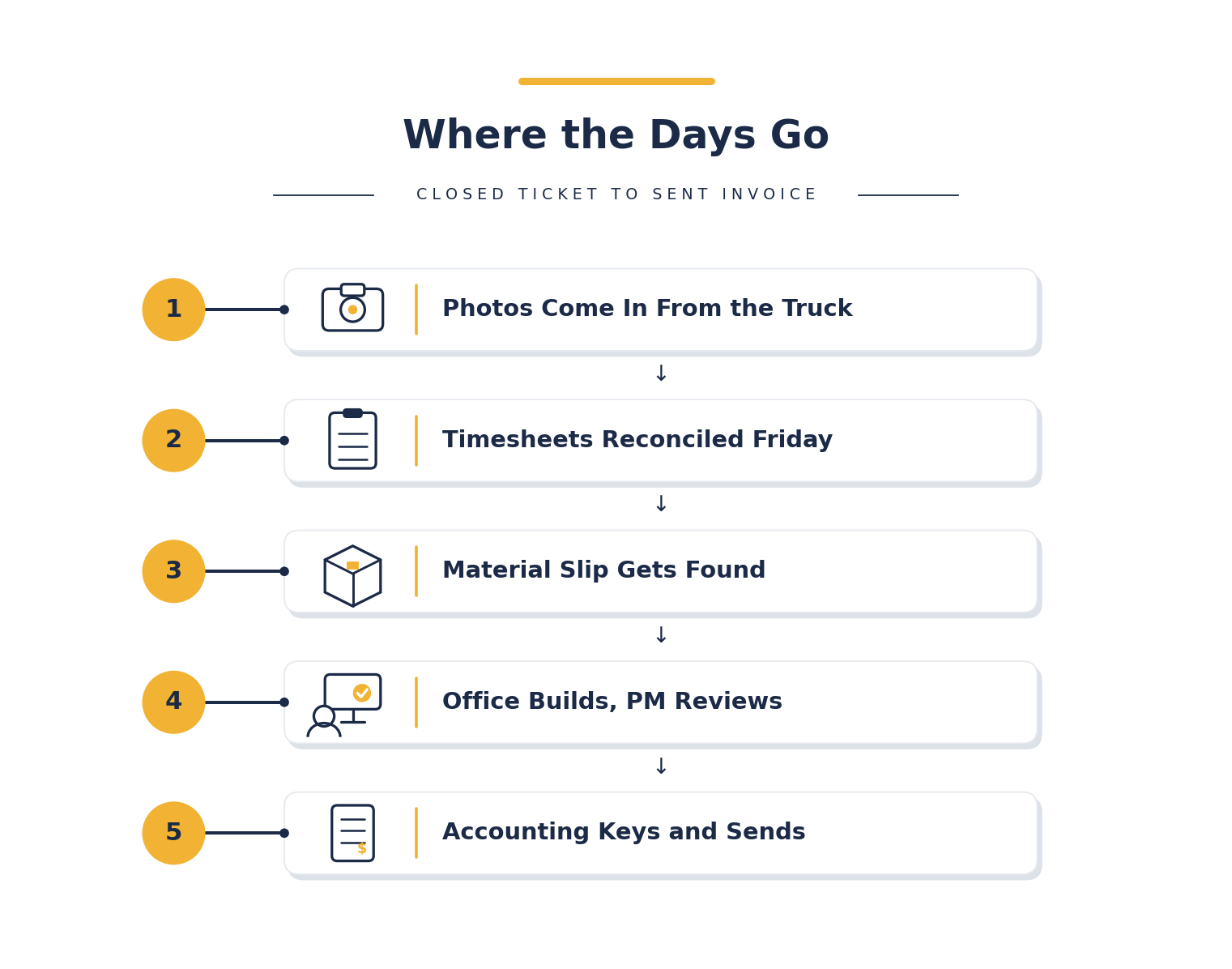
The sequence is consistent across service departments that haven't changed it. Each step is reasonable on its own. Together they are a week.
- Day 0: The crew finishes the repair and moves to the next job. Photos are on a phone, hours are in a notebook, materials came off the truck.
- Days 1 to 2: Photos and notes come in from the truck, or the coordinator calls the tech to confirm what was done.
- Days 2 to 4: Hours are reconciled against a paper timesheet that arrives Friday.
- Days 3 to 5: Someone locates the material slip or reconstructs it from the supplier statement.
- Days 5 to 7: The office builds the invoice and a project manager reviews it.
- Days 7 to 10: Accounting keys the invoice into QuickBooks and sends it.
Rabbet's 2024 Construction Payments Report found 82 percent of contractors regularly wait more than 30 days for payment. Every day of internal lag is added to that wait before the customer's clock even starts.
What Does a Seven-Day Invoicing Lag Actually Cost?
Take a service department billing $100,000 a month across 40 tickets, an average of $2,500 per ticket. A seven-day lag means roughly $23,000 is always sitting between completion and invoice. Cut the lag to one day and that cash comes back once and stays back. One contractor's own model puts the value of each day removed from the payment cycle at about $1,250 a year per $5 million of revenue at current borrowing costs, before counting the labor spent chasing documents.
The larger cost is softer and harder to see. An invoice that arrives three days after the leak stopped gets paid. An invoice that arrives three weeks later gets questioned, because the facility manager has moved on and the emergency is a memory. Disputes rise with the gap, and so does the count of tickets that quietly never get billed at all. That last category shows up in real-time service cost tracking as margin the department can't explain.
Pro Tip: Pull the last 30 closed service tickets and compute the median days from completion date to invoice date. That number, put on the wall and reported weekly by crew, typically drops by half within a month before any software changes, because people fix what gets counted.
Which Field Practices Eliminate the Lag?
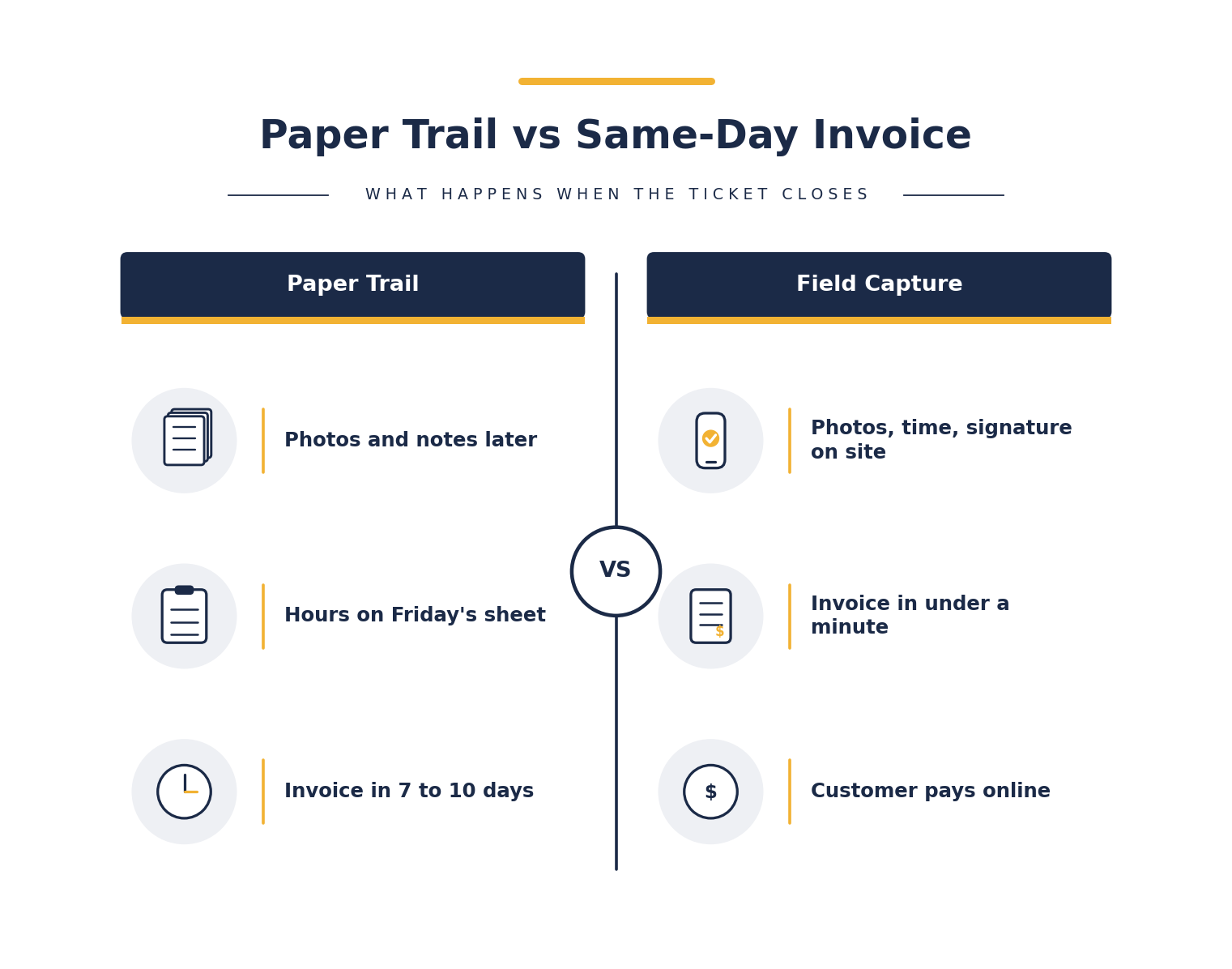
Every day in the sequence above traces to something that could have been captured on the roof at the time of the work. For the invoice to be ready the moment the ticket closes, five things have to happen in the field:
- Photos on the ticket before the crew leaves site, timestamped and attached, so nobody calls the tech on day two.
- Hours logged against the ticket by the technician on the day. Paper timesheets are where days two through four go. The transition is covered in Digital Timesheets.
- Materials recorded against the ticket as they are used, from truck stock or the supplier ticket, so nobody reconstructs them from a statement.
- Customer signature captured on the phone when the work is done, which removes the most common reason an invoice gets disputed.
- Ticket marked complete in the field, which becomes the trigger for the invoice rather than the start of a paperwork chase.
Each step that happens on site is a day not lost later. The mobile work order is the mechanism, and the office's role shrinks to a review and a send.
How Should Contractors Measure It, and What Is a Good Benchmark?
Measure the median days from completion to invoice across all closed service tickets, then split it by technician and by coordinator. The spread is usually the story. One crew's tickets invoice in a day because the lead photographs and logs time on the phone. Another crew's take nine because everything arrives on Friday.
Good looks like this: under one day for standard service work, two days for tickets that need project manager review, and a weekly report by crew. Departments that start measuring it typically cut it in half within a month. The service call checklist is the right place to build the field steps in.
“A service department doesn't have a collections problem. It has a documentation problem that shows up as a collections problem 60 days later.”
Why Invoicing Speed Is a Retention Metric
Facility managers renew maintenance agreements with the contractor whose paperwork is easiest to process. An invoice that arrives the same day with photos, hours and a signed completion attached is approved without a phone call. An invoice that arrives three weeks later with a line item nobody can verify gets held, and the account gets a reputation in the customer's AP department. Payment cycles across construction lengthened by 8 to 12 days over the past year. The contractors whose invoices are clean and immediate are the ones whose cycles didn't move.
Pro Tip: Report ticket-to-invoice time alongside DSO on the same page. When leadership sees that the internal seven days are larger than the difference between the best-paying and worst-paying customers, the priority sets itself.
Invoice the Moment the Ticket Closes
Terial's service workflow is built around the moment a crew marks a ticket complete. Technicians capture photos, log time, record materials and collect a customer signature on the ticket from their phone. When the job is marked complete, the invoice generates in under a minute with line items auto-populated from the ticket, the office reviews and sends, and QuickBooks Online sync handles the accounting entry. Integrated payments let customers pay by card or ACH directly from the invoice, which contractors on the platform use to accelerate collection by up to 50 percent and recover 20 or more hours a week of administrative time. See how Terial's service management closes the gap between completion and cash.
Key Takeaways
FAQ
What is a good ticket-to-invoice time for commercial roofing service?
Under one day for standard service tickets and no more than two for tickets that need project manager review. Departments that have never measured it typically sit between five and ten days.
How is ticket-to-invoice time different from DSO?
DSO counts from invoice date to payment and depends mostly on the customer. Ticket-to-invoice time counts from job completion to invoice date and depends entirely on the contractor's process. Fixing the second shortens the first.
Why do service invoices get delayed?
The invoice is waiting on something from the field: photos, logged hours, a material record or a customer signature. Each arrives on its own schedule and the invoice waits for the last of them.
Does invoicing faster actually get you paid faster?
Yes. The customer's payment clock starts earlier, and invoices sent while the work is fresh are questioned less and paid closer to terms. Contractors with integrated online payment shorten the cycle further.
Recommended
- Real-Time Service Cost Tracking for Commercial Roofers
- Cash Flow Management for Roofing Contractor Growth
- How to Track Labor Hours for Maximum Project Profit
- Terial | Workflow Automation for Commercial Roofers


More articles


Book a personalized demo
Get a 30-minute demo tailored to how you run your commercial roofing business

“Making the switch to Terial has greatly exceeded my expectations and has already had a meaningful impact on our team’s productivity. Terial has significantly reduced the amount of time required to complete many of our day-to-day operational tasks, allowing our team to focus more on serving our customers.”

