
Roofing KPIs for Private Equity: What Operating Partners Actually Track
Private equity buyers underwrite roofing companies on a defined set of financial, operational and platform KPIs. Here is the list, the reporting gap that discounts most platforms, and how to close it before a sale or an add-on.

Private equity roofing KPIs are the financial, operational and platform-level metrics a sponsor uses to underwrite a roofing acquisition and then to manage the business after close. Buyers don't pay for revenue. They pay for measurable, comparable, repeatable performance, and they expect to see it in a monthly reporting pack within 90 days of closing. A $20 million commercial platform that can't produce gross margin by job type across its branches as of the same date is priced as three separate companies with a holding company on top.
The pace makes this urgent. Private equity acquired a U.S. roofing platform roughly every 48 hours through 2025, with 134 deals projected for the year, more than double 2021 volume. Commercial sits earlier in the cycle than residential, where strategic buyers still lead the high end of the market. The operators who reach the table first with clean numbers set the terms.
Key Takeaways
- Buyers underwrite a defined KPI set: normalized EBITDA, recurring service revenue, backlog convertibility, WIP position and branch comparability decide the multiple, not revenue size.
- Recurring service revenue moves the multiple: commercial maintenance exposure adds 0.5 to 0.8 turns before any other adjustment.
- Comparability is the platform KPI: the same definitions, on the same date, at every branch. Without it, branch numbers are estimates.
- Fragmented systems are priced as risk: a data warehouse on top of inherited stacks produces numbers two to four weeks late that don't reconcile.
- Integration capacity sets acquisition pace: Renovo absorbed 15 to 20 companies in 24 months on unmerged systems and filed Chapter 7 inside four years.
What Do Private Equity Buyers Underwrite in a Roofing Company?
Sponsors don't pay a premium for every roofing company. The advisors who run these processes describe the underwriting list as normalized EBITDA, backlog quality, recurring service revenue, commercial versus residential mix, warranty risk, working-capital requirements, crew continuity, management depth, and whether the business runs without the founder holding it together. After close, the same list becomes the monthly reporting pack. The KPIs below map to it directly.
The multiple attached to those numbers is wide. 2026 roofing transactions range from about 2.5x to 9x EBITDA, with most deals clustering at 4x to 5x and commercial maintenance-contract businesses commanding 5.5x to 9x. The spread is explained in Roofing Company Valuation: 2026 Guide for Contractors. How a buyer verifies those numbers is where most platforms lose turns.
Which Financial KPIs Do Operating Partners Track?
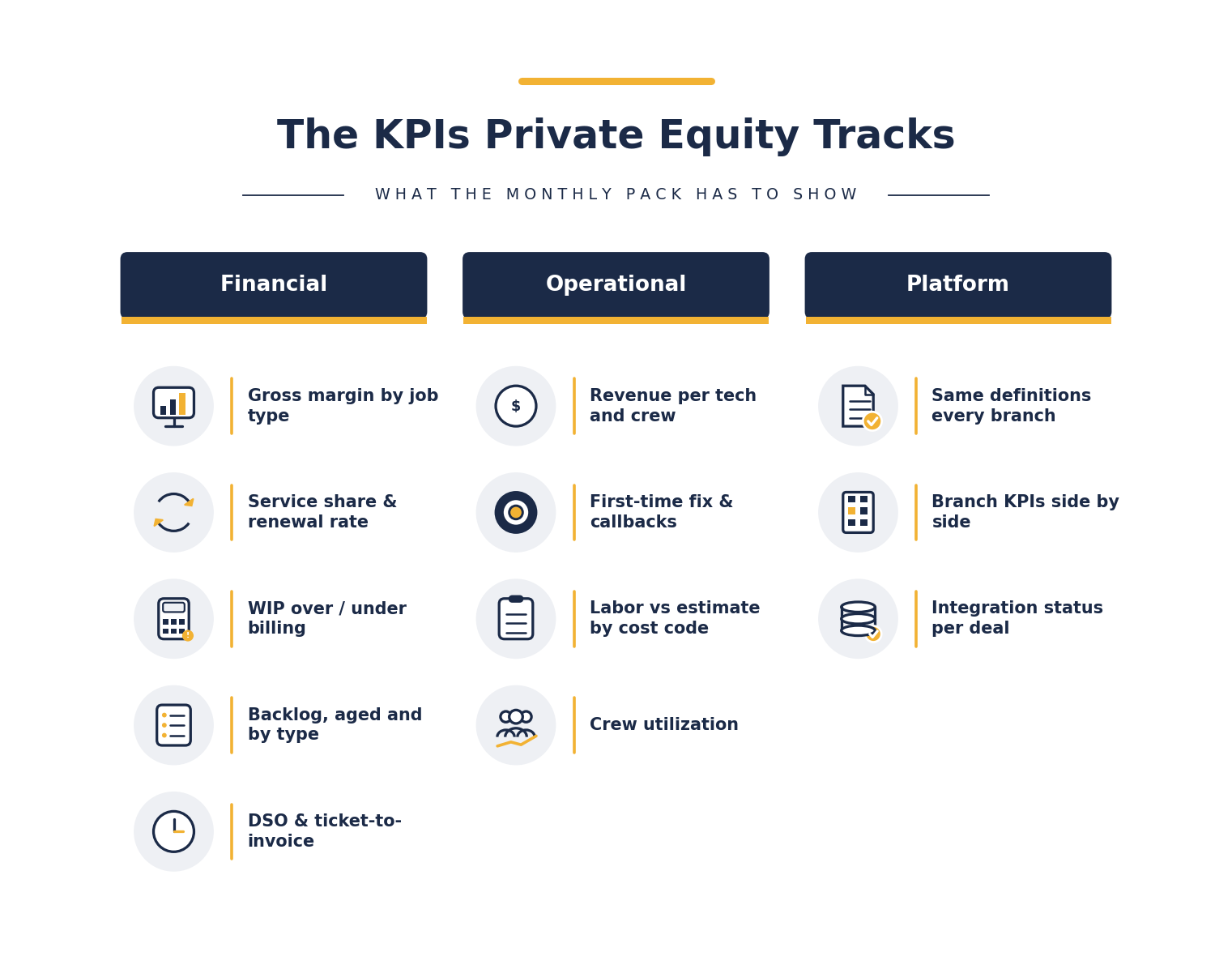
- Gross margin by job type. Service, repair and re-roof are different businesses with different margins. A blended margin hides which one is slipping, and a buyer who sees only a blended number assumes the worst.
- Recurring service revenue and agreement renewal rate. The line that moves the multiple. Buyers underwrite contracted revenue at a premium because it doesn't depend on winning bids or on weather.
- WIP position: over and under billing by job. The only report that shows whether reported profit is real. Chronic underbilling means the company is financing customers; growing overbilling alongside falling closed-job margins means it is funding losses with future revenue.
- Backlog convertibility. A $3 million backlog of signed contracts with deposits and permits is worth more to a buyer than $5 million of verbal commitments. Retainage of 5 to 10 percent sits on its own line or it lands in the working capital dispute at closing.
- DSO and ticket-to-invoice time, split by service and project. Construction DSO averages 60 to 90 days against 30 to 45 in most industries. Cash conversion is where a buyer discovers which branch is actually run well.
Pro Tip: Report service margin and project margin on separate lines from the first month a sponsor sees your numbers. Blending them is the single most common reason a buyer applies a haircut to reported EBITDA during diligence.
Which Operational KPIs Matter Most After Close?
Four operational metrics tell an operating partner whether the financial results will hold under new ownership.
- Revenue per technician and per crew, by location. The productivity baseline for comparing branches and for sizing the next add-on.
- First-time fix rate and callback rate on service work. Callbacks are unbilled labor and the fastest way to lose a maintenance agreement at renewal.
- Labor hours against estimate on production jobs, by cost code. The earliest signal that a project margin is eroding, weeks before it shows on the WIP.
- Crew utilization, meaning billable hours as a share of paid hours. The measurement method is covered in Track Technician Productivity in Your Roofing Service.
“A sponsor doesn't need the numbers to be good in month one. A sponsor needs the numbers to be true, comparable, and available on the same day at every branch.”
What Are Platform KPIs, and Why Do They Decide the Exit Multiple?
Once a platform holds more than one location, value depends on the branches being comparable. Platform KPIs measure that directly: whether a callback means the same thing in Ohio and Texas, whether margin by branch is available side by side as of the same date, and whether each acquisition is fully integrated. Operating partners formalize the last as an integration scorecard: system of record live, shared cost codes, tickets and invoicing on the platform, history migrated, branch KPIs flowing into the topco view. Until every line is green, that branch's numbers are estimates.
Here is the pattern that erodes platform value between the first acquisition and the exit:
- Month 0: Platform closes on a $12M commercial contractor. Legacy CRM and spreadsheet job costing stay in place "until things settle."
- Month 6: Topco reporting pack is built from three exports and a consultant's workbook. Numbers arrive 18 days after month end.
- Month 12: Second add-on closes. Now there are two definitions of a service ticket and three of a callback.
- Month 24: Exit diligence. The buyer's team can't reconcile branch margins to the consolidated P&L and applies a discount to the platform multiple.
The same platform with one system of record live at each branch inside 30 days of close produces branch margin on day one of every month and carries three years of comparable history into the data room. On $5 million of platform EBITDA, one turn is $5 million.
Why Can Most Roofing Platforms Not Produce These Numbers Monthly?
The typical roll-up inherits a different software stack with every acquisition. Reporting across them means exporting from each system, loading into a data warehouse, building an analytics layer on top, and reconciling definitions by hand. The result arrives two to four weeks after month end. The data warehouse is the symptom: if the branches run on different systems of record, no analytics layer produces comparable numbers. The mechanics are covered in Management Information Systems in Roofing Roll-Ups.
Renovo Home Partners is the reference case. The platform absorbed 15 to 20 companies inside two years, several brands kept their legacy CRMs and processes, and corporate attempted consolidated reporting on top of systems that were never unified. Lenders placed the loans on non-accrual in late 2024, and the company filed Chapter 7 in late 2025. Industry coverage attributes the collapse to integration complexity compounding with leverage. The lesson drawn across the trades is that integration capacity should set the acquisition pace ahead of deal flow.
Pro Tip: Before the next add-on closes, confirm that every existing branch scores green on the integration scorecard. A platform with four acquisitions and one fully integrated branch is carrying three sets of numbers it can't compare, and the gap widens with every close.
How Should a Roofing Company Prepare Its KPI Pack Before a Sale or an Add-On?
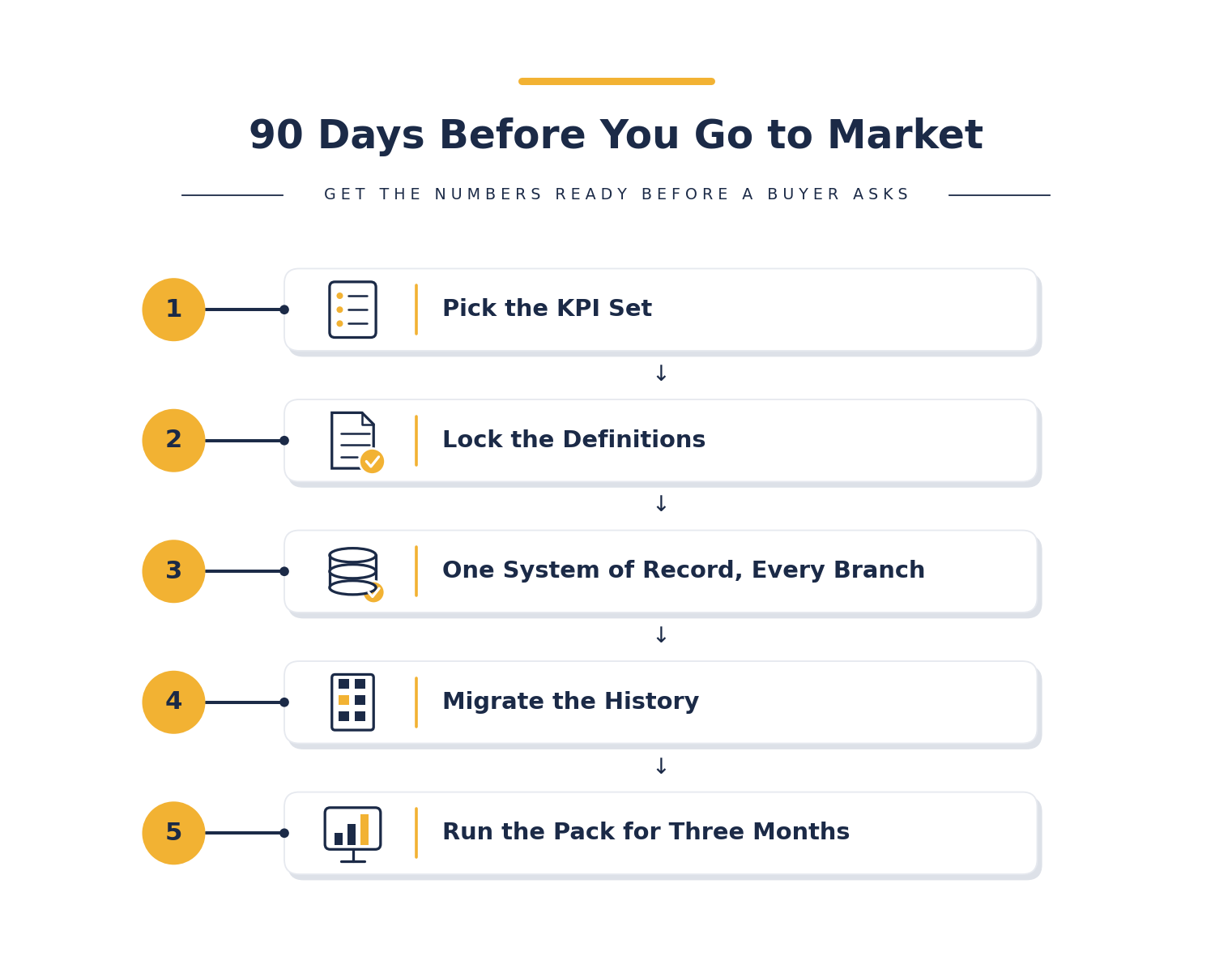
Preparation is where the multiple is defended or lost. The sequence that holds up in diligence:
- Define the KPI set in writing. Twelve metrics is sufficient; thirty is noise.
- Lock the definitions. What counts as a callback, what counts as service revenue, when a ticket is complete. Branch managers agree before the numbers enter a data room, because every definition gets tested there.
- Put every location on one system of record. Job costing, tickets, time and invoicing on one platform with shared cost codes. This step decides whether the other five hold. The case is made in Why Roofing Roll-Ups Lose Synergies Without Shared Systems.
- Migrate three years of history. History left in a legacy system means the trend line starts at integration day, and diligence teams notice.
- Run the pack for three consecutive months before anyone outside the company sees it. Fix every number that moves for a reason you can't explain.
- Build the data room exhibit. One page per branch, same KPIs, same dates, integration status noted. This is what a buyer's analyst reads before the management presentation.
The Metric Most Roofing Platforms Are Not Tracking
Most operators already know the KPI list. What they don't track is definition drift: the gap between how a metric is defined at the platform level and how each branch records it. A callback logged as a new ticket at one branch and as a warranty visit at another produces two callback rates that can't be compared and one topco number that is wrong. Definition drift is invisible on a dashboard and obvious in diligence, where an analyst pulls ten tickets per branch and rebuilds the metric by hand.
The platforms that win on exit aren't running better branches. They are running the same workflow at every branch, so the definition is enforced by the system rather than by a reporting analyst, and every number in the pack can be traced back to the ticket or the job it came from.
Run a Platform Buyers Can Actually Diligence
Terial is the unified operating system built for commercial roofing contractors and the platforms that acquire them. Roll-up reporting runs across every portfolio company on one system, with location dashboards for regional managers and topco views that compare job costing, margins and crew productivity across acquisitions as of the same date. Real-time job costing shows variance by cost code as work happens, and profitability analysis by job type separates service margin from project margin. New locations go live in under two weeks, and the migration pipeline carries 95 percent or more of historical job, customer and financial data across, so an acquired company's trend line is intact from day one. If you are preparing a platform for its next add-on or its exit, see how Terial supports multi-location operators and PE roll-ups.
Key Takeaways
FAQ
What KPIs do private equity firms track in roofing companies?
Gross margin by job type, recurring service revenue and renewal rate, WIP over and under billing, backlog convertibility, DSO, revenue per technician, callback rate, labor against estimate, and branch-level comparisons of all of them under one set of definitions.
Why is recurring service revenue weighted so heavily in roofing valuations?
It is contracted, predictable and insulated from storm cycles and bid volatility. Commercial maintenance exposure adds 0.5 to 0.8 turns to the multiple before other adjustments.
Do roofing roll-ups need a data warehouse?
Only if the branches run different systems of record. A single operational platform across locations produces comparable KPIs directly, on the first day of the month rather than the eighteenth.
What did the Renovo collapse teach roofing platforms?
That acquisitions outpacing systems integration leave corporate reporting on top of numbers that don't reconcile, and leverage turns that reporting gap into a solvency problem. Integration capacity, not deal flow, should set the acquisition pace.
Recommended
- PE Backed Roofing Companies: 2026 Investor Guide
- Roofing Company Valuation: 2026 Guide for Contractors
- Roofing Portfolio Performance Metrics List for Contractors
- Terial | Workflow Automation for Commercial Roofers


More articles


Book a personalized demo
Get a 30-minute demo tailored to how you run your commercial roofing business

“Making the switch to Terial has greatly exceeded my expectations and has already had a meaningful impact on our team’s productivity. Terial has significantly reduced the amount of time required to complete many of our day-to-day operational tasks, allowing our team to focus more on serving our customers.”

