
Management Information Systems in Roofing Roll-Ups Explained
Discover what does management information system mean roofing roll-ups. Learn how an MIS boosts operational efficiency and drives profit in roofing.

A management information system (MIS) in roofing roll-ups is a centralized platform that consolidates workflows, job data, and reporting across multiple acquired roofing businesses into one connected operating environment. For commercial roofing executives asking what does management information system mean in roofing roll-ups, the answer is direct: it is the operational backbone that replaces disconnected spreadsheets, siloed field apps, and manual reporting with a single source of truth. The roofing industry averages a 6.4% margin, and private equity platforms target double-digit returns through operational standardization. Without a purpose-built MIS, that gap stays closed by guesswork and manual labor instead of data.
How Does a Management Information System Support Operational Efficiency in Roofing Roll-Ups?
An MIS in roofing roll-ups provides unified visibility across every stage of the job lifecycle. That means sales pipeline, estimating, production scheduling, subcontractor coordination, and payment collection all feed into one system rather than five separate tools that never talk to each other.
The operational gains are concrete:
- Unified job data: Every location reports into the same platform, so leadership sees real-time job status without chasing regional managers for updates.
- Automated reporting: Automated reporting dashboards give executives consolidated revenue, timeline, and cost data across all locations without manual compilation.
- Faster acquisition onboarding: A roofing-specific MIS carries pre-built workflows that a newly acquired company can adopt in days, not months.
- Eliminated spreadsheet bridges: Manual data transfers between disconnected tools disappear when one system handles the full workflow.
The speed advantage compounds quickly. When a new acquisition plugs into an existing MIS, it inherits the parent company’s process discipline immediately. That cuts the integration window from quarters to weeks.
Pro Tip: Map every manual handoff in your current workflow before selecting an MIS. Each handoff is a future automation target, and knowing them in advance lets you evaluate platforms against real operational needs rather than feature lists.
What Are the Common Challenges Roofing Roll-Ups Face Without an Effective MIS?
The failure rate in private equity roll-ups is not a mystery. 30–40% of PE roll-ups underperform due to integration failures, and mismatched software systems are a primary cause. One documented case showed a 14-day project delay and $200,000 in lost contracts traced directly to software incompatibility after an acquisition.
The operational problems stack fast without a tailored MIS:
- Incompatible field workflows: 68% of roofing mergers struggle within 18 months because field processes at acquired companies do not match the parent platform. Rework costs on a single medium-sized project can exceed $14,000.
- Spreadsheet bridges: Manual sync tools between disconnected systems create “zombie” jobs that drift between platforms with no clear owner. Errors multiply and accountability disappears.
- Data silos: Fragmented systems let teams hide behind siloed data, creating uncertainty at the leadership level about actual job performance.
- Hidden IT costs: Forcing legacy systems to communicate through middleware costs $50,000 to $100,000 per acquired firm. These costs rarely appear in acquisition budgets.
The pattern is consistent. Executives underestimate integration complexity, overestimate the flexibility of generic software, and absorb the cost in margin erosion and delayed growth. Understanding why disparate tools undermine efficiency is the first step toward fixing it.
What Are the Key Components of an Effective MIS for Roofing Roll-Ups?
An effective MIS for roofing roll-ups is not a generic ERP with roofing labels applied. It is a system built around how roofing businesses actually operate in the field and in the office.
Core Architecture Requirements
The foundation is a centralized data platform that connects every business unit. All job records, cost data, and customer communications live in one place. No location operates on an island.
Workflow automation must cover the full job cycle: lead capture, proposal generation, contract execution, production scheduling, crew dispatch, change order management, and final invoicing. Roofing-specific platforms cover all of these natively, which eliminates the customization delays that plague generic software deployments.
Reporting and Accountability Tools
Real-time dashboards give leadership a consolidated view of revenue, job progress, and cost performance across all locations. This is not a nice-to-have. Without it, executives rely on weekly calls and emailed spreadsheets to understand what is happening across a multi-location platform.
Role-based access controls matter too. A project manager in one region should see their jobs clearly. A regional director should see all jobs in their territory. The CEO should see everything. An MIS that cannot segment visibility by role creates noise instead of clarity.
Scalability Across Locations
The system must handle multi-state, multi-location operations without requiring a separate implementation for each acquisition. Operations management software built for growth supports adding new business units without rebuilding the data architecture from scratch.
Pro Tip: Before signing any MIS contract, ask the vendor to demonstrate onboarding a simulated acquisition in real time. If they cannot show you a working example in under 30 minutes, the platform is not built for roll-up speed.
How Can Roofing Executives Successfully Implement an MIS for Roll-Up Operations?
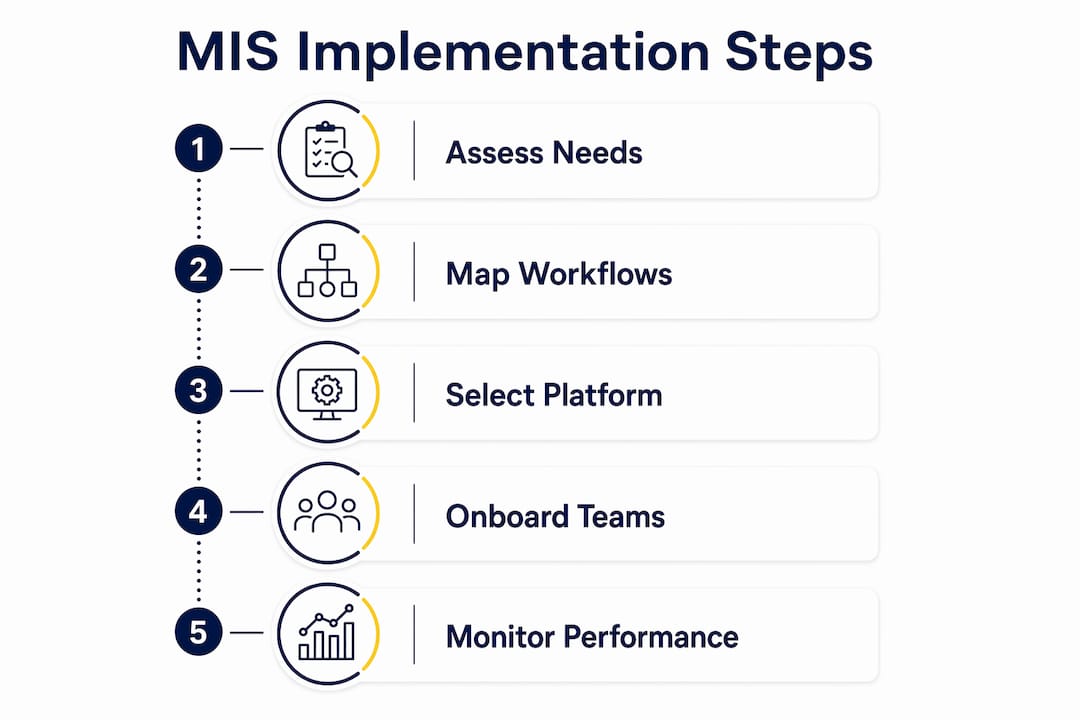
Implementation success depends on process discipline before software selection. PMIS failures most often stem from poor planning and fragmented information, not from software complexity. The technology is rarely the problem. The process gaps it exposes are.
Follow this sequence for a disciplined rollout:
- Map current workflows. Document every step from lead to invoice at each acquired company. Identify where handoffs break down and where data gets lost between systems.
- Define responsibilities with a RACI matrix. Assign clear ownership for every workflow step. Responsible, Accountable, Consulted, and Informed roles must be explicit before automation begins.
- Select a roofing-specific platform. Generic project management tools require heavy customization to fit roofing workflows. That customization adds months to deployment and introduces new failure points. Use the roofing business scaling checklist to evaluate readiness before committing to a platform.
- Phase the rollout. Start with one location or one workflow module. Prove the system works at small scale before pushing it across the entire platform.
- Train field and office teams together. Field adoption is the single biggest predictor of MIS success. If crews do not use the system, the data is incomplete and leadership loses visibility. Field software adoption requires hands-on training, not just a login and a manual.
- Monitor and refine. Track adoption rates, data completeness, and reporting accuracy in the first 90 days. Adjust workflows where friction appears before it becomes a habit.
The goal is not to force a top-down mandate onto acquired companies. Roofing businesses do not compress easily under rigid directives. The MIS must respect field-level workflows while giving leadership the visibility they need to run a multi-location platform.
What Is the Measurable Impact of MIS Adoption on Roofing Roll-Up Profitability?
The margin math is clear. The roofing industry averages 6.4% margins. PE-backed roll-ups using integrated CRM and digital infrastructure reach double-digit margins through better operational discipline and data visibility. That is not a marginal improvement. It is a structural shift in how the business performs.
The gains come from multiple directions at once. Rework drops when field crews follow consistent, documented workflows. Project delays shrink when job status is visible in real time rather than discovered at the weekly call. Change orders get captured and billed instead of absorbed as cost overruns.
Moving from disconnected tools to an integrated MIS platform transforms roofing roll-ups by providing clarity, accountability, and speed rather than just new features. Unified data removes the uncertainty that fragmented systems create, and that clarity directly improves decision-making at every level of the organization.
Valuation multiples also respond to MIS adoption. Acquirers pay more for platforms with documented, repeatable processes and clean data. A roll-up that can demonstrate consistent margins, low rework rates, and real-time reporting across all locations commands a higher exit multiple than one running on spreadsheets and phone calls. Building operational infrastructure fast is not just an efficiency play. It is a valuation strategy.
Key Takeaways
A purpose-built MIS is the single most effective tool for closing the gap between a roofing roll-up’s current margins and its double-digit potential.
Terial’s Platform for Roofing Roll-Up Operations
Roofing roll-ups running on fragmented tools pay for that fragmentation in margin erosion, delayed acquisitions, and leadership blind spots. Terial is built specifically for commercial roofing contractors who need every workflow connected in one place. From estimating and sales pipeline to crew dispatch, change orders, and invoicing, Terial unifies the full job lifecycle in a single system that field crews actually use. The platform’s workflow automation features are built alongside leading contractors, which means they reflect how roofing businesses operate rather than how generic software assumes they do. For executives running or building a roofing roll-up, Terial replaces the cost of fragmentation with operational clarity from day one.
FAQ
What Does a Management Information System Mean in Roofing Roll-Ups?
A management information system in roofing roll-ups is a centralized platform that connects job data, workflows, and reporting across multiple acquired roofing companies. It gives leadership real-time visibility and replaces disconnected tools with a single operating environment.
Why Do Roofing Roll-Ups Fail Without an Effective MIS?
30–40% of PE roll-ups underperform due to integration failures caused by mismatched software systems. Without a unified MIS, acquired companies operate on incompatible workflows that produce rework, project delays, and data gaps that erode margins.
What Is The Difference Between a Generic ERP and a Roofing-Specific MIS?
A generic ERP requires heavy customization to fit roofing workflows, adding months to deployment. A roofing-specific MIS includes native support for estimating, crew dispatch, change orders, and subcontractor coordination without custom development.
How Long Does MIS Implementation Take For a Roofing Roll-Up?
Implementation timelines vary by platform and roll-up size, but roofing-specific platforms with pre-built workflows significantly reduce onboarding time compared to generic software. A phased rollout starting with one location typically proves the system within 30–90 days.
How Does MIS Adoption Affect Roofing Roll-Up Valuation?
Roll-ups with documented, repeatable processes and clean real-time data command higher exit multiples. PE-backed platforms using integrated digital infrastructure consistently reach double-digit margins, which directly improves the valuation case at exit.
Recommended




Book a personalized demo
Get a 30-minute demo tailored to how you run your commercial roofing business

“Making the switch to Terial has greatly exceeded my expectations and has already had a meaningful impact on our team’s productivity. Terial has significantly reduced the amount of time required to complete many of our day-to-day operational tasks, allowing our team to focus more on serving our customers.”

