
Reduce Rework on Low-Slope Roofing Jobs: Operations Playbook
Learn how to reduce rework on low-slope roofing jobs. Implement simple strategies to improve communication and efficiency on your team.

The fastest way to reduce rework on low-slope roofing jobs is to fix the handoff before the crew ever touches the roof. Communication failures — not craftsmanship — drive most rework in commercial roofing. Standardize your estimating-to-field scope packet, protect a schedule buffer for detail work, run in-process verification on flashings and transitions, capture every change order in the field, and tie all of it together in a single operating system.
Start here — three things your crews can do today:
- Run a 48-hour readiness confirmation before mobilizing: verify deck condition, penetration layout, and site access
- Hold a 5–10 minute kickoff huddle each morning to align the foreman on scope, sequence, and open questions
- Require photo capture of all critical details (flashings, penetrations, transitions) before covering them
Why Does Rework Keep Happening on Low-Slope Commercial Jobs?
Rework rarely announces itself. It hides inside labor hours, extra trips, and callbacks that never get coded as rework. By the time you add it up across a season, the cost rivals what you lost on material price increases.
Rework does not start where most people think it does. It begins with unclear scope language, missing details in the handoff from estimating to operations, and job packets that fail to answer the questions field leaders inevitably ask.” — Florida Roofing Industry Insight
The root causes of low-slope rework break into three categories:
- Communication and handoff failures: Estimators include details that never reach the foreman’s packet. PMs give verbal instructions that get interpreted differently on the roof. Foremen make assumptions rather than call.
- Scheduling pressure: Back-to-back scheduling without buffer forces rushed workmanship. When trades overlap, even experienced crews produce errors they would not make under normal conditions.
- Flashing and detail variability: Field-fabricated flashings introduce inconsistency at the exact points most likely to fail. Prefabricated, factory-welded accessories remove that variability.
Rework hides inside labor and callbacks, not material line items. That is why most contractors never track it and why the ones who do find profit they did not know they were losing.
How to Build a Field-Ready Scope That Eliminates Assumptions
A clean handoff is a document, not a conversation. Every scope packet should include annotated drawings, required pre-installation photos, explicit acceptance criteria for penetrations and flashings, and a named person responsible for confirming the roof is ready.
- Attach annotated drawings with penetration locations, flashing types, and membrane termination heights marked
- Include a photo log of existing conditions taken during the site walk
- Define acceptance criteria for each critical detail before work begins
- Require the foreman to sign off on scope receipt and flag open questions before mobilization
- Mandate visual confirmation for any scope change — no verbal-only updates
Pro Tip: Require a 48-hour readiness confirmation from the foreman before mobilizing crews. This single check — deck condition, penetration layout, access confirmed — prevents burned crew days and the rushed workmanship that follows.
Pair this with a “confirm-don’t-assume” rule: if a field condition does not match the drawing, work stops until the PM confirms the correct approach in writing. That one rule eliminates a significant share of the callbacks that come from foremen making reasonable but wrong calls.
How to Schedule Low-Slope Jobs With Built-In Slack
Scheduling without buffer is how good crews produce bad work. Industry guidance recommends building a schedule buffer on every low-slope job. On projects, build in protected time for detail work, weather, and trade coordination to prevent rushed workmanship.
- Lock MEP penetrations before membrane work begins — never let other trades create new penetrations after installation starts
- Protect dedicated “detail days” for flashings and transitions; do not let production pressure absorb them
- Avoid scheduling critical access points for two trades simultaneously
- Build the 48-hour readiness confirmation into the schedule as a formal milestone, not an afterthought
When schedules compress, sequencing breaks down. Tear-off gets ahead of installation, crews rush, and mistakes follow. The buffer is not slack — it is insurance against the callbacks that cost three times the original labor.
Should You Inspect During Installation or Wait for the Punch List?
Wait for the punch list and you will pay for it. In-process verification during installation costs minutes; end-of-project corrections cost trips, labor, and customer confidence.
- Check flashing reinforcement before the membrane goes over it
- Run heat-weld calibration at startup — every shift, not just the first day
- Pull-test seams within the first hour of welding to confirm temperature and speed settings
- Inspect penetration seals before covering with walkpads or equipment
- Document every failure immediately with a photo and a corrective action note
Short calibration and pull-test routines at startup prevent hours of rework later.
Pro Tip: Give foremen explicit authority to pause work when a field condition is unclear. Create a same-shift escalation path — PM responds within two hours or the crew moves to a different task. Waiting until tomorrow is how small questions become expensive corrections.
The NRCA’s quality control guidelines for membrane roof systems reinforce this: designate someone on-site during the entire application process with the authority to correct noncompliant work before it gets covered.
How to Build a Photo and Closeout Workflow That Prevents Disputes
Daily end-of-day recaps with photos give office staff the information they need to avoid surprises and shorten punch lists. Make photo capture mandatory, not optional.
Pro Tip: Require 2–3 representative end-of-day photos as part of the daily recap. This takes under five minutes and creates a timestamped record that resolves most GC disputes before they escalate.
Closeout packages should include: completed in-process photo audit, signed acceptance checklist, digital signatures from foreman and PM, and a branded report delivered to the owner or GC within 24 hours of completion. A commercial roofing service call checklist built into your workflow makes this repeatable rather than heroic.
How to Capture Field Change Orders Before They Become Undocumented Rework
Verbal change orders are the single fastest way to create rework. A foreman hears “move that drain six inches,” does it, and nobody writes it down. Three weeks later, the GC disputes the extra labor. Or worse — the instruction was wrong and the drain is in the wrong place.
Pro Tip: No change order, no work. Make this a non-negotiable field rule. If the foreman cannot capture it in the app before starting, the crew moves to a different task.
The field change-order workflow:
- Foreman photographs existing condition and sketches the proposed change
- Estimated labor and material impact entered immediately
- PM receives automated notification and approves or redirects within two hours
- Approval timestamp and instructions confirmed before installation begins
- Post-installation photo captured and attached to the change order record
‘Top firms mandate photos and diagrams for all scope changes instead of relying on verbal instructions.’ — Cotney Consulting
Every change order should include: scope description, before/after photos, cost impact, approval status, timestamps, and the name of who confirmed installation instructions. Poor work order management is one of the most consistent sources of undocumented rework across commercial jobs.
Why a Unified Operating System Beats a Stack of Point Tools
Fragmented tools create handoff gaps. Your estimating software does not talk to your scheduling app. Your scheduling app does not talk to your field photo tool. Your field photo tool does not connect to invoicing. Every gap is a place where information gets lost — and lost information becomes rework.
Disconnected tools undermine your ability to enforce the practices in this guide. You cannot mandate field acknowledgments if acknowledgments live in a text thread. You cannot track real-time cost if job costs update once a week in a spreadsheet.
A unified operating system for commercial roofing enforces the handoff automatically:
- Mobile photo capture tied directly to the job record
- Mandatory field acknowledgments before work begins
- Integrated change orders that route to PM approval and update job cost instantly
- Real-time dispatching that reflects actual schedule status
- Cost visibility at the job level, updated as labor and materials post
Terial is built specifically for this. It connects estimating, scheduling, field documentation, change orders, and invoicing in one system — so the data that lives in the field reaches the office in real time, not at the end of the week. Dedicated low-slope roofing software enforces these workflows in ways generic project management tools cannot.
Pro Tip: Before evaluating any platform, map your current handoff gaps. Where does information get lost between estimating and the field? Between the field and invoicing? A unified OS should close every one of those gaps — if it does not, it is just another point tool.
Which KPIs Actually Tell You If Rework Is Improving?
Treat rework as a measurable operational metric, not an inevitability. Successful contractors track callback rate, rework labor hours, and gross margin per job to find repeat failure modes by crew, detail type, or job class.
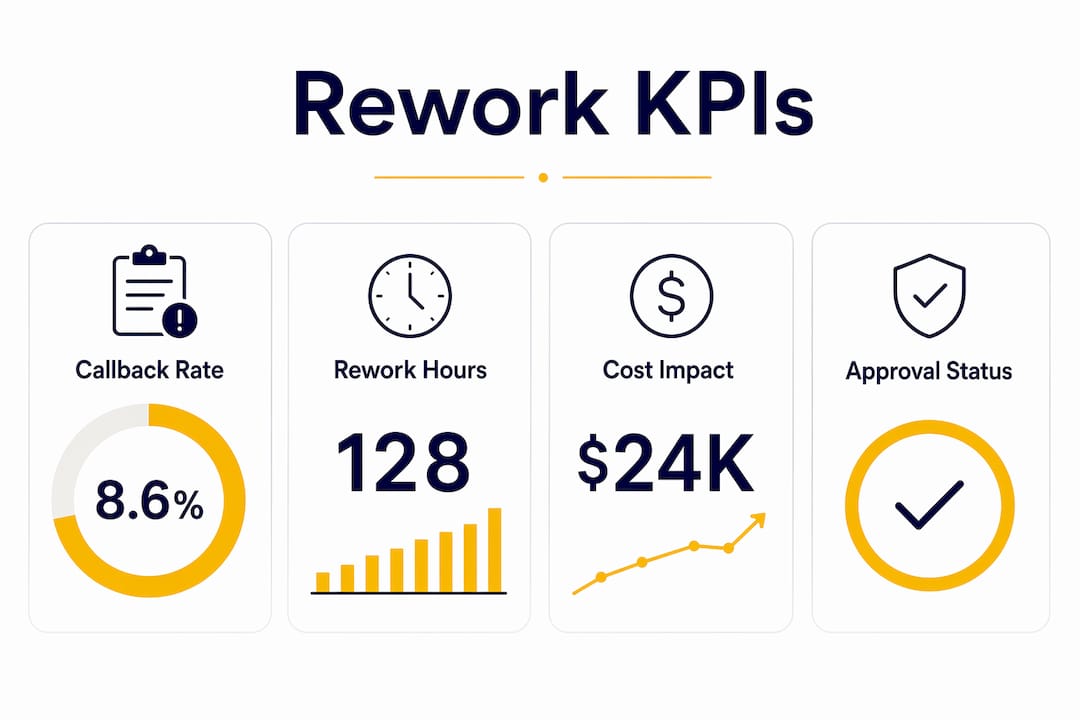
To compute simple ROI from process changes: multiply labor hours saved per job by your fully loaded labor rate, then multiply by jobs per month. Even one hour saved per job across 20 jobs per month adds up fast. Automated reporting makes this calculation visible without manual data pulls.
How to Roll Out These Changes Without Disrupting Production
- Select two pilot jobs — different job classes if possible (new construction and reroof)
- Define your baseline KPIs before the pilot starts
- Train pilot foremen on the scope packet, photo workflow, and change-order process in one session
- Run the pilot for 4–8 weeks; collect data weekly
- Hold a post-pilot ops review: what improved, what broke, what needs adjustment
- Update job packet templates and roll out to the full fleet
Pilot readiness checklist:
- Scope packet template finalized and loaded into your system
- Photo naming conventions and required photo types documented
- Change-order form configured and tested on a mobile device
- Foreman authority rules defined (when to pause, who to call)
- KPI measurement plan in place before day one
Pro Tip: Run a weekly ops review during the pilot — 30 minutes, same time each week. Review callback rate and rework hours against baseline. If a metric moves, trace it to a specific process change. That feedback loop is what makes improvements stick.
Understanding why contractors underbid projects often reveals the same root causes as rework: scope gaps and missing detail costs that surface in the field.
How to Coordinate Subcontractors Without Creating Rework
Subcontractor coordination failures follow the same pattern as internal handoff failures — assumptions replace documentation, and the roof pays for it. Require every sub to receive the same scope packet your own foremen get. Define sequencing rules in writing: who owns penetration layout, who confirms deck readiness, and who signs off before membrane work begins.
Hold a pre-installation meeting with all trades before mobilization. Assign a single point of contact for field questions — not a group text. Any sub-initiated scope change follows the same change-order workflow as an internal change. No exceptions.
Quality control on subcontracted work requires the same in-process verification schedule you apply to your own crews. Do not wait for the sub to call you with a problem. Build inspection checkpoints into the subcontract and show up for them.
What Specialized Tools Catch Failures Before They Become Callbacks?
Moisture meters and infrared scans are the two most cost-effective diagnostic tools for low-slope commercial roofing. A moisture meter identifies wet insulation before it gets covered — wet insulation under a new membrane is a callback waiting to happen. Infrared scanning after installation maps moisture intrusion across the entire field without destructive testing.
For single-ply systems, a seam probe and pull-test kit should be on every job. Heat-weld calibration at startup is not optional — temperature and speed settings drift, and a seam that looks welded may not be. The University of Alabama’s low-slope roofing design guidelines specify minimum slope requirements and flashing decoupling details that, when followed, reduce the conditions that create moisture failures in the first place.
Prefabricated flashings and factory-welded accessories remove the most failure-prone fabrication tasks from the roof entirely. When a flashing is cut and welded in a controlled environment, it arrives on the job with consistent geometry and weld quality that field fabrication rarely matches.
How to Train Crews So Rework Drops and Stays Down
One-time training does not change behavior. Rework drops when crews internalize the standard — and that requires repetition, accountability, and a feedback loop tied to real job data.
Build training around the specific failure modes your KPIs reveal. If callback rate is highest on penetration seals, that is your first training module. If rework hours spike on reroof jobs, focus on scope-reading and condition assessment. Generic training does not move the needle; failure-mode-specific training does.
Standardize the pre-shift calibration routine: heat-weld settings checked, seam probe tested, photo workflow confirmed. Make it a two-minute checklist, not a lecture. Foremen run it; PMs verify it during site visits. When a crew passes an in-process check consistently, that becomes the baseline expectation — not the exception.
How to Quantify Rework Costs on Low-Slope Jobs
Most contractors undercount rework because they never create a cost code for it. Fix that first. Add “rework labor” and “rework materials” as line items in your job costing system. Require foremen to log rework hours separately from production hours — even when the amounts feel small.
At the end of each job, calculate rework cost as a percentage of gross margin. Track it by job class, crew, and detail type. Over three to six months, patterns emerge: a specific crew consistently has higher rework on penetrations, or reroof jobs in a particular building type generate more callbacks than new construction. Those patterns tell you exactly where to invest in training, tooling, or process changes.
The ROI calculation is straightforward: rework hours saved per job × fully loaded labor rate × jobs per month = monthly savings. Add callback trip costs and you have a number that justifies almost any process investment.
How to Proactively Prevent Defects With Risk Management
Low-slope roofing has predictable failure points: drainage, edge and corner wind uplift, and penetration and flashing transitions. Engineering guidance from J.S. Held confirms that most high-severity losses originate at these same locations. Build your risk management around them.
Before each job, score the risk level of each failure point: slope adequacy, drain count and sizing, number of penetrations, flashing complexity, and trade coordination requirements. High-risk jobs get additional in-process inspection checkpoints and a dedicated quality control visit from a PM or senior foreman.
Positive drainage is both a durability and a structural issue. Ponding water accelerates membrane aging and adds structural load. Verify that the as-built slope meets the minimum 1/4 inch per foot requirement before the membrane goes down. If it does not, stop and resolve it — not after the job closes.
Terial Closes the Gaps That Create Rework
Every practice in this guide requires information to move cleanly from estimating to the field and back to the office. Disconnected tools make that impossible. Terial is the unified operating system built for commercial roofing contractors who are done paying for the same mistakes twice.
With Terial, your foremen capture photos, acknowledge scope, and submit change orders from their phones. PMs see real-time job cost the moment labor and materials post. Change orders route for approval automatically. Closeout packages generate in minutes, not hours.
Three outcomes contractors see when they replace fragmented tools with Terial:
- Fewer callbacks, because field documentation creates accountability at every critical detail
- Faster closeouts, because photo audits and digital signatures are captured during the job
- Clearer project cost visibility, because job cost updates in real time rather than at month-end
See how it works at terial.com or review the field service application to understand how mobile-first workflows enforce the handoff practices this guide covers.
Key Takeaways
Rework on low-slope commercial jobs is a controllable operational metric. Fix the handoff, protect detail time, verify in-process, and measure the results.
Useful Sources
The findings in this guide draw from the following industry sources:
- Cotney Consulting — Prevent Rework With Better Field Communication: primary source for communication as the root cause of rework and the mandate for visual documentation of scope changes
- DNB Roofing — Roof Install Scheduling for New Builds: primary source for the 10%–15% schedule buffer, 48-hour readiness confirmation, and rework KPI tracking
- Flash-Tech — Roofing Flashing Failures Causing Commercial Roof Callbacks: primary source for in-process verification, heat-weld calibration, and prefabricated flashing benefits
- RoofersCoffeeShop — Stop Rework Before It Starts: source for daily huddles, end-of-day photo recaps, and structured communication rhythms
- Florida Roofing Industry — Preventing Rework in Roofing: practitioner insight on how rework hides inside labor and callbacks
- J.S. Held — Commercial Roofing Systems and Low-Slope Roof Performance: engineering perspective on drainage, wind uplift, and QA/QC as risk management
- NRCA Quality Control Guidelines — Application of Membrane Roof Systems: industry standard for on-site evaluation and continual inspection during installation
- University of Alabama Design Guidelines — Low Slope Roofing: design standards for slope, flashing decoupling, and reroof detailing
“Rework is not an inevitable part of construction. It is the consequence of breakdowns in clarity, communication, preparation, and discipline. Contractors who decide to treat rework as a measurable, preventable loss find profit they did not know they were losing.” — Florida Roofing Industry Insight
FAQ
What Causes Rework on Low-Slope Roofing Jobs?
Most rework starts with communication and handoff failures, scheduling pressure, or inconsistent flashing and detail work. Unclear scope documents, missing field information, and verbal instructions create assumptions that later turn into callbacks and extra labor.
How Can Roofing Contractors Reduce Rework Before Installation Begins?
Contractors can reduce rework by standardizing the estimating-to-field handoff before crews mobilize. Scope packets should include annotated drawings, existing-condition photos, acceptance criteria, and a 48-hour readiness confirmation covering deck condition, penetrations, and site access.
Why Is In-Process Inspection Important on Low-Slope Roofing Projects?
In-process inspection catches problems while they are still quick and inexpensive to correct. Checking flashings, seams, penetration seals, and heat-weld settings during installation helps prevent defects from being discovered later during punch lists or callbacks.
How Should Roofing Contractors Track Rework?
Contractors should track callback rate, rework labor hours, rework cost as a percentage of gross margin, first-time pass rate, and punch-list items. Measuring these by job, crew, and detail type makes recurring failure patterns visible and shows where process or training improvements are needed.
Recommended



Book a personalized demo
Get a 30-minute demo tailored to how you run your commercial roofing business

“Making the switch to Terial has greatly exceeded my expectations and has already had a meaningful impact on our team’s productivity. Terial has significantly reduced the amount of time required to complete many of our day-to-day operational tasks, allowing our team to focus more on serving our customers.”

