
How Leak Calls Turn Into Re-Roof Projects: The Service-to-Reroof Conversion Playbook
Service-to-reroof conversion is the share of replacement projects that come from an existing service relationship. Here is the repair-vs-replace math, the ticket signals that predict a replacement, and the workflow that turns a third leak call into a proposal.

Service-to-reroof conversion is the share of a commercial roofing contractor's replacement projects that originate from an existing service relationship, usually a repeat leak call or a maintenance agreement, rather than from a competitive bid. It's the highest-margin project revenue in the business and the least measured. On a 30,000 square foot low-slope roof, replacement at $12 to $15 per square foot is a $360,000 to $450,000 decision. U.S. spending on roof repair and replacement is up 30 percent since 2022. A growing share of that replacement work is being decided on roofs that a service department already knows. Whether that department captures the project or hands it to a competitor comes down to whether the leak calls and the re-roof pipeline live in the same system.
Key Takeaways
- Re-roof leads sit in service ticket history: three leak calls on the same section inside 18 months is a replacement conversation, and most contractors never surface it.
- The owner is doing repair-vs-replace math without a framework: repair runs $3 to $10 per square foot against $10 to $15 for replacement, and repair spend above 2 percent of replacement cost for three years favors replacing.
- Documentation on the third call wins the project: a condition report with the owner's own ticket history is the one document no competitor can produce.
- Service-fed backlog raises the multiple: buyers underwrite recurring service revenue and backlog convertibility ahead of almost everything else.
- Conversion rate is the metric to track: re-roofs won from serviced buildings divided by total re-roofs won. Most operators have never calculated it.
What Is Service-to-Reroof Conversion and Why Does It Matter?
Every leak call is a data point on a roof's remaining life. One leak on a 12-year-old TPO roof is a repair. A third leak on the same section in 18 months is a building owner who is about to spend real money. When the service department tracks tickets by building and roof section, that pattern is visible months before the owner calls for bids. When it doesn't, the pattern is invisible, and the estimating team finds out about the replacement at the same time as its competitors.
Projects that come from service relationships close faster, price better and cost less to sell, because the contractor already knows the roof and the owner already trusts the crew. The principle is covered in How Roofing Service Data Drives New Contracts. This article is the operating version: the math the owner is doing, the signals to watch, and the workflow that converts them.
What Does the Repair-vs-Replace Math Look Like to the Building Owner?
Somewhere around the third leak, the owner or property manager starts asking whether the roof is worth patching. They rarely have a framework for that decision. The contractor who brings one, with the owner's own repair history attached, controls the conversation.
- Repair versus replacement cost. Commercial roof repair typically runs $3 to $10 per square foot depending on the issue, while replacement starts around $10 to $15 for standard single-ply systems. On 30,000 square feet, the gap is often $100,000 or more, which is why owners patch for as long as they can.
- The 2 percent rule. When annual repair spend exceeds 2 percent of replacement cost three years running, replacement wins on dollars alone. On a $400,000 roof, that's $8,000 a year in repairs.
- Leak frequency. Three or more leak calls a year on the same roof generally signals systemic failure, and cumulative repair spend reaching 25 to 50 percent of replacement cost is where owners typically stop patching.
- Roof age. Repairs make sense while the roof is under 75 to 80 percent of its expected service life. Past that point, replacement or a restoration coating delivers the better return.
- Insurance pressure. Some carriers now require replacement or impose higher deductibles on roofs over 20 years old, which forces the decision regardless of leak history.
Pro Tip: Bring the owner's own numbers, not industry averages. Three tickets totaling $9,400 on a $380,000 roof is 2.5 percent of replacement cost in one year. Stated that way, the replacement conversation starts itself.
Which Signals in Service Ticket History Predict a Replacement?
The signals are consistent across commercial portfolios. Surfacing them requires tickets tagged to a building and a roof section, and one person who reviews the history monthly.
- Repeat visits to the same roof section. Two in 12 months is worth a look. Three in 18 is a conversation.
- Rising cost per ticket on one building. Repairs grow because the membrane is deteriorating, not because the leaks are unlucky.
- A system past 15 years with any of the above. Single-ply roofs run 20 to 30 years, and the final third is where leak calls cluster.
- Drain and penetration failures. Drains are the most common source of interior leaks on a flat roof, with rotted deck around a drain running $300 to $800 per drain and curb flashing rebuilds $500 to $2,500 per penetration. Multiple penetrations failing together is a system problem.
- Wet insulation found during a repair. Saturated insulation above 25 to 30 percent of the roof area is a replacement indicator on its own.
- A manufacturer warranty inside two years of expiring. Owners who are about to lose coverage begin planning replacement whether or not the roof is leaking.
When tickets carry the building, the section and the photos, this review takes five minutes. When they don't, it takes a day of digging, and it doesn't get done. That gap is the reason roof lifecycle management belongs to the contractor rather than the owner.
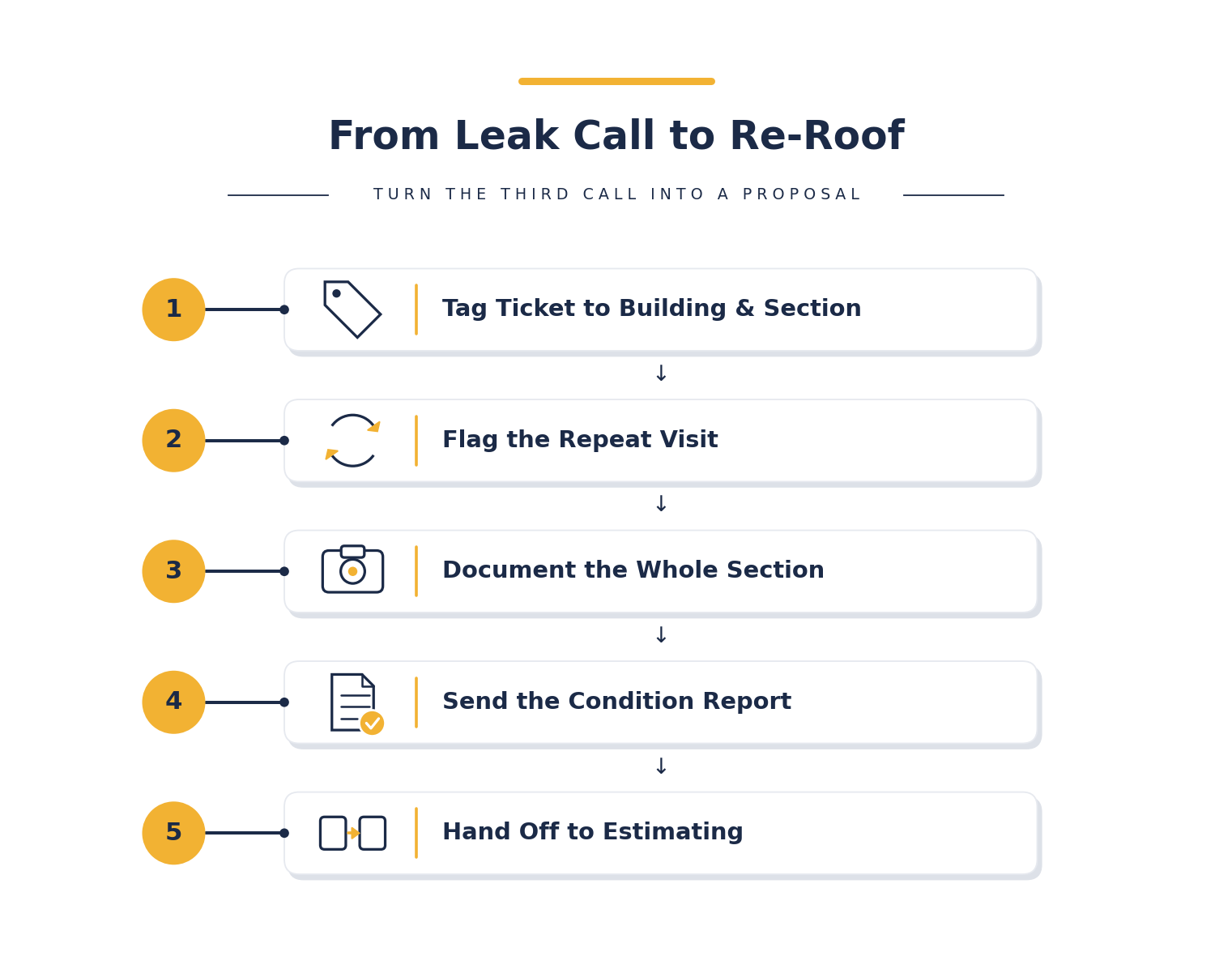
How Do You Turn the Third Leak Call Into a Proposal?
The workflow that captures the conversion has five steps, and most of them happen on the technician's phone.
- Tag every ticket to a building and a roof section, not just the customer. This is the step most operators skip and the one that makes the other four possible.
- Flag repeat visits before dispatch. A second ticket on the same section inside a year should be visible to the service manager before the crew is assigned. A third should trigger a different kind of visit.
- Document the whole section on the third call. The tech still fixes the leak. They also take wide shots, note membrane type and age, check for wet insulation, and photograph every drain. Ten extra minutes on the roof.
- Send a condition report with the history attached. The last three tickets, what was found each time, the photos, and a plain read on where the roof sits in its life. No pitch. The owner has never received this document from anyone.
- Hand off to estimating as a warm opportunity. The estimator receives the ticket history, the photos and the condition report, and walks in as the contractor who has been on that roof three times rather than one of three bids.
Here’s the pattern that loses the re-roof:
- Month 0: Leak call on the east section. Tech patches a seam, invoices $1,400, closes the ticket. No photos beyond the repair.
- Month 7: Second leak, same section. Different tech. Patch, $2,100, closed. Nobody sees the first ticket.
- Month 15: Third leak. Emergency call at a 25 to 50 percent premium. Patch, $3,800. Owner asks the tech whether the roof needs replacing. Tech says probably.
- Month 18: Owner's property manager requests three re-roof bids. Your estimator does a site visit with no history and prices it blind. A competitor wins on price.
“The contractor with the repair history isn't selling a re-roof. They are presenting a decision the owner has already made, with the evidence attached.”
Pro Tip: Techs document, service managers send the report, estimators propose. Technicians who pitch a re-roof on the roof lose trust. Technicians who photograph every drain on the third visit win the project for the company.
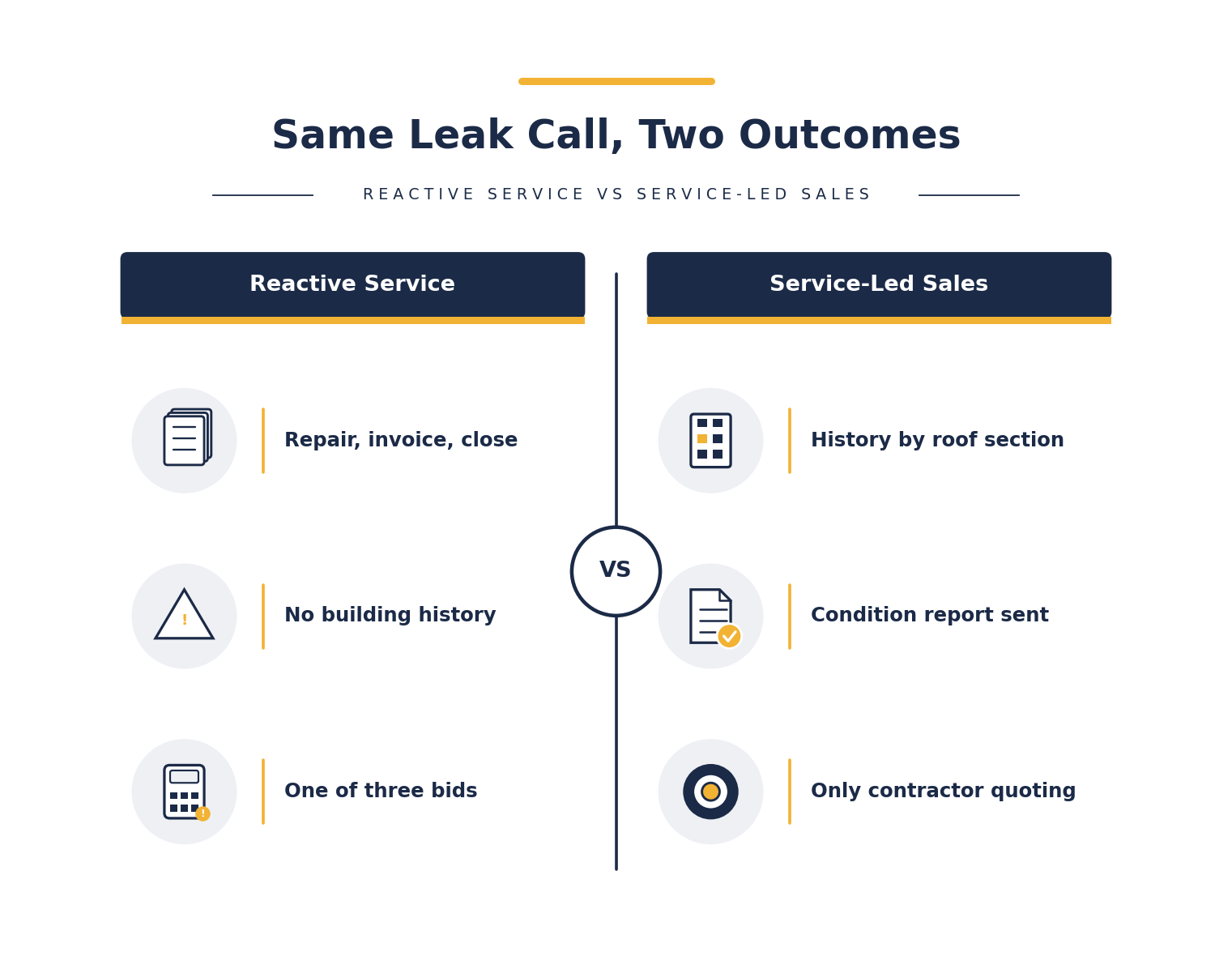
Why Does Service-Fed Backlog Change What the Company Is Worth?
Re-roofs won from service relationships do more than improve project margin. They change the quality of the backlog, and backlog quality is a line item in every roofing valuation. Buyers underwrite recurring service revenue and backlog convertibility ahead of almost everything else, and commercial maintenance exposure adds 0.5 to 0.8 turns to the multiple before any other adjustment. A pipeline fed by the contractor's own service history is exactly the kind of backlog a buyer pays for, because it's predictable and it transfers with the customer relationship rather than with the owner. The full valuation picture is in PE Backed Roofing Companies: 2026 Investor Guide.
The Metric Most Roofing Companies Are Not Tracking
Service-to-reroof conversion rate is re-roof projects won in the trailing 12 months from buildings the company already serviced, divided by total re-roof projects won. Most operators have never calculated it. Those who do are usually surprised in both directions: by how high the number could be given the buildings they already service, and by how low it actually is.
The failure point is rarely the technician or the estimator. It's the handoff. The ticket closes in the service system, the opportunity never opens in the sales system, and the building's history stays in five places. The companies converting service into projects at scale aren't running better crews. They're running one record per building that both departments read. The same discipline drives retention, which is why the service department is the most undervalued asset in most commercial roofing companies.
Turn Service History Into Project Pipeline
Terial gives contractors a complete operating history for every property they service. Each building has a single record with roof sections mapped directly onto the property, alongside every service ticket, photo, invoice, inspection report and prior repair. Instead of piecing together context from old jobs, inboxes and individual technicians, the entire history of the roof is available in one place.
That context changes how service work gets handled from the moment a call comes in. Dispatch can see repeat visits, previous repairs and open issues before assigning a crew. Technicians arrive with the last three tickets already on their phone, including the photos and notes they need to understand what has happened on that roof before. Crews spend less time reconstructing the history of a property and more time solving the problem in front of them.
Terial also turns service visits into a more systematic source of new work. When a technician identifies an additional repair, replacement or maintenance opportunity on site, they can capture it immediately with photos and notes, route it for approval and track it through the upsell process. If the customer moves forward, the opportunity converts into either a new service ticket or a production project in one click, with the property information, site data and photos already attached.
Service and production remain separate operational pipelines, while sharing the same underlying building record. That means an estimator preparing a replacement project can see years of service history, inspections and field documentation rather than starting from zero on a roof the company already knows.
For contractors with large service operations, that shared property history compounds over time. Every visit makes the next dispatch more informed, every inspection improves future estimating, and every field interaction creates another opportunity to turn existing customer relationships into additional revenue. James King Roofing grew service volume 171% on Terial.
Key Takeaways
FAQ
How many leak calls before a re-roof conversation makes sense?
Three on the same roof section inside about 18 months, or two on a system past 15 years. Either threshold justifies a condition report with the repair history attached.
Should the service technician pitch the re-roof on site?
No. The technician documents the section and flags it. The service manager sends the condition report and the estimator handles the proposal. Techs who pitch on the roof lose trust; techs who document well win the project for the company.
What should a roof condition report include?
The recent tickets with dates and findings, photos of the section and drains, membrane type and approximate age, any wet insulation found, warranty status, and a plain repair-vs-replace read using the owner's own repair spend.
How do you calculate service-to-reroof conversion?
Re-roof projects won in the trailing 12 months from buildings already under service, divided by total re-roof projects won. Track it quarterly and by branch.
Recommended
- How Roofing Service Data Drives New Contracts
- Why Your Service Department Is Your Most Undervalued Asset
- Reactive vs Proactive Roof Maintenance: What the Data Says
- Terial | Workflow Automation for Commercial Roofers


More articles


Book a personalized demo
Get a 30-minute demo tailored to how you run your commercial roofing business

“Making the switch to Terial has greatly exceeded my expectations and has already had a meaningful impact on our team’s productivity. Terial has significantly reduced the amount of time required to complete many of our day-to-day operational tasks, allowing our team to focus more on serving our customers.”

