
Reactive vs Proactive Roof Maintenance: What the Data Says
Discover how reactive vs. proactive roof maintenance - what the data actually says about cost can save you money and extend roof lifespan.
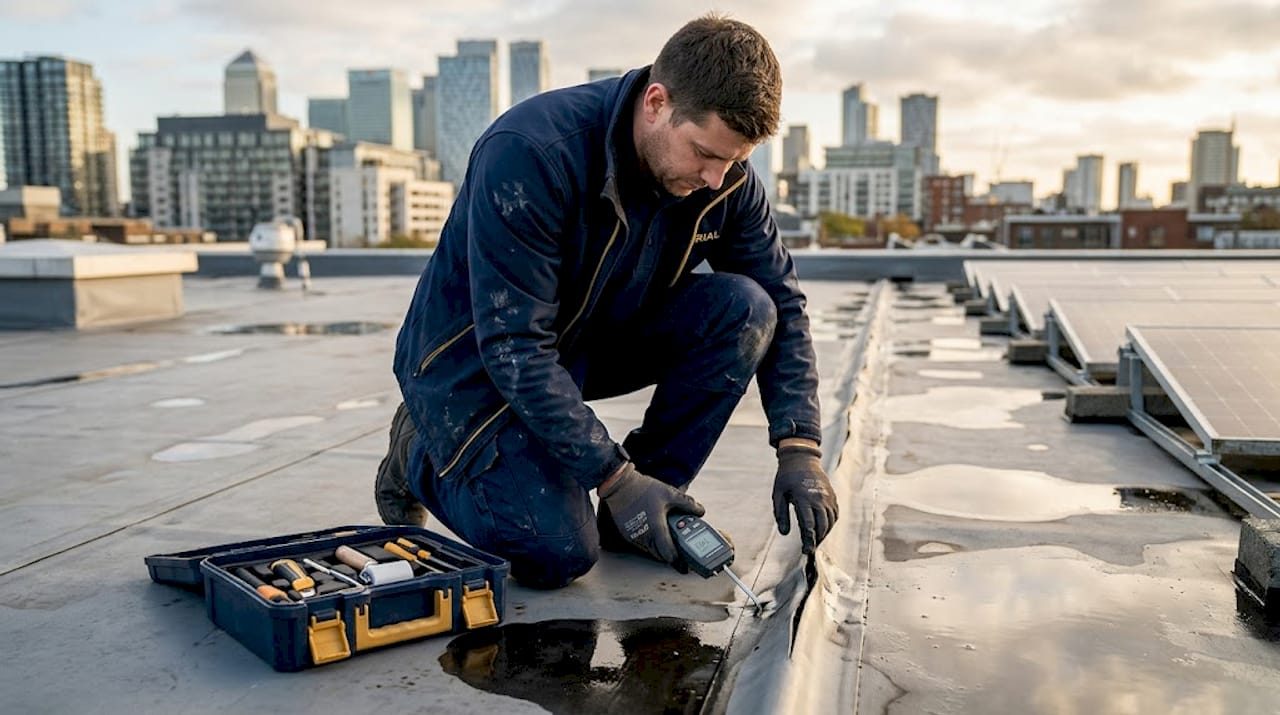
Most commercial roofing executives assume reactive maintenance is simply the cheaper path when budgets get tight. Fix it when it breaks. Skip the scheduled inspections. Defer the flashing repair until next quarter. The reactive vs. proactive roof maintenance question, and what the data actually says about cost, is that this assumption costs you dramatically more than you think. Proactive maintenance programs consistently outperform reactive approaches on total cost, roof lifespan, and budget predictability. The numbers are not even close, and if you are running a commercial roofing operation above $5M, the way you position these programs to clients directly affects your margins and your retention rates.
Key Takeaways
- Proactive maintenance saves money: Planned roof maintenance costs 66-82% less than reactive emergency repairs over 10 years.
- Biannual inspections are critical: Twice-yearly roof inspections catch issues early to avoid costly damages and extend roof lifespan.
- Reactive costs are often hidden: Business interruptions, tenant issues, and insurance impacts inflate reactive maintenance true expenses.
- Proactive extends roof life: Preventive programs can increase roof service life by up to 80%, deferring expensive replacements.
- Data-driven planning boosts ROI: Condition scoring and lifecycle modeling improve capital budget accuracy and reduce surprises.
Understanding Reactive and Proactive Roof Maintenance
These two terms get used loosely in the field, so let’s be precise before we get into the numbers.
Reactive maintenance addresses urgent problems only after failure becomes visible. A tenant calls about a ceiling stain. A facility manager notices water near the HVAC unit. The work order gets created, a crew dispatches, and the repair happens under time pressure. No documentation of what caused it. No assessment of what else might be degrading nearby. Just the visible problem, patched.
Proactive maintenance is a scheduled, documented program built around consistent inspection and early intervention. It typically includes:
- Biannual inspections, usually spring and fall
- Minor repairs during each visit: resealing penetrations, clearing drains, reattaching lifted flashings
- Condition assessments with scores tied to remaining useful life estimates
- Ventilation and drainage checks that surface hidden deterioration
- Digital records that create an auditable history of the roof’s condition
The difference is not just operational. It is financial. Helping clients understand that distinction is one of the highest-leverage conversations you can have. The roofing companies who sell programs instead of individual repairs build better revenue predictability, and their roofing maintenance scalability improves dramatically as a result.
Data-Backed Cost Comparison: Proactive vs Reactive Maintenance
Here is where the reactive vs. proactive roof maintenance picture gets concrete. The cost data across multiple 2026 analyses consistently points in the same direction.
Proactive maintenance costs 66% less than reactive over a 10-year period. When you factor in secondary damage costs like interior water damage, business disruption, and insurance impacts, that gap widens to 82%.
- Average annual maintenance costs: A reactive approach averages around $10,925/year, while a proactive maintenance strategy reduces that to roughly $3,709/year.
- Emergency repair costs: Reactive maintenance often leads to emergency call premiums that are 2–4x higher than standard service rates. Proactive maintenance helps avoid these emergency fees entirely.
- Business disruption: Waiting for problems to happen creates high and unpredictable disruption costs, while proactive maintenance keeps disruptions minimal.
- Roof lifespan: Reactive maintenance can shorten a roof’s usable life. Proactive maintenance can extend roof lifespan by 8–12 years.
- Long-term cost impact: Over a 10-year period, proactive maintenance can reduce total roofing-related costs by up to 82% when factoring in secondary costs like downtime and emergency repairs.
“The most expensive roof decision most property owners make is waiting until something goes wrong. The second most expensive is not documenting what was done when something finally did.”
The lifespan extension alone changes the math for your clients entirely. An 8 to 12 year deferral on a $15-20 per square foot replacement is not a minor benefit. On a 30,000 square foot roof, that is potentially $450,000 to $600,000 in deferred capital expenditure. That is the number you lead with when a client pushes back on a $12,000 annual maintenance contract.
For roofing companies, this data also supports the case for structured maintenance programs as a recurring revenue model. Commercial roof lifespan improvements are a direct outcome of documented, consistent programs, and they are measurable, which means they are sellable.
Why Reactive Maintenance Drives Higher Costs and Business Disruption
The mechanics behind these numbers are worth understanding because they explain why even smart facility managers consistently underestimate reactive costs.
Roofs degrade silently. Membrane separations, flashing lifts, and compression failures in insulation board can develop for 18 to 24 months before any interior symptom appears. By the time a tenant reports a stain, the actual damage radius is typically three to five times larger than the visible wet area. The reactive repair addresses the symptom. The underlying cause keeps spreading.
The cost of repeated emergencies compounds quickly. Each reactive call carries a premium. Emergency labor rates run 2 to 4 times standard planned-work rates. Material procurement under time pressure eliminates negotiating power. And each emergency visit typically uncovers additional damage that was not in the original scope.
Here is the pattern that kills commercial roof budgets:
- Year 1: Small flashing separation ignored. No inspection scheduled.
- Year 2: First interior water damage event. Emergency repair: $4,800.
- Year 3: Repeat leak in adjacent area. Emergency repair: $6,200. Insurance notified.
- Year 4: Widespread membrane degradation discovered. Full section replacement: $38,000.
That same roof, under a proactive program, likely receives a $200 flashing repair in Year 1 and nothing else until a planned inspection in Year 3 catches a minor drainage issue.
Pro Tip: When you present proactive maintenance to facility managers, reframe the conversation around risk, not cost. Ask them what one interior damage event, including tenant remediation and business interruption, would actually cost their organization. Most will land on a number five to ten times higher than your annual maintenance fee.
Effective labor management in roofing also takes a serious hit under reactive patterns. Dispatching crews reactively means inefficient routing, unplanned overtime, and no ability to batch work by geography or crew skill, all of which erode your margins on emergency calls even when you charge premium rates.
Key Elements of an Effective Proactive Roof Maintenance Program
Knowing the cost case is one thing. Knowing how to build and deliver a program that actually captures those savings is what separates roofing companies that win maintenance contracts from those that keep chasing one-time repairs.
Consistent biannual inspections are the foundation. Spring visits catch winter damage. Fall visits prepare the roof for thermal stress and moisture exposure. The programs that fail are the ones that start strong and then skip a cycle when the schedule gets tight. That inconsistency is exactly where the savings leak out.
An effective proactive maintenance program includes five core components:
- Biannual scheduled inspections with written reports and condition photos delivered to the client within 24 hours of the visit
- Minor repairs during each inspection including resealing penetrations, clearing drains of debris, and reattaching any lifted edge flashings or termination bars
- Condition scoring tied to a remaining useful life estimate, giving clients a data-based capital planning tool instead of guesswork
- Ventilation assessments to detect inadequate airflow that accelerates shingle and membrane degradation from the underside, a problem reactive programs almost never catch
- Digital documentation that creates a continuous record, making it easy to demonstrate program value, support warranty claims, and identify deterioration trends before they become failures
Pro Tip: Condition scoring is one of the most underused selling tools in commercial roofing maintenance. A simple 1 to 10 scale with a projected replacement year gives facility managers something to present to their finance teams. It turns your inspection visit into a capital planning asset, and it makes it significantly harder for a competitor to displace you.
The CRM strategy behind maintenance programs matters here too. Companies that manage their inspection schedules in disconnected spreadsheets and paper reports consistently lose visibility on which clients are due for visits, which conditions have worsened, and which roofs are approaching replacement conversations.
Comparing Lifecycle Cost and ROI: Practical Framework for Executives
Let’s put the full financial picture on paper in a way you can use directly in executive conversations.
Annual proactive maintenance costs $0.10 to $0.25 per square foot, citing NRCA and GSA data. Replacement costs run $10 to $20 per square foot and proactive programs extend roof life by 40 to 80 percent.
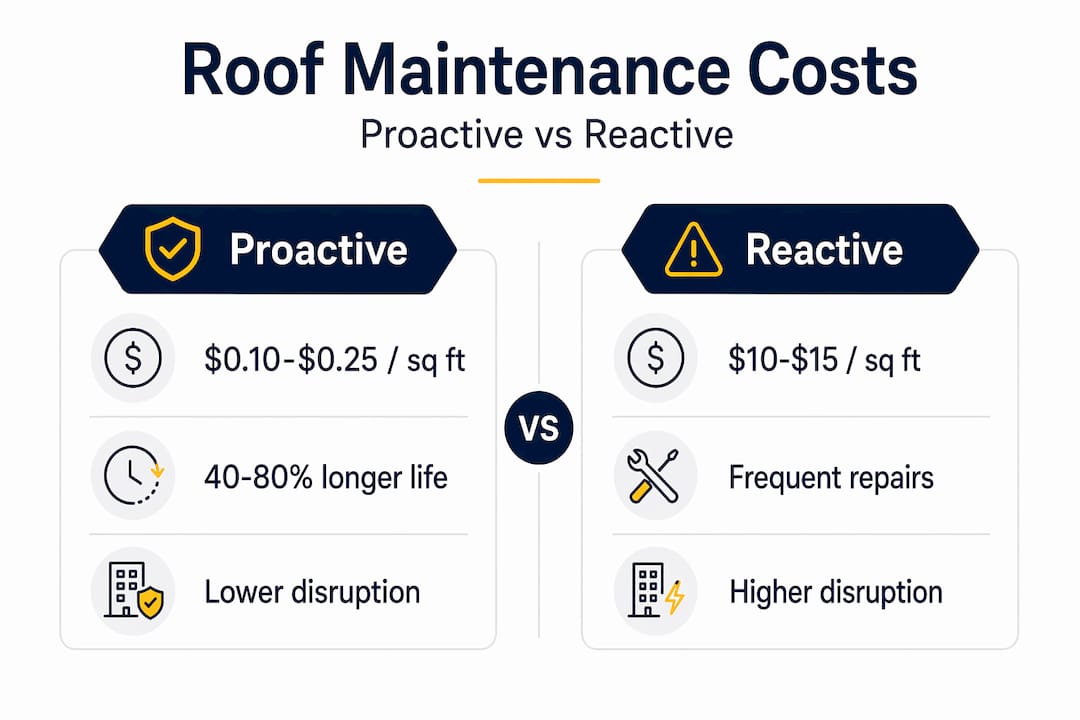
- 20,000 sq ft roof: Proactive maintenance typically costs $2,000–$5,000 annually, compared to a potential $200,000–$400,000 roof replacement. Extending the roof’s lifespan can result in $80,000–$320,000 in avoided replacement costs.
- 50,000 sq ft roof: Annual proactive maintenance costs are usually $5,000–$12,500, while full replacement can range from $500,000–$1,000,000. Extending roof life can save $200,000–$800,000 over time.
- 100,000 sq ft roof: Proactive maintenance generally costs $10,000–$25,000 per year, versus $1M–$2M for replacement. Extending the roof’s lifespan can generate $400,000–$1.6M in savings.
On a 50,000 square foot roof, a $25,000 to $75,000 annual maintenance investment prevents $500,000 to $1.25 million in replacement costs. Even at the high end of the maintenance range, the ROI is not debatable.
The financial model that works best for executive-level conversations has three lines:
- Proactive annual cost (maintenance program fee)
- Deferred replacement value (years of replacement cost pushed out, discounted by expected inflation)
- Avoided reactive costs (emergency repairs, insurance adjustments, business interruption estimates)
When those three lines are on a single page, the preventive maintenance case makes itself. The executives you are talking to are not skeptical of maintenance value. They are skeptical of any vendor’s ability to deliver it consistently and document it credibly. That is the real sale.
The Metric Most Roofing Companies are Not Tracking
Most operators already believe proactive is better. They have read the data. They know the math. What they do not have is a way to deliver proactive programs with enough consistency and documentation quality to actually capture those savings for clients and use them as a retention tool.
The failure point is almost never the inspection itself. It is everything around the inspection. The report does not get written until three days after the visit. The photos are sitting on someone’s phone. The condition score from last spring is in a spreadsheet no one can find. The follow-up repair quote gets forgotten in an email chain.
When the documentation breaks down, the program loses its value. The client cannot see what they are paying for. And when a lower-priced competitor shows up, there is no evidence base to defend the relationship.
The roofing companies running $8M to $15M who are systematically winning maintenance contracts are not doing it with better inspections. They are doing it with better delivery. Same roof. Same crew. Better reporting, faster follow-up, and a clear record that makes the client feel like their asset is being managed, not just visited.
That is where operational infrastructure matters. Not as a back-office efficiency play, but as a direct driver of revenue retention and program renewals.
Run Maintenance Programs Your Clients Can Actually See the Value Of
Terial gives commercial roofing contractors a single connected system where inspection workflows, condition reports, follow-up repair quotes, and client communication all live in the same place. Field crews capture photos, complete checklists, and close out inspection visits from their phones. The office gets the report automatically. The client gets a branded summary the same day.
When you are managing 40 or 80 maintenance agreements across a region, that consistency is what keeps clients renewing and what gives your team the data to have real capital planning conversations. If you are running maintenance programs today on disconnected tools, the cost of that fragmentation shows up directly in client retention and program margins. See how Terial supports commercial roofing operations built around recurring revenue.
Frequently Asked Questions
What is the average cost difference between reactive and proactive roof maintenance?
Proactive maintenance costs 66% less over a 10-year period compared to reactive maintenance, and that gap grows to 82% when secondary damage and business disruption costs are included.
How often should proactive roof inspections be conducted to maximize savings?
Biannual inspections in spring and fall are the standard recommended by roofing industry data, as they catch both seasonal damage and pre-season vulnerabilities before they become expensive failures.
What hidden costs are associated with reactive roof maintenance?
Beyond the direct repair bill, reactive maintenance generates real costs in business interruptions, tenant complaints, insurance premium increases, and management time overruns that often exceed the visible repair expense itself.
Can proactive maintenance extend the lifespan of commercial roofs?
Yes. Buildings with documented preventive maintenance programs achieve 40-80% longer service life compared to roofs managed reactively, according to data from the NRCA and GSA.
How does proactive maintenance impact capital expenditure budgeting?
68% of reactive property managers face capital expenditure overruns of 20% or more because they lack condition scoring data, while proactive programs give finance teams a predictable, defensible replacement timeline.
Recommended
- How Manual Processes Limit Roofing Scalability
- Terial Case Study | How James King Roofing Grew Service by 171%
- How to Track Labor Hours for Maximum Project Profit
- Terial | Workflow Automation for Commercial Roofers



Book a personalized demo
Get a 30-minute demo tailored to how you run your commercial roofing business

“Making the switch to Terial has greatly exceeded my expectations and has already had a meaningful impact on our team’s productivity. Terial has significantly reduced the amount of time required to complete many of our day-to-day operational tasks, allowing our team to focus more on serving our customers.”

