
Running a Profitable Commercial Roof Service Department
Discover the keys to Running a Profitable Commercial Roof Service Department. Boost cash flow, client retention, and margins with actionable strategies!

Most commercial roofing owners treat their service department like a necessary nuisance — the crew that handles leak calls between the real work. That framing is costing you serious money. Running a profitable commercial roof service department is not about squeezing margins on small tickets. It is about recognizing that your service division, when structured correctly, can deliver steadier cash flow, stronger client retention, and higher margins than your reroof projects. This guide breaks down exactly how to get there: pricing, workflows, technician training, and the metrics that tell you whether it is working.
Key Takeaways
- Service profitability potential: Commercial roof service departments can become stable and lucrative revenue engines when managed strategically.
- Structured pricing discipline: Adopting tiered, flat-rate pricing with documented scopes prevents chronic underpricing in service work.
- SOPs and tech training: Standardized operational workflows and communication-trained technicians improve consistency and upsell rates.
- Metric tracking for margin: Weekly monitoring of labor utilization, job-level margin, and CAC reveals hidden profit leaks early.
- Revenue mix and overhead control: Optimizing maintenance contracts and controlling overhead ratio are critical for sustained net profit growth.
Why Your Service Department is Your Most Undervalued Profit Center
The average commercial roofing company treats service as reactive. A client calls, a tech gets dispatched, a ticket gets written up somewhere, and someone chases the invoice two weeks later. That is not a service department. That is organized chaos with a labor cost attached.
Service work can be one of the most stable, profitable income sources versus large reroof projects, provided the service division is correctly structured. That word “structured” is doing a lot of work. Most service departments fail not because the demand is not there, but because the operations behind them are informal.
Here is what undervalued service departments typically have in common:
- No formal pricing system — technicians quote from memory or gut feel
- No standard operating procedures for dispatch, repair approval, or follow-up
- Understaffed or staffed with techs who are not trained to represent the company
- No tracking of job-level margins, so nobody knows which tickets are profitable
The irony is that service clients are often your most loyal customers. They call you first, they trust you with their buildings, and they are primed for upsells on maintenance contracts. That is a relationship-driven revenue stream most owners are leaving on the table.
Service work becomes profitable when leadership stops treating it as informal leak-calls and engineers it like a repeatable product with structured pricing, SOPs, training, and measurement.
When you shift from reactive to structured, the service department stops being a cost center and starts compounding. Repeat business, referrals, and maintenance contract renewals build on each other in a way that new construction bids simply cannot replicate.
Building a Pricing System that Captures Your Service Value
Underpricing is the single biggest margin killer in commercial roof service. It is not laziness — it is a systems problem. Most contractors apply the same estimating rigor to a $400,000 reroof that they never apply to a $1,200 repair ticket. The result is a service department that stays busy but never gets ahead.
Most contractors underprice service tickets due to a lack of formal estimating systems used in reroofs. The fix is not complicated, but it does require discipline. Build a flat-rate, tiered pricing menu for your most common service calls. Think of it as a Good/Better/Best structure:
- Good: Basic repair, single-layer, standard materials, under two hours of labor
- Better: More complex repair, modified bitumen or TPO, two to four hours, includes inspection report
- Best: Full assessment, multi-area repair, written scope, priority scheduling, warranty documentation
Pricing discipline requires service-specific workflows with documented labor and time assumptions and standardized scopes. That means writing down how long each repair type actually takes, what materials it consumes, and what your fully loaded labor cost is before you set a price. Not after.
Pro Tip: Pull your last 90 days of service tickets and calculate the actual margin on each one. Most owners who do this exercise find at least three to five ticket types they have been pricing below cost without realizing it.
Internal pricing menus also speed up your dispatch process. When a client calls and your office can quote a ballpark within two minutes using a structured pricing system, you close faster and you look more professional. Both matter for commercial roofing profitability.
Service pricing discipline is not about charging more for the sake of it. It is about charging accurately for the value you deliver and the risk you carry.
Operational Workflows and Technician Training for Consistency and Revenue Growth
Pricing gets you in the right range. Workflows keep you there. Without standard operating procedures, your service department’s profitability depends entirely on who shows up that day and how they are feeling. That is not a business. That is a gamble.
Successful roofing contractors create SOPs for dispatch, repair approvals, upsell scripts, and standard workflows to stabilize revenue. A basic service call SOP should cover at minimum:
- Dispatch confirmation with arrival window communicated to client
- On-site documentation: photos, roof condition notes, scope of work
- Verbal repair explanation to the client or property manager before work begins
- Written approval for any work above a pre-set threshold (say, $500)
- Upsell check: does this roof need a maintenance inspection or preventive treatment?
- Invoice sent digitally before the tech leaves the property
That last point is not a small detail. Invoicing on-site shortens your collection cycle by days, sometimes weeks. It also signals professionalism to your commercial clients.
Technician training and SOPs are inseparable. Your techs are not just repair workers. They are the face of your company on every service call, and they are your best upsell opportunity. Training techs to explain repair options and communicate effectively builds trust and increases upsell conversion.
Pro Tip: Role-play the upsell conversation with your techs before they go into the field. A simple script like “While I was up there, I noticed the flashing around your HVAC units is showing wear. Want me to write that up for you?” can add $300 to $800 per call with zero additional marketing cost.
Efficient SOP workflows also reduce the time your office spends chasing information after a job. When techs document on-site, you eliminate the back-and-forth that kills administrative efficiency and delays invoicing.
Tracking Key Metrics: Utilization, Margin visibility, and Customer Acquisition Cost
You cannot manage what you do not measure. Most service departments track revenue and not much else. That is like driving with your eyes closed and checking the odometer to see how you are doing.
Job costing typically surfaces 2 to 4 points of hidden margin loss within 90 days. That is not a rounding error. On a $2 million service department, that is $40,000 to $80,000 walking out the door annually because nobody is looking at job-level costs. Use real-time job costing to track labor and margin on every service ticket, not just at month-end.
Here are the three metrics that matter most for efficient roof service management:
- Billable utilization
- Target benchmark: 85% or higher
- Tells you how much of your labor hours are generating revenue
- Gross margin per ticket
- Target benchmark: 45% to 55%
- Tells you if your pricing is capturing full value
- Customer acquisition cost (CAC)
- Target benchmark: below 10% of first-year revenue
- Tells you whether your marketing spend is efficient
Track billable utilization weekly with an 85% or higher benchmark to maximize labor deployment. If a tech works 40 hours but only 30 are billable, you are paying for 10 hours of overhead with no return. Weekly tracking lets you catch that drift before it compounds.
Measuring utilization, margin, and CAC monthly is not optional for a profitable service department. It is the feedback loop that tells you whether your systems are working.
Customer acquisition cost is often ignored in service departments because most leads come from existing relationships. But if you are running any marketing, attending trade events, or paying referral fees, you need to know what a new service client actually costs you versus how much they generate over their lifetime. Use time tracking features to capture accurate labor data that feeds directly into your job costing.
Maximizing Profitability Through Job Mix Optimization and Overhead Management
Once your pricing, workflows, and metrics are in place, the next lever is the composition of your revenue. Not all service work is created equal, and the best practices for roof departments include being intentional about which types of work you pursue.
Shifting revenue mix to maintenance contracts directly boosts profitability and stability. Maintenance contracts typically carry gross margins of 50% or higher because the scope is predictable, the scheduling is controlled, and you are not responding to emergencies with rushed labor. Compare that to emergency leak calls, which often carry margins below 30% once you factor in overtime, expedited material sourcing, and administrative time.
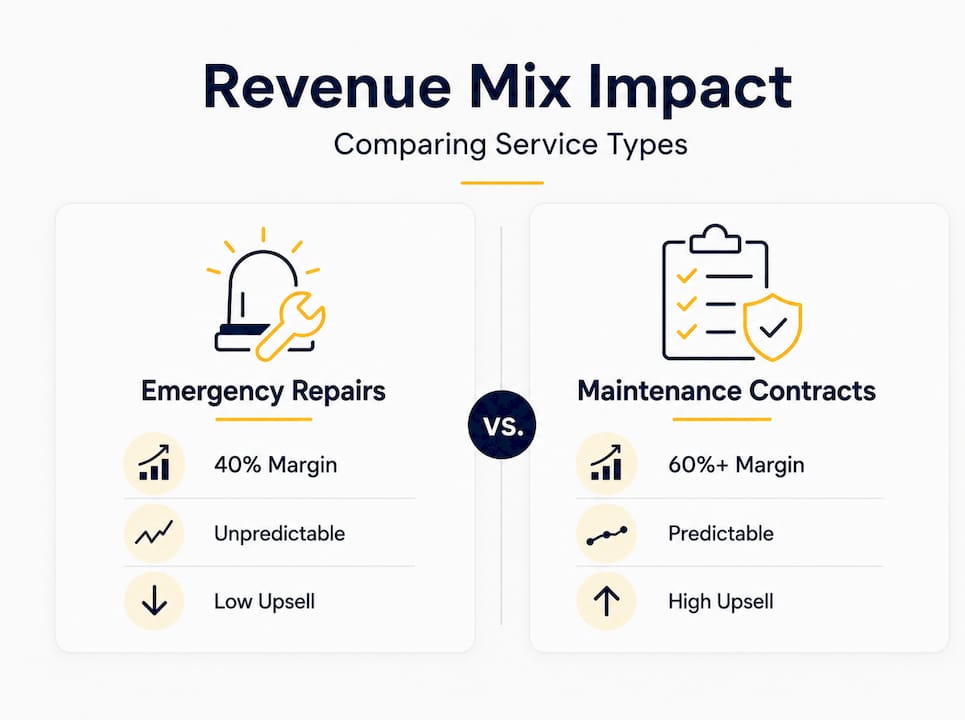
Here is a practical comparison:
- Emergency repairs
- Typical gross margin: 25% to 35%
- Predictability: Low
- Upsell potential: Low
- Scheduled repairs
- Typical gross margin: 40% to 50%
- Predictability: Medium
- Upsell potential: Medium
- Maintenance contracts
- Typical gross margin: 50% to 60%
- Predictability: High
- Upsell potential: High
To increase roof service revenue, shift your mix toward the bottom row. That means actively selling maintenance agreements to every service client, not just mentioning them occasionally.
On the overhead side, manage your overhead ratio monthly to prevent unnecessary expense growth. The target is below 30% of revenue. When service revenue grows but overhead grows faster, your net profit shrinks even as your top line looks healthy. Watch it monthly, not quarterly.
Here is a four-step approach to tightening overhead and improving cash flow:
- Audit your overhead monthly and categorize every line item as fixed, variable, or discretionary
- Require deposits on service contracts before scheduling to reduce your cash flow gap
- Send digital invoices on-site so payment cycles start the day work is completed
- Review your overhead and scalability quarterly to identify where growth is creating cost drag
Pro Tip: If your overhead ratio is above 35%, the problem is almost always in one of two places: administrative labor that is duplicating effort, or software and tools that are not integrated. Both are fixable without cutting into field capacity.
Why Treating Your Service Department as a Repeatable Product is the Game Changer
The contractors who struggle with service profitability are not struggling because of pricing or workflows in isolation. They are struggling because they have never decided what their service department actually is.
Is it a favor you do for your reroof clients? Is it a break-even operation that keeps techs busy in slow seasons? Or is it a product you have designed, priced, staffed, and measured with the same intention you bring to your largest projects?
Service becomes profitable when leadership stops treating it as informal leak-calls and engineers it like a repeatable product with structured pricing, SOPs, training, and measurement. That framing matters more than any individual tactic. When you treat service as a product, every decision changes. You document processes because products need documentation. You train technicians on communication because your product is delivered by people. You track margins because you would never sell a product without knowing its cost.
The contractors we see consistently growing their service as a product are not necessarily the ones with the best techs or the most sophisticated tools. They are the ones who made a deliberate choice to build the department rather than just staff it. That decision comes before any software, any pricing menu, or any training program. It is a leadership posture, and it is the one thing you cannot outsource.
Transform Your Service Department with Terial’s Workflow Automation
The strategies in this guide only work when your systems support them. If your dispatch, invoicing, time tracking, and job costing are running on disconnected spreadsheets and text threads, you will rebuild the same problems every quarter. Terial’s workflow automation for roofers connects every part of your service operation into one real-time system, so your pricing, labor data, and margin visibility are always current. Explore service workflow features built specifically for commercial roofing service departments, from dispatching and field documentation to on-site invoicing. If you want to go deeper on building a revenue-generating service operation, the CRM strategy webinar walks through practical frameworks for turning your service department into a reliable growth engine.
Frequently Asked Questions
How can I stop my service department from being a cost center?
Service work becomes profitable when correctly structured with pricing, SOPs, technician training, and consistent metric tracking. Start by auditing your current ticket margins and building a flat-rate pricing menu for your most common repair types.
What utilization rate should I aim for my field staff?
Billable utilization should be tracked weekly with a benchmark of 85% or higher to ensure your labor costs are generating revenue rather than sitting as overhead.
Why is job-level costing important for profitability?
Job costing surfaces 2 to 4 points of hidden margin loss within 90 days by showing the actual cost and profit of each individual ticket, which lets you fix pricing and workflow problems before they compound.
How do maintenance contracts affect profitability?
Revenue mix shifting to maintenance contracts directly boosts profitability because the work is predictable, schedulable, and carries gross margins 15 to 25 points higher than emergency repairs.
What is a good overhead ratio to target?
Keep your overhead ratio below 30% of revenue and measure it monthly. Anything above 35% typically signals administrative redundancy or unintegrated tools that are creating hidden labor costs.
Recommended
- How to Track Labor Hours for Maximum Project Profit
- How Manual Processes Limit Roofing Scalability
- Terial | Workflow Automation for Commercial Roofers
- Terial Case Study | How James King Roofing Grew Service by 171%





Book a personalized demo
Get a 30-minute demo tailored to how you run your commercial roofing business

“Making the switch to Terial has greatly exceeded my expectations and has already had a meaningful impact on our team’s productivity. Terial has significantly reduced the amount of time required to complete many of our day-to-day operational tasks, allowing our team to focus more on serving our customers.”

