
Why Residential-First Roofing Software Fails on Commercial Jobs
Discover why residential-first roofing software fails on commercial jobs. Learn how to choose better tools to protect your margins and efficiency!
If you’ve ever tried to run a commercial roofing project through software built for residential contractors, you already know something feels broken. The problem isn’t your crew or your process. Why residential-first roofing software fails on commercial jobs comes down to a fundamental architectural mismatch: these tools were designed to close a $15,000 shingle replacement in two days, not manage a $500,000 TPO re-roof across multiple phases with subcontractors, retainage billing, and a general contractor breathing down your neck. Using them anyway doesn’t just create friction. It quietly bleeds your margins.
Key Takeaways
- Residential software limitations: Residential-first roofing software lacks essential commercial features causing inefficiencies and errors.
- Commercial roofing complexities: Unique commercial workflows require software designed for multi-phase projects, subcontractors, and retainage.
- Fragmentation costs: Using multiple disconnected tools increases costs and operational risks for commercial contractors.
- Technical estimation gaps: Residential AI and measurement tools often miscalculate commercial roof types, risking inaccurate bids.
- Choose commercial software: Integrated commercial roofing platforms improve productivity, reduce errors, and support scalable growth.
Why Residential Roofing Software Falls Short for Commercial Projects
The gap between residential and commercial roofing isn’t just project size. It’s an entirely different operational model, and residential platforms were never built to support it.
- Subcontractor management: No native tools for tracking subcontractor scopes, payments, or compliance documentation.
- Lien waiver tracking: Commercial projects require conditional and unconditional lien waivers at multiple milestones. Residential tools don’t support this workflow.
- Multi-phase job tracking: A commercial re-roof might span demolition, insulation, membrane installation, and punch-out across weeks or months. Residential platforms treat every job as a single event.
- Change order audit trails: Commercial GCs require documented change orders with approval signatures. Residential software handles this informally at best.
- Certified payroll and prevailing wage: Irrelevant for residential work. Non-negotiable for public commercial projects.
The limitations of residential roofing software compound quickly when you look at what’s simply missing from the feature set:
The result is a patchwork of spreadsheets, email threads, and workarounds that your office team maintains manually. Every manual bridge is a place where data gets lost, delayed, or wrong.
The Unique Complexities of Commercial Roofing Software Needs

Understanding commercial needs clarifies why residential-first software falls short in these areas. Commercial roofing isn’t just bigger residential roofing. The entire project lifecycle operates differently, and your software needs to reflect that.
Here are the core operational requirements that residential roofing software consistently misses when applied to commercial work:
- Multi-phase job tracking. A commercial project moves through bid, award, mobilization, installation phases, inspections, and closeout. Each phase has its own costs, timelines, and documentation requirements. Residential tools track jobs as a single timeline.
- GC bid process support. Submitting bids to general contractors involves specific formatting, scope breakdowns, and often bonding documentation. Residential platforms have no concept of this workflow.
- Retainage billing. Most commercial contracts withhold 5 to 10 percent of each invoice until project completion. Your software needs to track retainage automatically across every draw. Residential billing tools don’t.
- Subcontractor coordination. Managing multiple subs across a large commercial job requires scope assignment, compliance tracking, and payment scheduling. This is absent from residential platforms.
- Longer sales cycle pipeline management. A commercial deal might take 60 to 180 days from first contact to signed contract. You need CRM pipeline stages that reflect that reality, not a residential tool optimized for a 48-hour close.
The commercial job tracking requirements alone justify moving to purpose-built software. When your system can’t track phase-level labor costs, you’re estimating your profitability by feel rather than data.
Technical Failures in Residential Roofing Software Applied to Commercial Roofs
These technical issues exacerbate operational inefficiencies on commercial roofs. The problems go deeper than missing features. The underlying technology in residential platforms is calibrated for a completely different product.
Consider AI-powered measurement tools. The AI measurement software in residential platforms is trained and optimized for pitched shingle roofs. When you apply those same tools to a flat commercial roof with TPO, EPDM, or modified bitumen, the accuracy drops significantly. Parapet walls, rooftop equipment, drains, and penetrations don’t register the same way. An estimate built on flawed measurements isn’t just wrong. It’s a signed contract you’ll lose money on.
The technical gaps extend further:
- Material specification databases: Residential platforms catalog shingles, underlayment, and ridge caps. They don’t carry commercial membrane systems, tapered insulation assemblies, or the specific product data sheets your commercial clients require.
- Jurisdictional code differences: Commercial roofing is subject to different building codes, wind uplift calculations, and energy compliance requirements than residential. Residential software doesn’t flag these distinctions.
- Roof system complexity: A commercial roof might include multiple drainage zones, expansion joints, and varying insulation depths across a single plane. Residential tools have no framework for modeling this.
Pro Tip: Before committing to any roofing software for commercial work, ask the vendor specifically how their measurement tools handle flat roofs with rooftop HVAC units and parapets. If they can’t give you a precise answer, that’s your answer.
The liability exposure here is real. An underbid commercial job because your software miscalculated a drainage slope or missed a penetration count doesn’t just hurt your margin. It can define your reputation with a GC you’ve spent years building a relationship with.
Hidden Costs and Inefficiencies from Fragmented Software Tools
The cost implications highlight why operational clarity is key for commercial roofing software. Most commercial contractors who’ve outgrown residential tools don’t switch immediately. Instead, they add tools. A separate CRM here. A project management app there. A spreadsheet layer on top of everything.
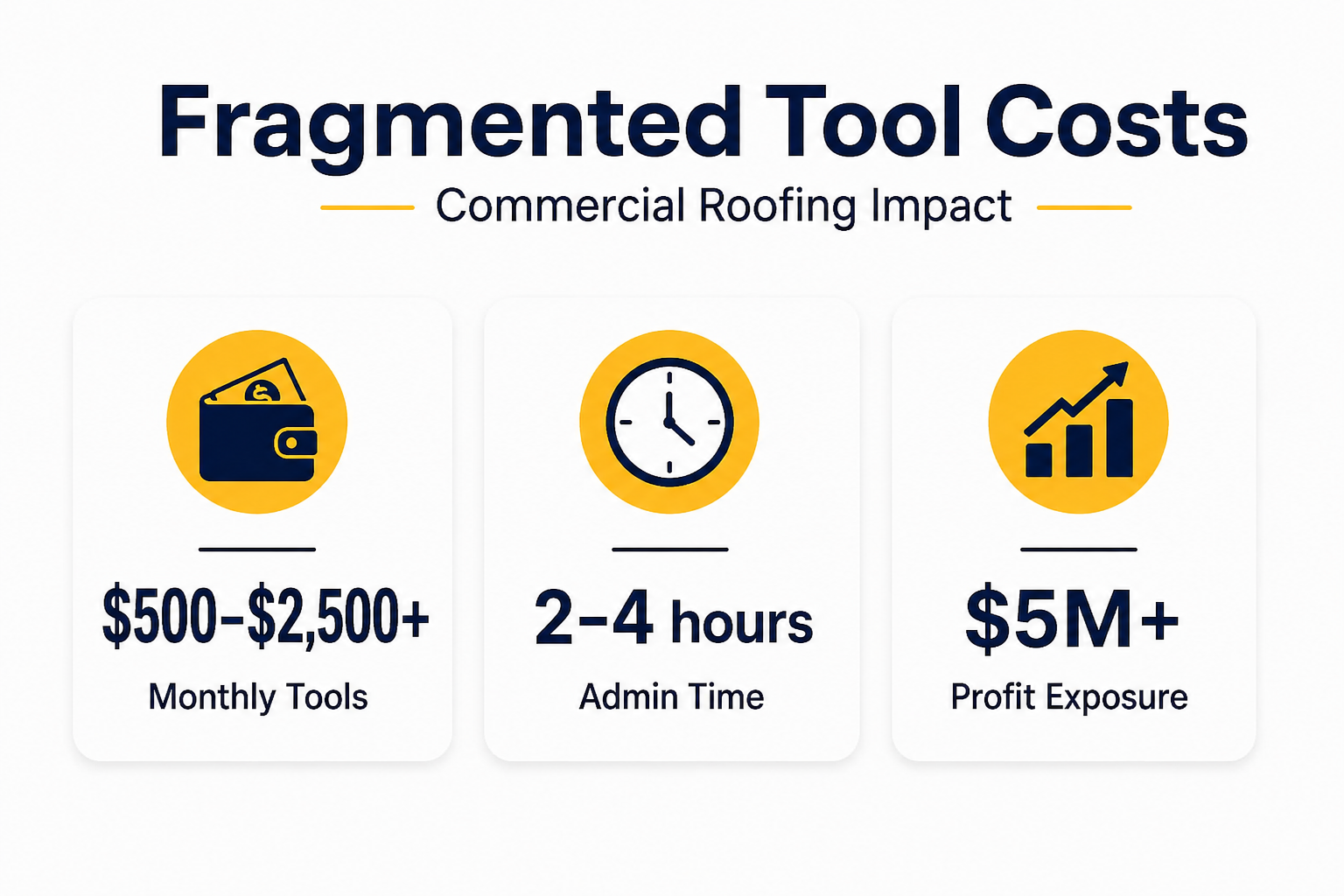
Tool fragmentation costs commercial contractors between $500 and $2,500 per month across disconnected platforms, and that’s before you account for the labor cost of the people manually reconciling data between them. Here’s what that fragmentation actually looks like at the operations level:
- Estimating — done in a standalone tool with manual export, costing 2 to 4 hours per bid in re-entry
- Job costing — tracked in spreadsheets updated manually, creating a weekly lag with no real-time visibility
- Subcontractor billing — handled through email and paper invoices, leading to missed payments and lien exposure
- Change orders — managed via email chains and PDFs, causing disputes and unapproved work
- Invoicing — processed in a separate accounting tool, adding a 3 to 5 day delay per invoice cycle
Every bulletpoint is a place where data gets stale, errors compound, and your team spends time on administration instead of production.
Pro Tip: Add up what you’re paying monthly across every software subscription your office uses to run a commercial job from bid to closeout. Most contractors are surprised to find they’re spending more on disconnected tools than a unified platform would cost, while getting worse results.
The software fragmentation impact on a $5M-plus commercial roofing operation is measurable. Profit leakage from unbilled change orders alone can run 2 to 4 percent of project revenue. At that scale, that’s real money left on the table every year.
Choosing Software Built for Commercial Roofing Success
Knowing the right features prepares you to avoid costly pitfalls of residential-first tools. When you’re evaluating platforms, the question isn’t whether the software has a mobile app or looks clean in a demo. The question is whether it was built around the way commercial roofing projects actually run.
Hybrid platforms and purpose-built commercial tools handle multi-phase job tracking, bid management, retainage, and payroll in ways residential-first software simply cannot replicate with add-ons or customization.
Here’s what to evaluate side by side:
- Multi-phase job tracking — residential-first tools don't support it, while commercial-purpose software offers native, phase-level cost tracking
- Retainage billing — a manual workaround on residential platforms, automated per contract terms on commercial ones
- Subcontractor management — basic or absent in residential tools, with full scope, compliance, and payment tracking on commercial platforms
- Aerial measurement integration — limited or manual on residential software, native API connections on commercial
- Certified payroll — not available in residential-first tools, built-in or integrated on commercial-purpose ones
- Field crew mobile adoption — residential apps are consumer-grade, while commercial tools are purpose-built for field use
Beyond the feature checklist, focus on these evaluation criteria:
- Field adoption rate: Software your crew won’t use is software you’re paying for twice. Look for platforms with mobile-first design built around field workflows, not office workflows ported to a phone.
- Real-time cost visibility: You need to see job costs update as labor hours are logged and materials are ordered, not after your accountant reconciles the books at month end.
- Integrated bid management: Your estimating, proposal, and contract workflow should live in the same system as your project execution.
- Change order controls: Every change order should require documented approval before work proceeds, with a clear audit trail.
Pro Tip: Run a pilot evaluation using an actual commercial project in progress. Don’t demo with hypothetical data. Put the software against a real job with real complexity and see where it breaks.
The commercial roofing software features that matter most aren’t the ones that look impressive in a sales presentation. They’re the ones that prevent a $50,000 mistake at 11pm on a Thursday when a GC calls asking about a change order your team can’t locate.
Why the Residential-First Roofing Software Approach Undermines Commercial Roofing Growth
Here’s the uncomfortable truth most software vendors won’t tell you: the problem isn’t that your team hasn’t learned the residential tool well enough. The problem is architectural. Residential software was designed around a fundamentally different transaction, and no amount of training, customization, or added integrations changes what it was built to do.
Commercial roofers who adopt residential software consistently hit a growth ceiling, often below $5M in revenue, because their operational capacity is limited by the workarounds they’ve built around inadequate tools. The spreadsheet bridges they’ve created aren’t process problems. They’re symptoms of an architectural mismatch that compounds as volume increases.
We’ve seen this pattern repeatedly. A contractor grows from $2M to $4M running a residential platform with enough duct tape to make it work. Then they land a $1.5M commercial project and suddenly the cracks become craters. The estimating tool can’t handle phased billing. The CRM has no concept of retainage. The field app doesn’t support subcontractor documentation. The owner ends up personally managing the gaps, which is not a scalable position.
The firms that break through $5M and grow toward $10M and beyond share one operational characteristic: they stopped trying to make residential tools work for commercial jobs and built their operations around systems designed for the work they actually do. That shift isn’t just about efficiency. It changes what projects you can credibly pursue, how fast you can mobilize, and how clearly you can see whether a job is profitable before it’s too late to course-correct.
The manual process pitfalls of residential software aren’t a technology problem you can solve with better training. They’re a strategic constraint on your growth, and treating them as anything less costs you more every year you wait.
Optimize Your Commercial Roofing Operations with Terial
If you recognize your operation in any of this, the answer isn’t adding another tool to your stack. It’s replacing the fragmentation with a system built for how commercial roofing actually works. Terial is the unified operating system built specifically for commercial roofing contractors, connecting estimating, bid management, field execution, subcontractor coordination, and invoicing in a single real-time system. No spreadsheet bridges. No manual re-entry. No profit leakage from disconnected workflows. Explore Terial’s core features to see how multi-phase job tracking, change order controls, and real-time cost visibility work in practice, or review the service workflow capabilities to understand how field crews actually adopt and use the platform on active jobs.
Frequently Asked Questions
Can residential roofing software be customized for commercial roofing needs?
Customization is possible, but residential software requires extensive workarounds and multiple integrations to approximate commercial workflows, which increases costs and introduces new failure points rather than solving the underlying problem.
What are the key features commercial roofing software must have?
Commercial roofing software must support multi-phase tracking and retainage alongside subcontractor coordination, detailed GC bid management, and certified payroll, since these are non-negotiable requirements for projects with longer sales cycles and complex billing structures.
How does software fragmentation impact commercial roofing operations?
Tool fragmentation costs $500 to $2,500 monthly and forces manual data re-entry across platforms, creating workflow bottlenecks, profit leakage from unbilled work, and operational risk that compounds as project volume grows.
Recommended
- Terial | Workflow Automation for Commercial Roofers
- How Manual Processes Limit Roofing Scalability
- How to Track Labor Hours for Maximum Project Profit
- Terial Case Study | How James King Roofing Grew Service by 171%




Book a personalized demo
Get a 30-minute demo tailored to how you run your commercial roofing business

“Making the switch to Terial has greatly exceeded my expectations and has already had a meaningful impact on our team’s productivity. Terial has significantly reduced the amount of time required to complete many of our day-to-day operational tasks, allowing our team to focus more on serving our customers.”

