
Roof Lifecycle Management: A Commercial Property Guide
Master roof lifecycle management to save costs, extend roof life, and protect budgets. Learn key stages and best practices for your property.

Roof lifecycle management is the systematic process of overseeing a commercial roof from installation through replacement, using documented condition data to control costs, extend service life, and protect capital budgets. Most commercial property managers treat roofs as a recurring expense until something fails. That reactive mindset is the single biggest driver of unbudgeted replacement costs. A structured lifecycle approach treats every roof as a managed financial asset, with forecasted capital expenditures and a documented service history that survives staff turnover, contractor changes, and ownership transitions.
What Are the Key Stages of the Commercial Roof Lifecycle?
Every commercial roof passes through five distinct phases. Understanding where a roof sits in that progression determines whether you repair, restore, or replace.
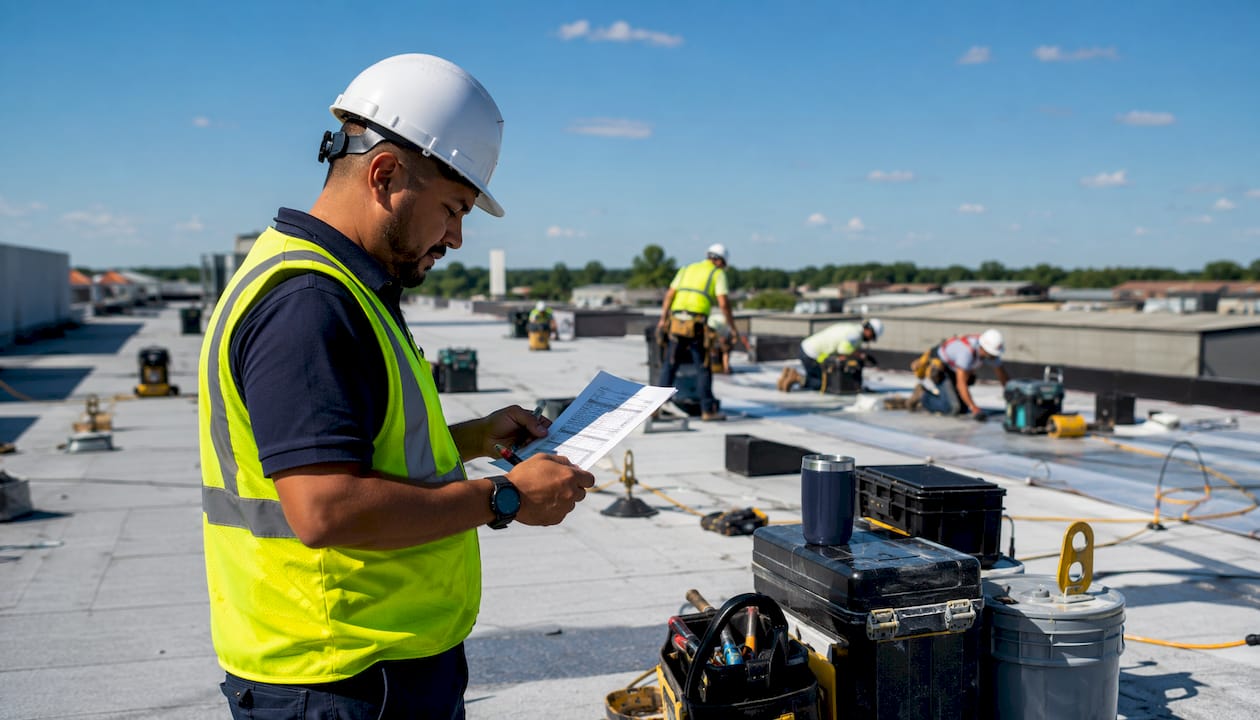
Installation and early life (years 1–5) is when the roof performs at peak capacity. Defects from installation show up quickly, so this phase requires a post-installation inspection and baseline documentation. Photograph every penetration, seam, drain, and flashing detail before the contractor leaves the site. That record becomes the comparison baseline for every future inspection.
Mid-life maintenance (years 5–15) is where most roofs are won or lost. Preventative maintenance programs can extend a commercial roof’s service life by 25–50% and reduce total repair costs by 30–50% compared to reactive repairs. That is not a marginal gain. It is the difference between a 20-year roof and a 30-year roof on the same building.
Late-life restoration (years 15–25) is the decision window. Restoration coatings and overlays can add 10–15 years to a membrane that still has structural integrity. The critical constraint is building code. Reroofing projects often trigger updated code compliance, increasing scope and cost. Proactive management lets you phase those upgrades instead of absorbing them all at once during an emergency replacement.
Replacement planning is the final phase, and it should never be a surprise. The repair-vs-replace threshold is clear: when repair costs reach 25–30% of the roof’s full replacement value, replacement becomes the economically sound choice. Beyond that threshold, you are spending capital to delay the inevitable.
Lifespan Benchmarks By Material

These ranges assume active maintenance programs. A neglected TPO roof can fail in 12 years. A well-managed one can reach 35.
How Do Commercial Property Managers Track and Document Roof Condition Effectively?
Documentation is the foundation of every sound lifecycle decision. Without it, you are managing by memory and guessing at remaining life.
The industry standard calls for biannual professional inspections, typically in spring and fall, with annual maintenance budgets of $0.10–$0.25 per square foot. That budget figure is not arbitrary. It reflects the actual cost of keeping a roof in inspectable, warrantable condition year over year.
Here is the documentation framework that protects your portfolio:
- Baseline inspection report. Completed at installation or at the start of your management tenure. Includes membrane type, installation date, warranty terms, contractor name, and date-stamped photographs of all critical areas.
- Biannual inspection logs. Each inspection should record condition scores by zone, identify active deficiencies, and note any changes since the prior visit. Attach photos to every deficiency entry.
- Repair records. Every repair, no matter how minor, gets logged with date, scope, materials used, and the contractor who performed the work. This history is what separates a credible remaining-life estimate from a guess.
- Warranty file. Many manufacturer warranties require date-stamped photos of critical roof areas to maintain validity. Without that documentation, warranty claims get denied. That is a six-figure exposure on a large commercial roof.
- Moisture survey results. Infrared and nuclear moisture surveys detect saturated insulation under intact membranes. Moisture infiltration often goes undetected without these diagnostics. Visual inspections alone miss the internal damage that causes structural deterioration.
Pro Tip: Schedule your infrared moisture survey in late fall, after the first cold nights. Temperature differential between wet and dry insulation is greatest then, which makes the scan significantly more accurate.
The consequence of skipping this framework is what experienced property managers call “baseline blindness.” You inherit a roof with no history, no condition baseline, and no way to know whether you have 2 years or 12 years of service life remaining. Every budget decision becomes a gamble.
Why Does Managing the Roof Lifecycle Protect Your Maintenance Budgets and Asset Value?
The financial case for proactive lifecycle management is direct. For every $1 spent on preventative maintenance, building owners save approximately $4 in future major repairs. That ratio holds across building types and roof systems. It means a $15,000 annual maintenance program on a 150,000-square-foot facility is actively preventing $60,000 in repair exposure.
Property managers should stop viewing roofs as recurring expenses and instead treat them as managed financial assets with forecasted capital expenditure cycles. That shift in framing changes how you budget, how you communicate with ownership, and how you prioritize competing capital demands.
The CapEx Forecasting Advantage
Documented condition indices allow property managers to forecast capital expenditures over a five-year window. That means you can tell ownership in January that Building C will need a $380,000 roof replacement in year three, with confidence. That is not a prediction. It is a data-driven projection based on current condition scores, repair history, and material benchmarks.
Without that data, the same replacement shows up as an emergency line item. Emergency replacements carry a cost premium and they destroy budget credibility with ownership.
The maintenance reserve budget of $0.10–$0.25 per square foot per year is the mechanism that makes this work. A 200,000-square-foot portfolio should carry $20,000–$50,000 in annual roof maintenance reserves. That reserve funds inspections, minor repairs, and the condition surveys that feed your CapEx forecast. Skipping the reserve to cut costs in year one is how you create a $500,000 surprise in year four.
Proactive management also protects against code compliance cost spikes. Early detection and phased planning help avoid sudden massive capital demands when a replacement project triggers updated building code requirements. A roof replacement that should cost $400,000 can reach $600,000 when code upgrades are absorbed all at once. Phased upgrades, planned years in advance, distribute that cost across budget cycles.
One more number worth internalizing: remaining roof life is influenced more by environmental exposure and maintenance history than chronological age alone. A properly maintained 12-year roof can outperform a neglected 7-year roof. Age is a starting point for assessment, not a conclusion.
What Challenges Disrupt Roof Lifecycle Management and How Can They Be Overcome?
The most common failure in commercial roofing asset management is not a bad roof. It is a broken information chain. Here is where the history gets lost:
- Staff turnover. A property manager who managed a building for eight years leaves. Their inspection notes, contractor relationships, and institutional knowledge walk out with them. The incoming manager starts from zero.
- Contractor fragmentation. Three different roofing contractors have worked on the same roof over 15 years. None of them have each other's records. The property manager has invoices but no condition documentation.
- Inspection reports that never get filed. The inspector emails a PDF. It sits in an inbox, never attached to a building record, never compared to the prior year's findings.
- Age-based decisions. The roof is 18 years old, so it gets flagged for replacement. No one checks whether it was restored at year 12 or whether the condition score actually supports replacement. The result is premature capital spend.
The solution to all four problems is the same: a centralized, digital record system where every inspection report, photo, repair log, warranty document, and condition score lives in one place, attached to the specific roof asset.
Pro Tip: When you take over management of a new property, commission a full roof condition assessment and infrared moisture survey within 60 days. That single investment gives you a defensible baseline and eliminates the guesswork that drives reactive spending.
The biggest challenge in roof lifecycle management is centralizing data, including warranties and condition history, to enable strategic decision-making. That is not a technology problem. It is a process discipline problem that technology solves when the process is in place. A structured lifecycle approach to roofing consistently outperforms reactive repair models on both cost and asset longevity.
How Terial Helps You Manage Roof Lifecycles Without the Fragmentation
Disconnected spreadsheets, email threads, and paper inspection reports are not a system. They are the reason roof history disappears between property managers, contractors, and ownership transitions. Terial gives commercial roofing contractors and the property managers they serve a single operating system where inspection records, repair logs, condition photos, and warranty files are attached to each roof asset in real time. Field crews capture site data on mobile, office teams see it immediately, and every service visit builds the documented history that powers your CapEx forecasts. If you are managing a commercial portfolio and still stitching together roof data from multiple sources, explore Terial’s workflow features to see how unified operations change the math on lifecycle costs.
FAQ
What is Roof Lifecycle Management?
Roof lifecycle management is the systematic process of tracking, maintaining, and planning for a commercial roof from installation through replacement using documented condition data. It treats the roof as a financial asset rather than a maintenance expense.
How Long Does a Commercial Roof Last?
Commercial roof lifespan varies by material: TPO and PVC membranes typically last 20–30 years, EPDM lasts 20–25 years, and metal roofing can last 40–60+ years with proper maintenance. Maintenance history and environmental exposure affect actual lifespan more than age alone.
When Should a Commercial Roof Be Replaced Instead of Repaired?
The repair-vs-replace threshold is when repair costs reach 25–30% of the full roof replacement value. Beyond that point, replacement is the more economical decision.
How Often Should Commercial Roofs Be Professionally Inspected?
The industry standard is biannual professional inspections, typically in spring and fall. Annual maintenance budgets of $0.10–$0.25 per square foot support this inspection schedule and fund minor repairs between visits.
Why Do Warranty Claims Get Denied On Commercial Roofs?
Many manufacturer warranties require date-stamped photographs of critical roof areas to remain valid. Property managers who rely on visual inspections without formal documentation risk claim denial when damage occurs.
Key Takeaways
Effective roof lifecycle management requires documented condition data, proactive maintenance reserves, and a centralized record system to protect asset value and eliminate unbudgeted capital surprises.
Recommended



Book a personalized demo
Get a 30-minute demo tailored to how you run your commercial roofing business

“Making the switch to Terial has greatly exceeded my expectations and has already had a meaningful impact on our team’s productivity. Terial has significantly reduced the amount of time required to complete many of our day-to-day operational tasks, allowing our team to focus more on serving our customers.”

