
Roof Maintenance for Property Owners: 2026 Guide
Ensure your investment lasts with expert roof maintenance tips. This 2026 guide covers essential strategies to protect your property.
Roof maintenance is the systematic practice of inspecting, cleaning, and repairing a roofing system to preserve its structural integrity, extend its service life, and prevent costly failures. For property owners and facility managers, neglecting this practice is not a passive choice. It is an active financial risk. Commercial roofs represent up to 30% of total building maintenance costs when neglected, and residential replacements average $9,000 per event. A disciplined maintenance program protects that investment, keeps warranties valid, and keeps operations running without weather-driven interruptions.
What Does Roof Maintenance Actually Involve?
Roof maintenance is not a single task. It is a repeating cycle of inspections, targeted repairs, and preventative care tied to specific roofing components. Each task addresses a distinct failure pathway.
The core tasks break down as follows:
- Gutter and drainage cleaning: Blocked gutters cause water to pool against fascia boards and membrane edges. Gutter maintenance is the most frequent required task in any maintenance program because standing water accelerates membrane degradation faster than almost any other factor.
- Flashing inspection and resealing: Flashing failure is the most frequent cause of active roof leaks in both residential and commercial buildings. Metal flashing around chimneys, vents, and parapet walls expands and contracts with temperature swings, breaking sealant bonds over time.
- Debris removal and tree trimming: Leaves and branches trap moisture against roofing surfaces, promoting moss and algae growth. Overhanging limbs create abrasion damage during wind events and provide a direct path for pests.
- Attic ventilation checks: Poor attic airflow raises roof deck temperatures in summer and traps moisture in winter. Both conditions degrade shingles from below, shortening their rated lifespan by years.
- Seasonal priority tasks: Spring maintenance focuses on winter damage assessment, clearing debris, and checking drainage. Fall maintenance centers on sealing penetrations and clearing gutters before freeze-thaw cycles begin.
Pro Tip: Prioritize flashing resealing and attic ventilation checks above all other tasks. These two items account for the majority of premature roof failures and are the ones most commonly skipped during informal walkthroughs.
Understanding each task’s function changes how you prioritize your maintenance budget. Cleaning gutters costs almost nothing. Replacing a membrane damaged by years of ponding water costs tens of thousands of dollars.
How Often Should You Inspect Your Roof?
Inspection frequency is the single most debated question in preventative roof care, and the industry answer is clear. Biannual inspections in spring and fall represent the minimum standard for both residential and commercial properties. Spring inspections catch winter damage before it worsens through summer heat. Fall inspections prepare the roof for freeze-thaw stress.

That biannual baseline is not sufficient on its own. Event-based inspections are mandatory after any storm with wind speeds exceeding 60 mph, significant hail, or heavy snow accumulation. These events can dislodge flashing, crack shingles, and block drainage in ways that are not visible from inside the building.
For high-risk commercial properties, including flat-roof buildings, facilities with rooftop HVAC equipment, or buildings in high-precipitation climates, quarterly inspections are the recommended standard. The added frequency pays for itself by catching minor defects before they become repair events.
Here is a practical inspection sequence for property owners and facility managers:
- Start from the ground with binoculars. Scan for missing shingles, sagging sections, and visible flashing displacement. Professional inspections cover 27 key points across flashing, gutters, shingles, and ventilation, and many of these are visible without climbing.
- Inspect the attic interior. Look for daylight penetration, moisture staining on decking, and compressed or wet insulation.
- Walk the roof surface if it is safe to do so, or hire a licensed inspector. Check all penetrations, seams, and drainage points.
- Document every finding with timestamped photos before leaving the site.
Pro Tip: Never skip the pre-winter inspection. Freeze-thaw cycles are the single most destructive force on roofing membranes and flashing sealants. A small gap in October becomes a major leak by February.
Professional inspections typically take 45–90 minutes and cost a fraction of what a single missed defect will cost to repair. That time investment is non-negotiable for any serious asset management program.
Why Roof Maintenance Tracking is Non-Negotiable
Documentation is where most maintenance programs fail. Property owners and facility managers often perform regular inspections but keep no usable records. That gap is expensive. Lack of detailed maintenance documentation leads to denied warranty claims and insurance rejections, even when the physical work was done correctly.
The standard for audit-ready documentation includes:
- Timestamped photographs linked to specific roof sections or assets, taken before and after each repair
- Repair work orders that identify the contractor, materials used, quantities, and labor hours
- Inspection reports that record findings by location on the roof, not just general condition notes
- A maintenance log that shows a continuous history of inspections, findings, and corrective actions
Linking inspection records to specific roof assets prevents the coverage gaps that lead to denied claims. Insurers and manufacturers require this level of traceability. A verbal description of past maintenance carries no weight in a claim dispute.
Condition-based management is the framework that makes documentation useful rather than just compliant. Instead of replacing roofing components on a fixed schedule based on age, condition-based management uses inspection data to prioritize repairs where degradation is actually occurring. This approach defers unnecessary replacements and concentrates spending where it produces the most protection. Digital asset management platforms that automate inspection scheduling and deficiency tracking make this approach practical at scale.
Pro Tip: Treat your roof maintenance log the same way you treat a vehicle service record. A documented history increases asset value, supports insurance claims, and proves due diligence if a failure leads to litigation.
The roofing project milestone workflow used by professional contractors gives you a useful template for structuring your own documentation practices.
What Hidden Failure Modes Look Like
The most dangerous roof defects are the ones you cannot see from the surface. Casual inspections miss them entirely, and by the time they produce visible symptoms, the damage is already severe.
Moisture trapped under roofing membranes acts as a thermal battery, absorbing heat during the day and releasing it at night. This cycle accelerates membrane breakdown from the inside out, causing structural damage well before any leak appears on the interior ceiling. Thermal imaging detects this saturation pattern early, when targeted repairs can restore insulation R-value without replacing the entire roof assembly.
Hidden defects like ventilation failures and moisture saturation diminish a roof’s expected lifespan even when the surface appears intact. For commercial properties, multi-spectrum aerial surveys and roof analytics platforms now make it possible to map these defects across large roof areas in a single site visit. The data output feeds directly into condition-based repair prioritization, which is the most cost-effective approach to managing a large roofing portfolio.
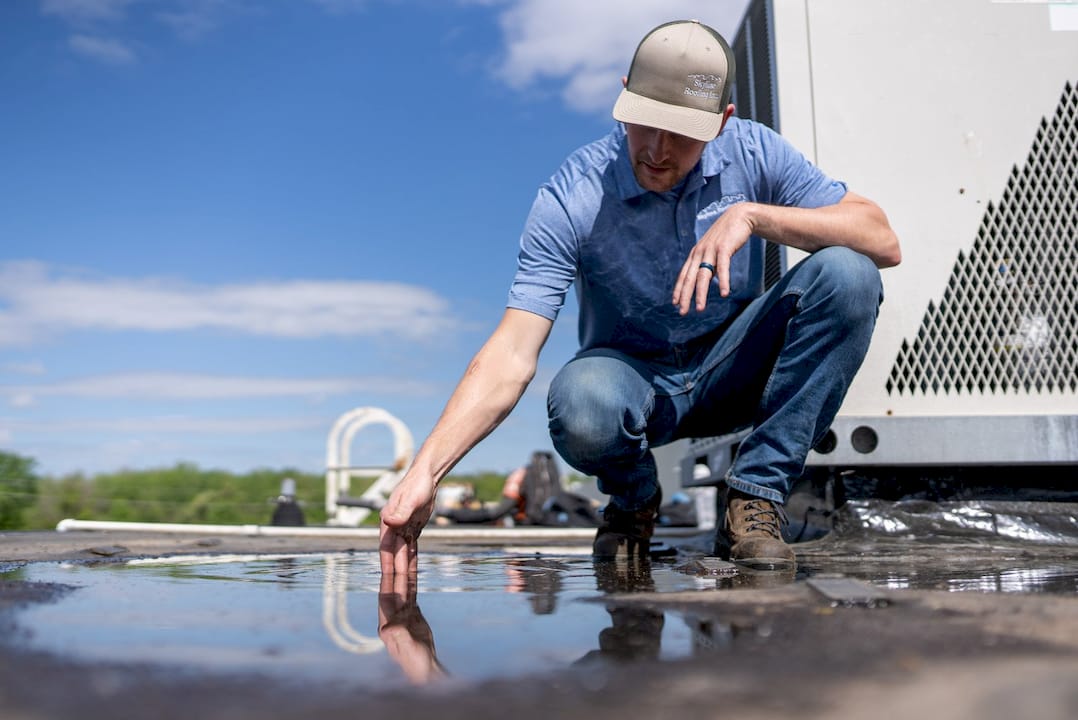
Ponding water on flat roofs deserves specific attention. Any water that remains standing more than 48 hours after rainfall indicates a drainage problem. The weight of standing water stresses the roof deck, and the prolonged moisture contact degrades membrane adhesion at seams and penetrations. Clearing drains and adjusting slope with tapered insulation are the two most common corrective actions.
How Much Does Skipping Maintenance Actually Cost?
The financial case for proactive upkeep is not subtle. Scheduled maintenance can prevent up to 80% of commercial roof replacements. That statistic represents the difference between a managed asset and an emergency capital expenditure.
A $300 biannual inspection can prevent a $25,000 repair event, delivering an 80x return before you factor in business disruption costs.” — Commercial Roof Maintenance Economics, OxMaint
"Residential roof replacements range from $5,750 to $12,500, with most projects landing around $9,000. Commercial premature replacements are common at the 12-year mark when moisture issues go undetected. A roof rated for 25 years that fails at 12 years represents a loss of more than half its expected value.
Insurance outcomes also shift with documented maintenance histories. Insurers treat properties with continuous, verifiable maintenance records as lower-risk assets. Claims are processed faster, and coverage disputes are less common. Properties without documentation face higher scrutiny and a greater likelihood of partial or full claim denial.
The math is straightforward. Two inspections per year at $300 each equals $600 annually. Over a 20-year roof lifespan, that is $12,000 in inspection costs. One avoided emergency repair event at $25,000 more than covers the entire program. The reactive vs. proactive maintenance comparison makes this gap even clearer with real-world data.
How Terial Supports Commercial Roof Maintenance Programs
Disconnected spreadsheets, email chains, and paper inspection reports are where maintenance programs break down. Terial is the unified operating system built specifically for commercial roofing contractors, and it eliminates that fragmentation. With Terial, inspection reports are generated digitally in the field, complete with timestamped photos and location-tagged findings that feed directly into repair work orders. Dispatching crews, tracking labor, and managing follow-up repairs all happen inside one connected system. For facility managers working with roofing contractors, that means audit-ready documentation without chasing records across multiple platforms. Explore what Terial’s workflow automation platform can do for your roofing asset management program.
Key Takeaways
Proactive roof maintenance, backed by condition-based inspection data and audit-ready documentation, is the single most effective strategy for extending roof lifespan and avoiding emergency replacement costs.
FAQ
What Is the Minimum Inspection Frequency for a Roof?
The industry standard is at least two inspections per year, in spring and fall. Additional inspections are required after major storms, hail events, or winds exceeding 60 mph.
How Long Does a Professional Roof Inspection Take?
Professional roof inspections typically take 45–90 minutes and cover 27 key checkpoints including flashing, gutters, shingles, and ventilation points.
What Happens If You Skip Roof Maintenance Documentation?
Missing documentation leads to denied warranty claims and insurance rejections, even when physical maintenance was performed. Insurers require timestamped, linked records to validate coverage.
What Is Condition-Based Roof Management?
Condition-based management prioritizes repairs based on actual inspection findings rather than a fixed replacement schedule. This approach extends roof lifespan and reduces unnecessary capital spending.
Can Thermal Imaging Detect Hidden Roof Damage?
Yes. Thermal imaging identifies moisture saturation under membranes and ventilation failures that are invisible to surface inspection, allowing targeted repairs before structural damage develops.
Recommended
- Reactive vs Proactive Roof Maintenance: What the Data Says
- Commercial Roofing Service Call Checklist for Contractors
- Commercial Roofing Crew Scheduling Workflow Guide
- What Is a Roofing Operating System? A 2026 Guide


More articles



Book a personalized demo
Get a 30-minute demo tailored to how you run your commercial roofing business

“Making the switch to Terial has greatly exceeded my expectations and has already had a meaningful impact on our team’s productivity. Terial has significantly reduced the amount of time required to complete many of our day-to-day operational tasks, allowing our team to focus more on serving our customers.”

