
How Roofing Service Data Drives New Contracts
Discover how roofing service data drives new contracts by identifying high-conversion leads. Transform your contracting business today!

Roofing service data drives new contracts by giving commercial contractors the ability to identify high-conversion leads, act on them before competitors do, and stop wasting budget on prospects that never close. This is what the industry calls data-driven contract acquisition, and the gap between firms that practice it and those that don’t is measurable in dollars. Contractors routing leads into a CRM and following up within 24 hours increase conversion rates by up to 30%. That single operational discipline, powered by data, is the difference between a full pipeline and a leaking one. Roofing tools now make this level of intelligence accessible to any commercial roofing operation willing to use it.
How Roofing Service Data Drives New Contracts At The Source
The most impactful data in commercial roofing does not come from your accounting software. It comes from the front of the pipeline, where leads enter and estimates age. Understanding which data types to capture is the first step toward using them to close more work.
The four data categories that move the needle most are:
- Lead source and quality metrics. Not all leads are equal. Lead exclusivity and intent significantly impact conversion rates and ROI, and phone calls typically convert faster than form submissions. Tracking response rate, appointment rate, and close rate by source tells you exactly where to spend next month’s budget.
- Estimate aging data. Every quote sitting untouched past 72 hours is a contract bleeding out. Monitoring how long estimates stay open, and which sales reps let them age, reveals the exact point where your pipeline decays.
- Property condition and material intelligence. Knowing a building’s roof type, age, and damage score before you write a proposal lets you customize the scope and price with precision. Generic proposals lose to specific ones.
- Operational metrics. Dispatch efficiency, invoicing delays, and change order frequency all affect how fast you can close and start the next job. Slow back-office operations signal unreliability to repeat clients.
Pro Tip: Set a weekly data audit covering these four categories. Even a 30-minute review of lead source performance and estimate aging can surface a five-figure revenue leak before it becomes permanent.
How Do Data-Driven CRM Workflows Enhance Roofing Sales Conversion?
A CRM is only as useful as the workflows enforcing it. Passive data storage fails to prevent the conversion drop-offs that happen between 24 and 48 hours after a lead arrives. The firms winning more commercial contracts treat their CRM as an active enforcement system, not a contact database.
Here is how data-driven CRM workflows translate directly into signed contracts:
- Automated lead scoring. Assign point values to lead attributes: source type, property size, damage indicators, and prior service history. Reps work the highest-scoring leads first, not the most recent ones. This alone reallocates effort toward deals that are most likely to close.
- 24-hour follow-up enforcement. Delays beyond 24 hours correlate with a 30% drop in closing rates. Automated reminders and escalation alerts inside the CRM remove the human error that lets hot leads go cold.
- Rep performance coaching. When your CRM captures response time, proposal turnaround, and close rate per rep, you can identify exactly who needs coaching and on what. This is not a performance review exercise. It is a revenue recovery tool.
- Integration with estimating software. When CRM data connects directly to your quoting platform, the time between site visit and delivered proposal shrinks. Comprehensive CRM systems that automate workflows reduce sales cycle length and increase conversion efficiency. Every day saved in that cycle is a day your competitor cannot undercut you.
Pro Tip: Build a “stale lead” alert that fires at hour 20, not hour 48. By the time most teams react to a 48-hour flag, the prospect has already called someone else.
What Metrics Improve Marketing Spend Efficiency and Lead Quality?
Roofing contractors allocating 12 to 18% of operating budgets to marketing waste up to 43% of that spend on unqualified leads when they operate without data analytics. That is not a rounding error. For a firm spending $200,000 annually on marketing, it represents $86,000 in recoverable waste.
The metrics that separate efficient spend from wasted spend are straightforward:
- Cost-per-lead by source: Shows which channels produce leads at the lowest acquisition cost.
- Close rate by source: Shows which channels produce leads that actually become contracts.
- Cost-per-contract: Shows the true ROI of each marketing channel after close rate is applied.
- Lead-to-appointment rate: Shows where prospects are dropping off in the funnel.
Beyond tracking these numbers, property intelligence data changes the targeting game entirely. Hyper-local targeting based on roofing material type and climate data raises conversion rates by up to 40%. A campaign targeting flat-roof commercial buildings in a hail-prone zip code outperforms a generic “commercial roofing” ad in the same market every time. RoofPredict’s property data makes this level of targeting executable without a dedicated data science team.
How Do Operational Data Platforms Help Recover Lost Revenue?
Real-time operational intelligence shifts contractors from reactive to proactive management. Instead of discovering a lost contract during a monthly review, you catch the aging estimate on day three and act.
The revenue recovery case is concrete. Operational monitoring tools can recover $50,000 to $150,000 monthly from expired or aging estimates by flagging pipeline issues before they become permanent losses. That figure reflects what most commercial roofing firms leave on the table every month without realizing it.
What operational data platforms monitor in practice:
- Aging estimates. Any quote open past a defined threshold triggers an alert and an automated follow-up task. The critical hidden lever is controlling estimate aging through real-time alerts that extend or prioritize follow-up before revenue walks out the door.
- Dispatch bottlenecks. Delays between contract signing and crew deployment damage client relationships and reduce referral rates. Operational data surfaces these delays before they become complaints.
- Invoice backlogs. Slow invoicing after job completion is a cash flow problem and a client satisfaction problem. Automated alerts on invoice aging keep the back office moving at the same pace as the field.
- Competitor and weather intelligence. Platforms integrating external data feeds let contractors time outreach campaigns around storm events or competitor pricing shifts, turning market conditions into contract opportunities.
Operational data acts as a control system that prevents pipeline decay by monitoring aging quotes, dispatch bottlenecks, and invoice delays continuously. Without it, most firms only see the damage after the contract is already lost.
What Steps Can Contractors Take To Implement Data-Driven Contract Growth?
Knowing that data matters is not the same as having a system that captures and uses it. Most commercial roofing firms have data scattered across spreadsheets, email threads, and disconnected software. The cost of manual processes is not just inefficiency. It is contracts that close for competitors instead.
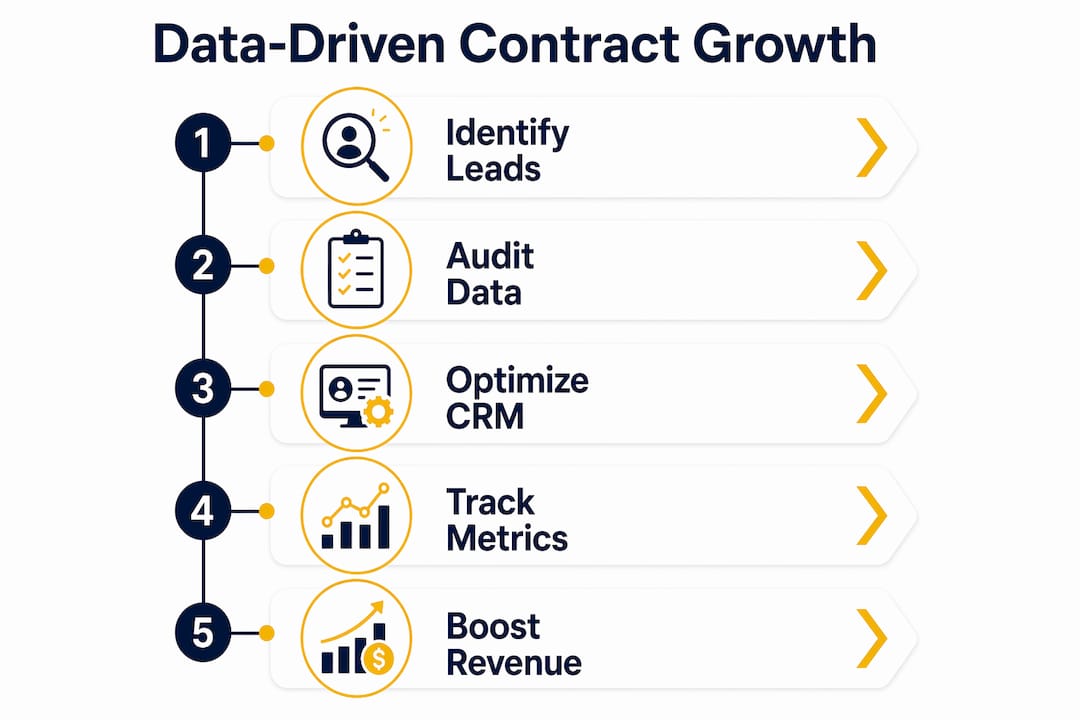
Here is a practical sequence for building a data-driven contract growth operation:
- Audit your current lead sources. Pull 12 months of closed contracts and trace each back to its origin. You will likely find that two or three sources produce 70% of your revenue. That is where data collection starts.
- Define your core performance metrics. Response time, close rate per source, estimate-to-contract cycle length, and cost-per-contract are the four numbers every service manager should review weekly.
- Adopt purpose-built platforms. RoofPredict provides property intelligence and marketing data. Zuper Sense monitors operational pipeline health. A platform like Terial unifies the operational layer so field data, dispatch records, and invoicing all feed into one system rather than three separate ones.
- Set a service level agreement for follow-up timing. Define the maximum hours between lead receipt and first contact, and between site visit and proposal delivery. Enforce both with automated alerts.
- Reallocate resources based on data, not habit. If your data shows that referral leads close at 45% and paid digital leads close at 12%, your next budget conversation writes itself. Using data for smarter marketing budgets can improve net profit by $12,000 to $18,000 per $100,000 spent.
Pro Tip: Start with one metric you can improve in 30 days. Response time is the fastest win. Cutting your average first-contact time from 36 hours to 18 hours will show up in your close rate within a single sales cycle.
Key Takeaways
Roofing service data drives new contracts by turning operational and marketing intelligence into faster follow-ups, smarter budget allocation, and real-time pipeline control that prevents revenue from aging out of the funnel.
- Follow-up timing is a contract lever: Responding within 24 hours can increase close rates by up to 30% compared to delayed outreach.
- Lead source data cuts wasted spend: Tracking cost-per-contract by channel can recover marketing budget lost to unqualified leads.
- Estimate aging kills pipelines silently: Flagging stale quotes can recover revenue that would otherwise fall through the cracks.
- Property intelligence sharpens targeting: Hyper-local campaigns using material and climate data can raise conversion rates.
- Unified systems outperform fragmented ones: Connecting CRM, dispatch, and invoicing data removes the gaps where contracts fall through.
How Terial Helps Commercial Roofers Turn Data Into Signed Contracts
Fragmented tools are the reason most roofing firms cannot act on their own data. When your CRM, dispatch system, and invoicing platform do not talk to each other, the signals that should trigger follow-up get lost between applications. Terial is built to eliminate that fragmentation. As the unified operating system for commercial roofing contractors, Terial connects estimating, field service, dispatch, and invoicing into a single real-time system. Damschroder Roofing used Terial’s connected workflows to close 15% more jobs without adding headcount. If you want to see how the platform’s full feature set maps to your current workflow gaps, the detail is worth reviewing.
FAQ
How does roofing service data directly increase contract wins?
Roofing service data increases contract wins by identifying high-intent leads, enforcing fast follow-up, and flagging aging estimates before they expire. Contractors using data-driven workflows close up to 30% more contracts than those relying on manual processes.
What is the most important metric for roofing contract acquisition?
Response time to new leads is the single most impactful metric. Follow-up delays beyond 24 hours correlate with a 30% drop in close rates, making speed of contact the fastest lever available to any sales team.
How does property intelligence data improve roofing marketing ROI?
Property intelligence data enables hyper-local targeting based on roof type, age, and climate exposure, which raises conversion rates by up to 40% and reduces cost-per-lead by over 60% compared to broad-audience campaigns.
What operational data should commercial roofing managers track weekly?
Service managers should track estimate aging, lead response time, close rate by source, and invoice cycle length weekly. These four metrics surface the most common points of pipeline decay and revenue loss.
Can a small commercial roofing firm benefit from data analytics?
A small firm benefits most from data analytics because every wasted lead and every aging estimate represents a larger percentage of total revenue. Starting with lead source tracking and a 24-hour follow-up rule requires no enterprise software and produces measurable results within one sales cycle.
Recommended





Book a personalized demo
Get a 30-minute demo tailored to how you run your commercial roofing business

“Making the switch to Terial has greatly exceeded my expectations and has already had a meaningful impact on our team’s productivity. Terial has significantly reduced the amount of time required to complete many of our day-to-day operational tasks, allowing our team to focus more on serving our customers.”

