
Preventive Maintenance Workflow for Roofing: 2026 Guide
Discover what is preventive maintenance workflow roofing and learn how structured inspections can extend roof lifespan and save costs. Explore our 2026 guide!
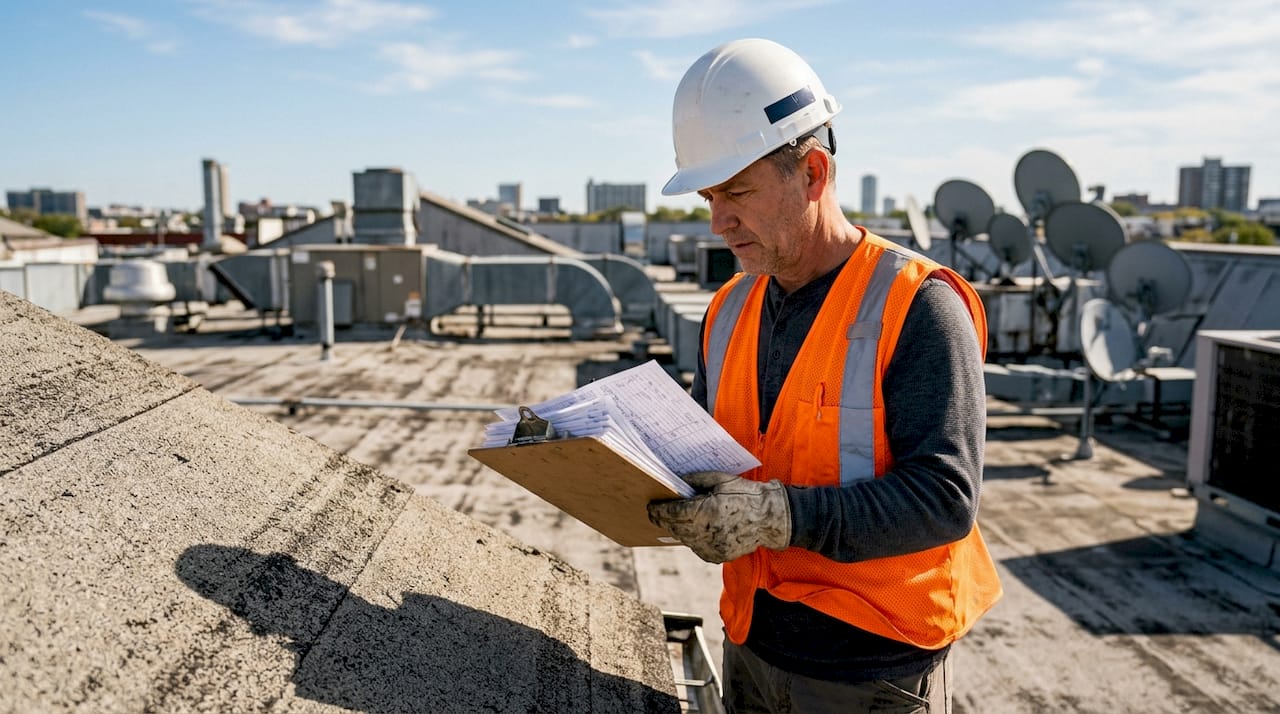
A preventive maintenance workflow in roofing is a structured, scheduled process of inspections, documentation, and prioritized repairs designed to extend roof lifespan and prevent costly failures. The industry term for this practice is planned preventive maintenance (PPM), and it applies directly to commercial roofing asset management. Unlike reactive repairs, a preventive maintenance workflow catches membrane deterioration, drainage blockages, and flashing failures before they become emergencies. Commercial roofing professionals who follow a defined roof maintenance process consistently outperform those who respond only to visible damage. This guide covers every component of an effective workflow, from inspection scheduling to third-party trade coordination, so you can protect your clients’ assets and your own margins.
What Is a Preventive Maintenance Workflow for Roofing?
A preventive maintenance workflow for roofing is a repeatable, documented system that schedules inspections, captures defect data, and drives repair decisions before damage escalates. The workflow replaces ad hoc service calls with a managed process tied to calendar triggers, condition thresholds, and budget cycles.
The financial case is direct. Emergency repairs cost 3 to 9 times more than planned maintenance interventions. That gap exists because reactive work requires mobilization under pressure, often involves temporary fixes, and frequently uncovers secondary damage that a scheduled inspection would have caught months earlier.
Proactively maintained roofs last about 21 years on average versus 13 years for roofs managed reactively. That is a 60% increase in service life from a process change alone. For a commercial roofing contractor, that difference represents either a long-term client relationship or a premature replacement job that erodes trust.
The workflow also protects warranties. Failure to document maintenance can void warranties that cover 5–8% of total building value. Warranty voidance turns a manageable repair into a six-figure liability, and it is entirely preventable with consistent record-keeping.
What Are the Key Components of an Effective Preventive Maintenance Workflow?
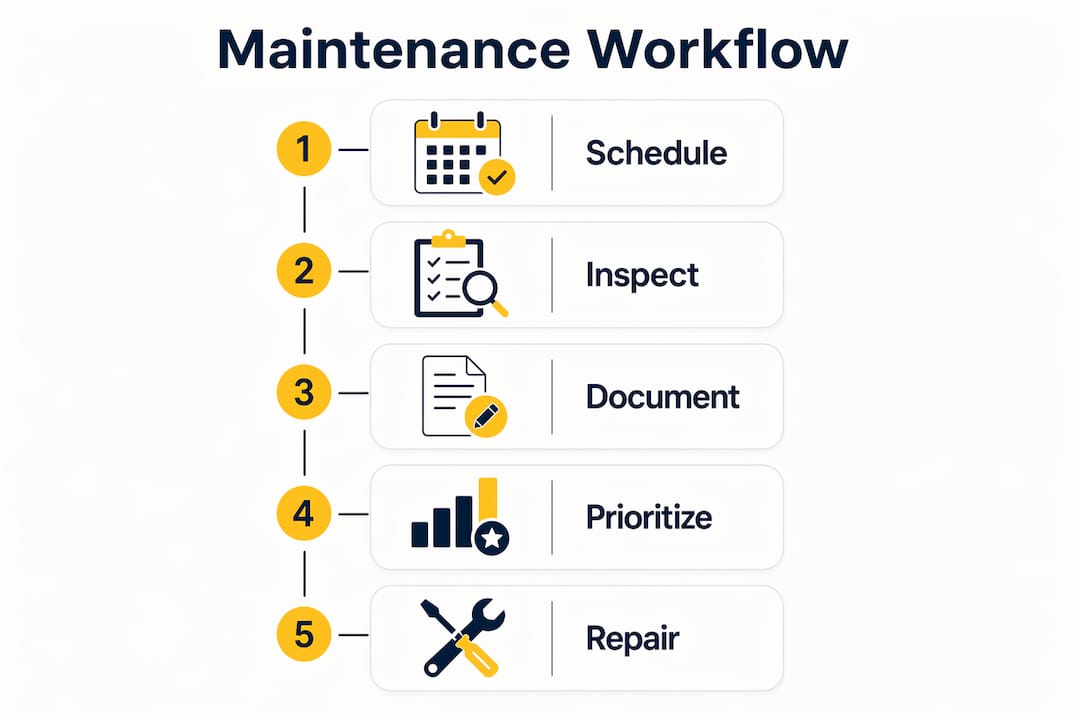
An effective workflow for roofing inspections runs on three pillars: scheduled visits, standardized inspection tasks, and a clear repair prioritization system.
Scheduling inspections
At least two scheduled inspections per year are the industry baseline, timed for spring and fall. Spring inspections assess winter damage: freeze-thaw membrane stress, ice dam residue, and clogged drains. Fall inspections prepare the roof for cold-weather stress by clearing debris and confirming seam integrity before freeze cycles begin. Post-storm checks are not optional. A single hail event or wind-driven rain can compromise membrane adhesion in ways that only become visible weeks later.
Core inspection tasks
Every site visit must cover the same checklist to produce comparable data across visits. Standard tasks include:
- Drainage clearance: Inspect and clear all drains, gutters, and scuppers. Drain checks come first because water backup accelerates every other failure mode.
- Membrane inspection: Look for blistering, punctures, surface erosion, and UV degradation.
- Flashing review: Check all penetrations, curbs, and perimeter flashings for separation or cracking.
- Seam integrity: Test lap seams and field seams for adhesion failure, especially at corners and penetrations.
- Recurring hotspot review: Investigate any area with a repair history for underlying structural causes, not just surface symptoms.
Pro Tip: Map recurring repair locations on a roof diagram and overlay them across multiple inspection cycles. Patterns reveal structural drainage problems or installation defects that single-visit inspections miss.
Repair prioritization
Prioritizing repairs by urgency into three categories gives facility managers and building owners a budget-ready action plan. Use these labels consistently:
- Immediate: Active leaks, open seams, or conditions creating interior damage risk. Address within 48 hours.
- Short-term: Defects likely to worsen within 90 days without intervention. Schedule within the current budget cycle.
- Scheduled: Cosmetic or slow-progressing issues that can be addressed at the next planned visit.
Facility managers report that priority rankings are more useful than raw defect lists. A list of 20 defects creates paralysis. A ranked list with three categories creates a capital plan.
How Does Documentation and Reporting Integrate into Roofing Preventive Maintenance Workflows?
Documentation is not a paperwork exercise. It is the mechanism that converts individual site visits into a managed asset record. Without it, each inspection is an isolated event with no cumulative value.
A complete roof file must contain the following, maintained in chronological order:
- Original warranty documents with coverage terms and maintenance obligations clearly noted.
- Installation drawings showing membrane type, drain locations, and penetration details.
- Inspection reports from every visit, including date, inspector name, weather conditions, and findings.
- Date-stamped photographs tied to specific roof coordinates or a grid reference system.
- Repair invoices with scope, materials used, and contractor details.
- Third-party access logs recording every non-roofing trade that accessed the roof, with dates and reported conditions.
Pro Tip: Store the roof file in a cloud-accessible system that field crews can update in real time. A comprehensive roof log with date-stamped photos and repair invoices is the single most effective tool for winning warranty claims and insurance negotiations.
Date-stamped photos serve two functions. First, they document the condition at the time of inspection, which protects the contractor if a client disputes the scope of prior work. Second, sequential photos of the same location across multiple visits show deterioration rates, which supports capital reserve forecasting.
Standard inspections for a 20,000 sq ft building require 16–32 labor hours annually. That time investment is recoverable through avoided emergency mobilizations and warranty disputes. Contractors who track this data can also price maintenance contracts accurately, rather than underpricing and absorbing losses.
Documentation also feeds capital planning. When a building owner can see a five-year repair history with cost trends, they can budget for roof replacement with confidence rather than reacting to a sudden failure. That conversation positions you as a trusted advisor, not just a repair vendor.
What Are the Benefits and Cost Savings of Implementing a Preventive Maintenance Workflow?
The business case for preventive roofing strategies is quantified, not theoretical. The numbers favor proactive care at every comparison point.
Treating a roof as a managed asset rather than a maintenance cost is the single most effective decision a building owner can make. Planned preventive care costs roughly 50% less over the roof lifecycle than reactive repairs, and the gap widens every year a reactive approach continues.” — Industry analysis, GAF Commercial Roofing.
The data on reactive vs proactive roof maintenance shows a consistent pattern: reactive maintenance costs run 80% to 900% higher than planned interventions. That range reflects the unpredictability of emergency work. A planned seam repair costs a fraction of the water intrusion remediation, drywall replacement, and business interruption that follows an undetected failure.
Preventive maintenance also reduces business disruption for your clients. Emergency repairs require immediate access, often during business hours, with no scheduling lead time. Planned maintenance visits are coordinated in advance, minimizing tenant or operational impact. That reliability is a competitive differentiator when renewing maintenance contracts.
The benefits of preventive roofing maintenance extend to insurance outcomes as well. Insurers treat documented maintenance records as evidence of due diligence. A building with a complete roof file negotiates from a stronger position after a weather event than one with no maintenance history.
How Can Commercial Roofing Professionals Improve Preventive Maintenance Workflows?
Workflow quality breaks down in two predictable places: third-party trade coordination and manual process gaps. Both are fixable with the right protocols and tools.
Managing third-party trade access
HVAC, solar, and telecom workers cause membrane punctures and damage without notice. The damage typically surfaces as a leak weeks or months later, by which point the responsible party is long gone. The fix is a mandatory access protocol: every non-roofing trade must log their roof visit and submit a post-service condition report. Mandated post-service reports from trades close the most common maintenance failure gap in commercial roofing. For guidance on structuring these protocols, the DFW roofing subcontractor role framework offers a practical model for what project managers and contractors should require from third-party trades.
Managing subcontractor coordination effectively requires more than a verbal agreement. You need a documented protocol that specifies who logs access, what the report must include, and who reviews it before the next scheduled inspection.
Technology and automation in the workflow
Mobile field applications change how inspections get done. Instead of paper checklists transcribed back at the office, crews capture photos, tag defects to roof coordinates, and submit reports from the field in real time. That eliminates transcription errors and cuts reporting lag from days to minutes.
Key workflow improvements technology enables:
- Automated inspection scheduling tied to calendar triggers, so spring and fall visits never get missed during busy project seasons.
- Digital repair tracking that links each defect to its inspection report, repair invoice, and follow-up status.
- Crew dispatching that assigns the right technician to each maintenance visit based on location, certification, and availability.
- Automated client reporting that generates branded, date-stamped summaries after each visit without manual formatting.
The crew scheduling workflow guide for commercial roofing covers how to structure dispatch and coordination so maintenance visits run on time and on budget. Automated workflows also create a feedback loop: when repair data flows back into scheduling, you can predict which roofs need attention before the next calendar trigger fires.
The 2026 inspection standards for commercial roofing reinforce that documentation and process consistency are no longer optional. Contractors who rely on disconnected tools, paper logs, and manual follow-up carry the operational risk of those gaps directly into their client relationships.
Terial Connects Your Entire Maintenance Workflow
Fragmented tools are the real cost in commercial roofing maintenance. When scheduling lives in one place, inspection reports in another, and repair tracking in a spreadsheet, things fall through. Terial is the unified operating system built specifically for commercial roofing contractors. It connects field service inspections, crew dispatching, repair documentation, and client reporting into one real-time system. Field crews capture photos and defect notes on mobile. Office teams see updates instantly. Clients receive branded reports without anyone manually compiling them. If you want to see how Terial eliminates the gaps in your preventive maintenance workflow, visit terial.com to learn more.
Key Takeaways
A preventive maintenance workflow for commercial roofing is the most cost-effective way to extend roof lifespan, protect warranties, and eliminate emergency repair costs.
FAQ
What Is a Preventive Maintenance Workflow in Roofing?
A preventive maintenance workflow in roofing is a scheduled, documented process of inspections, defect tracking, and prioritized repairs designed to extend roof lifespan and prevent emergency failures. It replaces reactive service calls with a managed, repeatable system.
How Often Should Commercial Roofs Be Inspected?
Commercial roofs require at least two scheduled inspections per year, timed for spring and fall, plus post-storm checks after significant weather events. This frequency is the industry baseline for warranty compliance and effective asset management.
How Much Does Preventive Maintenance Save Compared to Reactive Repairs?
Reactive maintenance costs run 80% to 900% higher than planned preventive interventions, and proactively maintained roofs last an average of 21 years versus 13 years for reactively managed roofs. The savings compound over the full roof lifecycle.
Why Does Documentation Matter in a Roofing Maintenance Workflow?
Documentation protects warranties, supports insurance claims, and enables accurate capital budgeting. Without a complete roof file, building owners risk voiding warranties that cover 5–8% of total building value.
How Do Third-Party Trades Affect Roof Maintenance Workflows?
HVAC, solar, and telecom workers frequently cause membrane damage that goes unreported until a leak develops. Requiring mandatory access logs and post-service condition reports from all non-roofing trades closes this common maintenance gap.
Recommended



Book a personalized demo
Get a 30-minute demo tailored to how you run your commercial roofing business

“Making the switch to Terial has greatly exceeded my expectations and has already had a meaningful impact on our team’s productivity. Terial has significantly reduced the amount of time required to complete many of our day-to-day operational tasks, allowing our team to focus more on serving our customers.”

