
How Fragmented Software Affects Roofing Margins
Discover how fragmented software affects roofing margins. Learn to prevent profit loss and improve efficiency in your roofing operations.

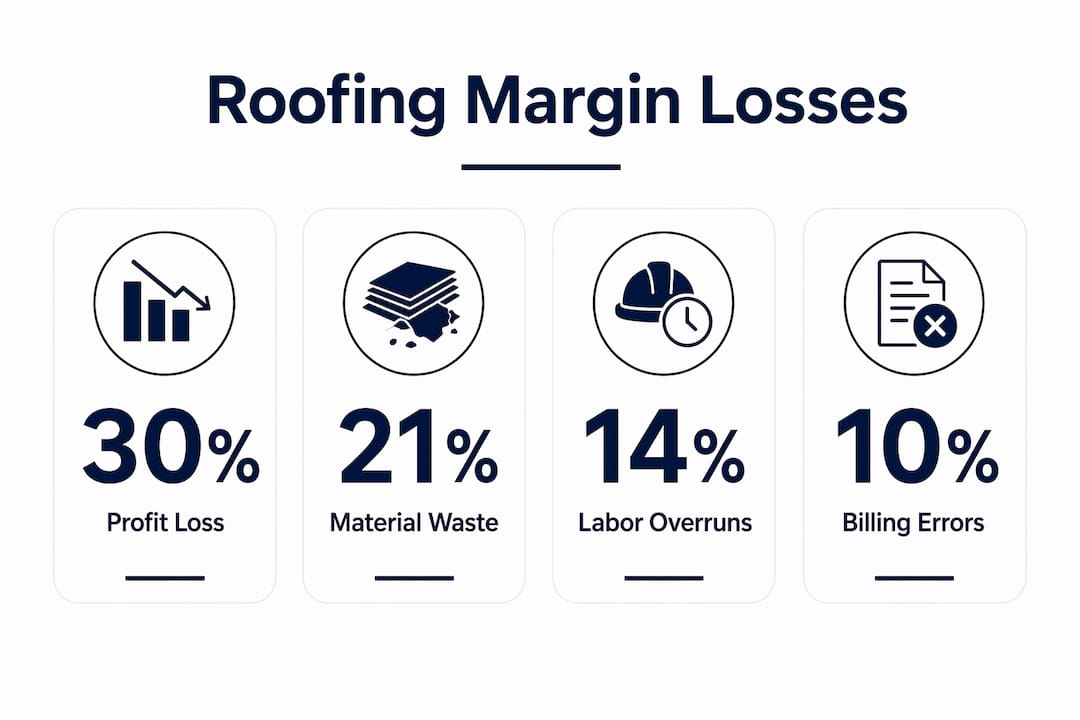
Fragmented software is defined as the use of multiple disconnected tools to manage a single business operation, and it is the leading cause of preventable profit loss in commercial roofing. Contractors running separate apps for estimating, scheduling, labor tracking, and billing face 10%–30% profit leakage on every project. For a $2M roofing operation, that translates to $127,000–$330,000 in annual losses. The industry term for this problem is “operational fragmentation,” and understanding how fragmented software affects roofing margins is the first step toward fixing it.
The damage shows up in three places: labor overruns, material waste, and billing errors. Each one is preventable. None of them are visible until it is too late, unless your systems talk to each other in real time.
How Fragmented Software Affects Roofing Margins Through Labor Inefficiencies
Labor is the largest variable cost on any commercial roofing project, and disconnected software makes it nearly impossible to control. Labor overruns of 12%–18% are the direct result of poor integration between scheduling tools, time-tracking apps, and project management platforms. When a foreman logs hours in one system and the office reconciles them in another, errors compound daily.
The math is brutal. Labor costs run approximately $28.50 per hour plus $17.25 per hour in benefits. On a $45,000 reroof, a labor overrun creates a $10,800 margin gap. That single project can wipe out the profit from two or three others. In a 120-project operation, human error and fragmentation have been documented causing $196,620 in annual losses, roughly 11% of gross revenue.
Manual reconciliation is the hidden engine behind these losses. When office staff spend hours each week cross-referencing spreadsheets, time cards, and scheduling boards, they introduce errors that no one catches until the invoice goes out. By then, the margin is already gone.
The practical fix is real-time labor tracking connected directly to job costing. When field crews log hours through a mobile app that feeds directly into project financials, overruns surface within hours, not weeks. Contractors using real-time labor tracking report catching budget variances early enough to adjust crew deployment before a project turns unprofitable.
- Disconnected time-tracking apps create duplicate entries and missed hours.
- Manual reconciliation delays cost visibility by days or weeks.
- Scheduling conflicts caused by siloed tools drive unplanned overtime.
- Labor disputes become harder to resolve without a single timestamped record.
Pro Tip: Set a daily labor budget alert tied to your job costing system. If a crew hits 80% of the labor budget before 80% of the work is complete, you need to know that day, not at invoice time.
Material Waste and Billing Errors Driven by Disconnected Systems
Material waste is the second major drain on roofing margins, and it is directly tied to software fragmentation. Contractors using disconnected estimating and ordering tools see material waste rates between 8% and 21%. That range is not random. The higher end belongs to operations where purchase orders, delivery confirmations, and job site usage logs live in separate systems with no automatic reconciliation.
The waste problem compounds at the billing stage. When estimating data does not flow directly into invoicing, change orders get missed, materials get under-billed, and clients receive invoices that do not match site reality. Billing fragmentation causes payment delays, disputes, and write-offs that erode cash flow for weeks after project completion.
Billing and change order management are critical profit protection points where fragmentation causes time-consuming disputes, delaying cash flow and increasing the risk of write-offs.
Incomplete documentation creates a second problem: blocked insurance claims. When site photos, material delivery records, and inspection reports live in different apps, assembling a complete claim file takes days. Insurers reject incomplete submissions. That rejection costs the contractor both time and money, and the root cause is always the same: no single source of truth.
- Missed change orders are the most common source of unbilled revenue in commercial roofing.
- Duplicate material orders occur when purchasing and field teams use separate systems.
- Incomplete photo documentation delays or blocks insurance reimbursements.
- Late invoices caused by manual billing processes push cash collection out by 30–60 days.
Centralizing material tracking and billing into one connected system eliminates most of these losses. When a change order is approved in the field, it should automatically update the estimate, the purchase order, and the invoice. That is not a luxury feature. It is the baseline for protecting margin on every job. Contractors dealing with common roof issues know that documentation gaps during a project create expensive disputes long after the crew has left the site.
What Are Delivery Silos and How Do They Erode Project Margins?
Delivery silos are the operational result of using disconnected project management, scheduling, and financial reporting tools. Each tool holds a piece of the project picture, but no one sees the whole thing in real time. Fragmented tools create delivery silos that delay margin visibility and prevent timely corrective action.
The core problem is data latency. By the time a project manager pulls reports from three different systems and consolidates them into a spreadsheet, the data is already 48–72 hours old. Fragmented systems create a lag between actual operations and financial reporting. Decisions get made on stale numbers, and cost overruns escalate before anyone realizes the project is in trouble.
Late detection of margin variance is expensive. A project that is running 15% over labor budget in week two is recoverable. The same project discovered at week six is a write-off. Delayed detection of margin variance prevents timely interventions and turns profitable projects into losing ones.
- Identify your data lag. Measure how long it takes from a field event (labor logged, material delivered) to that data appearing in your financial reports. Anything over 24 hours is a margin risk.
- Map your tool stack. List every app your team uses for a single project from estimate to invoice. Each handoff between tools is a point where data can be lost or delayed.
- Prioritize integration at the financial reporting layer. Real-time cost data at the project level is the single highest-value integration for margin protection.
- Assign accountability by exception. When a unified system flags a variance automatically, managers act on alerts rather than hunting for problems in spreadsheets.
Unified execution platforms with real-time margin intelligence eliminate the lag entirely. When every field event feeds directly into a live financial dashboard, project managers catch problems in hours, not weeks. That speed is the difference between a correctable variance and a margin-destroying write-off.
How Integrated Job Costing Recovers Roofing Profit Margins
Integrated job costing is the practice of connecting labor tracking, material costs, change orders, and billing into a single system that updates in real time. Contractors using unified job-costing systems achieve profit margins of 18%–22%, compared to 9%–14% for peers using fragmented estimating and accounting methods. That gap represents the direct financial cost of software fragmentation.
The recovery mechanism works at three layers. First, accurate labor tracking eliminates the overruns that siloed time-tracking creates. Second, connected material management cuts waste from 21% down to 8%. Third, automated billing tied to field-confirmed change orders captures revenue that fragmented systems routinely miss. One documented case showed a Texas contractor saving $316,865 annually from AI-powered integration against a total implementation cost of $16,100. The ROI arrived within 60–90 days.
Fragmented software also blocks access to advanced analytics. Disconnected data prevents roofing companies from using AI for margin optimization and limits their growth potential. A contractor who cannot see real-time cost data across all active projects cannot make accurate bids, cannot allocate crews efficiently, and cannot identify which job types actually generate profit.
The scalability argument is equally important. A company running 20 projects on disconnected tools faces the same reconciliation burden as one running 5. Adding projects does not add proportional revenue when the administrative overhead scales with the chaos. Unified platforms allow manual processes to be replaced with automated workflows, so adding projects adds revenue without adding office headcount.
Pro Tip: Before evaluating any software platform, calculate your current cost of manual reconciliation. Count the hours your office staff spend moving data between systems each week, multiply by their hourly rate, and annualize it. That number is your minimum ROI threshold for any integration investment.
The implementation path does not require a full technology overhaul on day one. Start by connecting your labor tracking to your job costing. That single integration surfaces the most expensive inefficiencies first. Add material tracking and automated billing in subsequent phases. Each layer compounds the margin recovery.
Terial Gives Commercial Roofers a Single System to Protect Margins
Fragmented software costs commercial roofing contractors real money on every project. Terial is built specifically to eliminate that cost by connecting estimating, labor tracking, change orders, scheduling, and invoicing into one real-time system. When field crews log hours through Terial’s field service application, that data flows directly into job costing and billing without manual entry. Change orders get captured and billed automatically. Margin variance surfaces in hours, not weeks. Terial’s automated invoicing cuts billing delays and reduces the disputes that fragment cash flow. Contractors who want to close the gap between their current margins and what integrated operations can deliver should see how Terial works.
Key Takeaways
Fragmented software directly erodes commercial roofing margins by creating labor overruns, material waste, billing gaps, and delayed financial visibility that unified job-costing systems can recover.
FAQ
How Much Profit Do Roofing Contractors Lose to Fragmented Software?
Fragmented software environments cause roofing contractors to lose 10%–30% of potential profit. For a $2M operation, that equals $127,000–$330,000 in annual leakage.
What Is the Difference in Margins Between Fragmented and Unified Systems?
Contractors using unified job-costing systems achieve 18%–22% profit margins. Those using fragmented tools average 9%–14%, a gap driven by labor overruns, material waste, and billing errors.
How Do Delivery Silos Affect Roofing Project Profitability?
Delivery silos delay margin visibility by creating data lag between field operations and financial reporting. By the time the variance is visible, corrective action is often too late to prevent a write-off.
Can Integrated Software Reduce Material Waste in Roofing?
AI-powered integrated platforms have documented cutting material waste from 21% to 8%. The reduction comes from connecting purchase orders, delivery records, and field usage logs into a single reconciled system.
How Quickly Do Roofing Contractors See ROI From Integration?
Documented cases show ROI from AI-powered integration arriving within 60–90 days. One Texas contractor saved $316,865 annually against a $16,100 implementation cost.
Recommended
- Why Disparate Tools Undermine Roofing Roll-Up Efficiency
- Why Residential-First Roofing Software Fails on Commercial Jobs
- The Integration Stack a $5M+ Commercial Roofer Should Build First
- Why Roofing Operating Partners Prioritize Field Software Adoption





Book a personalized demo
Get a 30-minute demo tailored to how you run your commercial roofing business

“Making the switch to Terial has greatly exceeded my expectations and has already had a meaningful impact on our team’s productivity. Terial has significantly reduced the amount of time required to complete many of our day-to-day operational tasks, allowing our team to focus more on serving our customers.”

