
Why Roofing Roll-Ups Lose Synergies Without Shared Systems
Discover why roofing roll-ups lose synergies without shared systems. Learn how fragmented workflows lead to financial losses and find solutions.

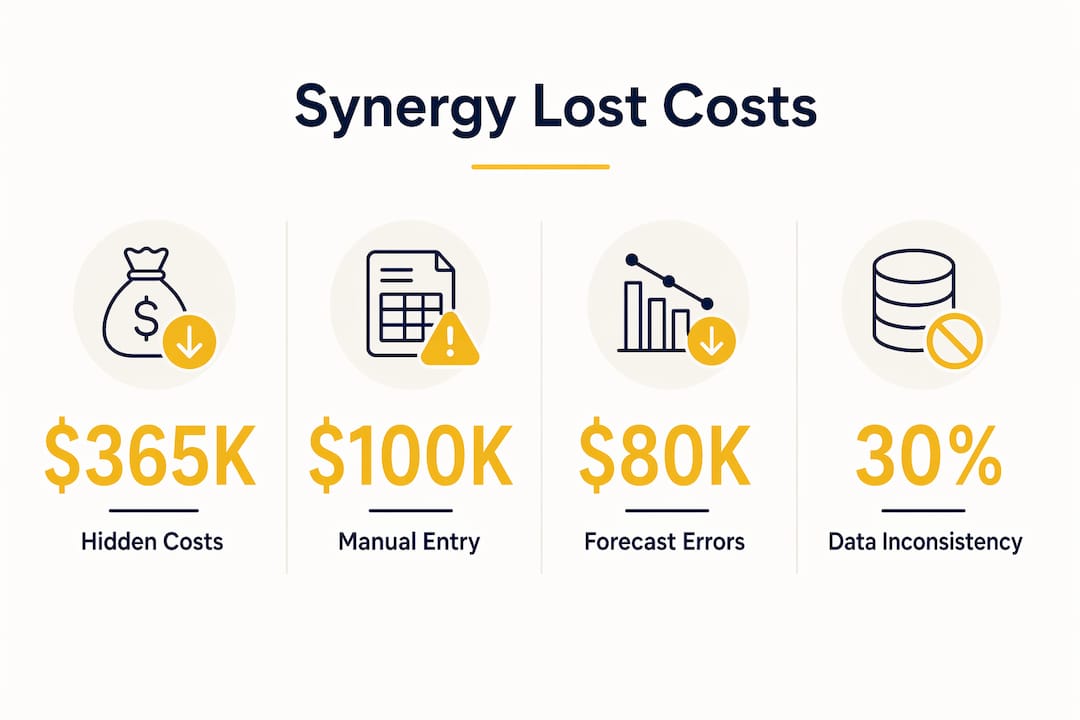
Roofing roll-ups lose their operational and financial synergies without shared systems because fragmented workflows, disconnected data, and siloed governance prevent acquired entities from functioning as a unified business. The industry term for this failure is integration breakdown, and it is the leading cause of value erosion in multi-entity commercial roofing platforms. Fragmented systems in mid-sized construction firms cause an annual revenue drain of roughly 3%, exceeding $365,000 in hidden costs for a 30-person firm. That number compounds across every entity you acquire without a shared operating foundation. Understanding why roofing roll-ups lose synergies without shared systems is the first step toward stopping the bleed.
Why Roofing Roll-Ups Lose Synergies Without Shared Systems
The promise of a roofing roll-up is simple: buy multiple contractors, combine their overhead, and capture margin through scale. The reality is that synergy requires shared infrastructure. Without it, you have not built one company. You have built a holding structure around several independent businesses that still operate like strangers.
Synergy in commercial roofing acquisitions means shared estimating standards, unified job costing, consolidated financial reporting, and coordinated crew dispatch. None of those outcomes are possible when each entity runs its own disconnected tools. The importance of shared systems is not a technology argument. It is a business architecture argument.
Successful roll-ups treat governance design and system integration as enablers of acquisition, not as post-close cleanup tasks. When integration is deferred, the cost of fragmentation accumulates daily across every entity in the portfolio.
What Operational Inefficiencies Arise From Lacking Shared Systems?
Disconnected systems create four specific cost categories that compound across a multi-entity roofing platform.
- Manual data entry: Field crews and office staff re-enter the same job data into multiple systems. This duplication costs time and introduces errors that distort job cost reports.
- Forecasting errors: Without a unified data layer, project managers forecast from incomplete information. Bid errors and scope gaps follow directly.
- Dispute rework: Inconsistent documentation across entities means change order disputes take longer to resolve and cost more to defend.
- Growth drag: Executives spend time reconciling data instead of managing performance, which slows the pace of integration and new acquisitions.
The hidden cost breakdown for a single 30-person firm includes $100,000 in manual entry costs, $80,000 in forecasting errors, $110,000 in dispute rework, and $45,000 in growth drag. Multiply those figures across a five-entity roll-up and the annual loss exceeds seven figures.
Inconsistent field data also degrades job costing at the source. When crews log labor hours in one system and materials in another, the controller cannot produce an accurate cost-to-complete without manual reconciliation. That reconciliation delay means margin problems surface weeks after they could have been corrected.
Pro Tip: Audit each acquired entity’s data entry touchpoints before integration. Map every place where the same data is entered twice. That map is your integration priority list.
The scalability limits of manual processes become visible fast in a roll-up. What works for a single-entity contractor breaks under the weight of multi-entity reporting demands.
How Do Financial Reporting and Governance Fail Without Consolidated Systems?
Financial reporting failure in a roofing roll-up follows a predictable sequence. Each entity closes its books independently. The corporate team then manually consolidates those reports. Intercompany transactions are reconciled by hand. Lender covenants are reported late. Investors lose confidence in the numbers.
ERP consolidation failures caused by disparate charts of accounts and billing systems prevent timely consolidated reporting and lower EBITDA valuation multiples by 1–1.5 points. That multiple compression is not abstract. On a $10 million EBITDA platform, 1.5 points of multiple erosion equals $15 million of lost exit value.
The governance failures that drive this outcome follow a clear pattern:
- No unified chart of accounts: Each entity uses different account codes, making consolidation a manual translation exercise every month.
- No intercompany agreement: Shared services like accounting, HR, and estimating are provided without formal pricing, creating cross-subsidies and IRS exposure.
- No consolidated reporting cadence: Entities report on different timelines, making real-time performance visibility impossible.
- No defined authority matrix: Decisions about hiring, purchasing, and pricing are made at the entity level without corporate alignment.
Shared services agreements must set arm’s-length pricing with rational cost allocation drivers to avoid cross-subsidies and IRS scrutiny. This is not optional for a platform with institutional backing. It is a compliance requirement that also protects EBITDA integrity.
Pro Tip: Build your chart of accounts before the second acquisition closes. Retrofitting account structures across three or four entities is exponentially harder than designing one standard from the start.
A platform that acquires businesses faster than it builds governance infrastructure eventually breaks due to predictable governance gaps. The fix is sequencing: governance design must precede acquisition pace, not follow it.
Why Does Implementing Software Alone Fail to Restore Synergy?
Software installation is not business integration. This distinction is the most expensive mistake roofing roll-up executives make after closing an acquisition.
Construction technology projects often fail because leadership focuses on technical integration rather than business integration, which includes workflow redesign and governance. A new platform connected to old workflows produces the same bad data faster. The system works. The business does not.
Construction firms that excel focus on operational transformation, governance overhaul, and workflow redesign alongside software deployment. The technology is the vehicle. The business design is the destination.
The failure modes are consistent across roll-ups that skip business integration:
- Unclear authority: Field supervisors do not know which system is the source of truth for labor hours, so they default to spreadsheets.
- No training cadence: Software is deployed but not adopted. Crew members use workarounds that bypass the system entirely.
- Workflow misalignment: The software is configured for a generic contractor, not for the specific way each acquired entity prices and executes work.
Crew adoption is the real integration test. If field crews are not using the system consistently, the data flowing into your consolidated reports is incomplete. Incomplete data produces unreliable margins. Unreliable margins produce bad decisions.
Business integration requires role-specific enablement, clear escalation paths, and a governance layer that defines who owns each workflow. Software is the tool. Governance is the operating system.
What Practical Steps Can Roofing Roll-Ups Take to Create Shared Systems?
Building shared systems across a multi-entity roofing platform requires sequenced execution, not a single technology deployment.
- Make field and AP systems entity-aware from day one. Multi-entity job costing failures are primarily data origination issues. Upstream systems must validate entity codes at the point of capture, not during month-end reconciliation.
- Standardize your chart of accounts before the next acquisition. Define margin categories, overhead allocation formulas, and revenue recognition rules once. Apply them to every entity at close.
- Execute ERP consolidation with measured timing. Delayed ERP migrations allow for operational stabilization but extend parallel-system costs and delay synergy capture. Early migration realizes faster consolidation benefits but may disrupt new teams. The right timing depends on entity complexity and team readiness.
- Draft formal shared services agreements. Define what corporate provides to each entity, at what cost, and on what terms. This protects EBITDA, satisfies lenders, and prevents internal disputes about overhead allocation.
- Build an integration playbook. Document every step from letter of intent to full system integration. Repeat it with each acquisition. The playbook reduces integration time and protects against key-person dependency.
Inconsistent overhead allocation formulas across legacy systems can silently bleed profitability. One documented case showed a $680,000 annual profit leak across 13 branches caused entirely by non-normalized costing. Normalization of cost, margin, and client records across legacy systems provides accurate performance benchmarking and reveals true operational gaps.
Pro Tip: Assign one integration owner per acquired entity. That person is accountable for data quality, system adoption, and reporting accuracy during the first 90 days post-close.
True multi-entity job costing requires a single entity-aware data feed into the ERP, eliminating retrofit cleanups by controllers. The integration priority list for a $5 million-plus commercial roofer starts with field data capture, not back-office software.
How Do Shared Systems Improve Roofing Roll-Up Valuation?
Shared systems do not just reduce costs. They directly improve the financial profile that buyers and lenders evaluate at exit.
- EBITDA multiple expansion: Clean, consolidated financials with consistent margin definitions command higher multiples. Buyers pay for predictability, not potential.
- Proactive margin management: Real-time cost visibility across all entities lets executives identify underperforming jobs before they close, not after the invoice is sent.
- Reduced overhead drag: Centralized estimating, accounting, and HR functions eliminate duplicated roles across entities. That reduction flows directly to EBITDA.
- Talent retention: Unified processes and clear career paths reduce turnover in acquired entities. High turnover post-acquisition is one of the most common synergy killers that executives underestimate.
The roofing company valuation equation in 2026 rewards platforms that can demonstrate operational consistency across entities. A roll-up with five entities running on shared systems looks fundamentally different to a buyer than five contractors loosely grouped under one holding company.
Operational transparency is the competitive advantage that shared systems create. When you can show a lender or acquirer a single dashboard with real-time margin data across every entity, you have built something defensible. That defensibility is what drives premium valuations.
Key Takeaways
Roofing roll-ups lose synergies without shared systems because fragmented data, disconnected workflows, and absent governance prevent acquired entities from operating as a single, financially coherent business.
How Terial Supports Synergy Retention in Commercial Roofing Roll-Ups
Terial is built specifically for the operational reality of commercial roofing platforms managing multiple entities. The platform unifies estimating, field data capture, project scheduling, and invoicing into a single real-time system, eliminating the data islands that cause synergy loss. Field crews adopt Terial because it is mobile-first and built for how roofing work actually happens on site. That adoption rate is what makes the consolidated data reliable. Executives running multi-entity roll-ups use Terial to monitor job costs and margins across all entities without manual reconciliation. If you are building a roofing platform and want to see what unified workflow automation looks like in practice, Terial is worth a close look.
FAQ
Why Do Roofing Roll-Ups Fail to Capture Synergies?
Roofing roll-ups fail to capture synergies when acquired entities continue operating on disconnected systems with no shared workflows, governance, or financial reporting. Fragmented data prevents the consolidated visibility that synergy requires.
What is the Financial Cost of Fragmented Systems in a Roofing Roll-Up?
Fragmented systems cost a single 30-person construction firm more than $365,000 annually in hidden costs, including manual entry, forecasting errors, and dispute rework. That figure multiplies directly with each entity added to the platform.
How Does ERP Consolidation Affect Roofing Roll-Up Valuation?
ERP consolidation failures caused by disparate charts of accounts lower EBITDA valuation multiples by 1–1.5 points, which translates to millions of dollars in lost exit value on a mid-sized platform.
Why Does New Software Fail to Fix Synergy Problems in Roll-Ups?
New software fails when it is deployed without accompanying workflow redesign and governance changes. Technical integration without business integration produces the same bad data faster.
What is the First Step to Building Shared Systems in a Roofing Roll-Up?
The first step is making field and AP systems entity-aware at the point of data capture. Retroactive data cleanup after month-end is far more costly than validating entity codes when the data is first entered.
Recommended




Book a personalized demo
Get a 30-minute demo tailored to how you run your commercial roofing business

“Making the switch to Terial has greatly exceeded my expectations and has already had a meaningful impact on our team’s productivity. Terial has significantly reduced the amount of time required to complete many of our day-to-day operational tasks, allowing our team to focus more on serving our customers.”

