
Roofing Company Valuation: 2026 Guide for Contractors
Discover essential insights on roofing company valuation in 2026. Learn metrics that maximize your business's worth and attract buyers today.

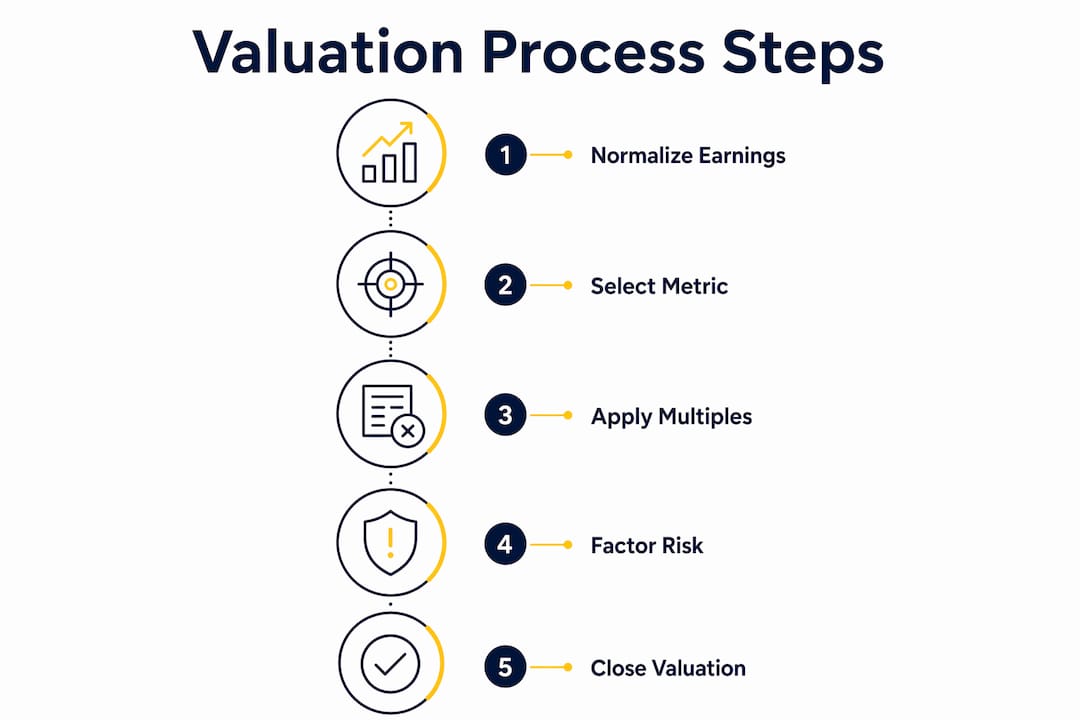
Roofing company valuation is defined as the process of applying risk-adjusted multiples to normalized earnings metrics like seller’s discretionary earnings (SDE) or adjusted EBITDA to determine what a roofing business is worth to a buyer. Buyers do not pay for gross revenue. They pay for sustainable, transferable cash flow. A $10 million revenue roofing company with thin margins, heavy owner dependency, and storm-driven revenue will fetch a fraction of what a $5 million company with commercial maintenance contracts and a strong management team commands. Understanding this distinction is the foundation of any serious roofing business appraisal.
What Are The Key Financial Metrics in Roofing Company Valuation?
Commercial and residential roofing contractors are valued using two primary earnings frameworks: SDE for smaller, owner-operated businesses and adjusted EBITDA for larger, management-driven operations. Knowing which applies to your business changes how you present financials to buyers.
SDE vs. Adjusted EBITDA: Which Applies To Your Business?
SDE adds back the owner’s total compensation, including salary, benefits, and personal expenses run through the business, to net income. It reflects the total economic benefit a single working owner extracts from the business. Adjusted EBITDA, by contrast, assumes a professional management team is in place and adds back only non-recurring or non-operational items. The distinction matters because SDE multiples appear lower numerically than EBITDA multiples, yet enterprise value can be nearly identical once owner salary add-backs are factored in.
Roofing businesses under roughly $2 million in annual earnings typically trade on SDE. Those above that threshold, especially with multiple crews and a management layer, trade on adjusted EBITDA. The crossover point is where buyers shift from evaluating a job you own to evaluating a business that runs without you.
Earnings Normalization: The Step Most Sellers Get Wrong
Normalization is the process of adjusting reported earnings to reflect true, repeatable operating performance. In roofing, this means removing one-time storm revenue spikes, adding back owner perks like personal vehicle expenses or family payroll, and adjusting for below-market or above-market owner compensation. Buyers scrutinize every line item. A single year of inflated storm revenue without normalization will cause buyers to reprice the entire deal downward.
Common add-backs in roofing include:
- Owner compensation above market rate for a replacement manager
- Non-recurring storm or insurance restoration revenue that inflated a single year
- One-time legal or settlement costs not expected to repeat
- Personal expenses run through the business (vehicles, travel, meals)
- Excess rent paid to a related-party entity above market rate
Pro Tip: Document every add-back with a one-paragraph explanation and supporting evidence before you enter any buyer conversation. Buyers who have to ask for justification discount the add-back by default.
How Do Revenue Mix and Business Model Affect Valuation Multiples?
2026 roofing valuation multiples range from about 2.5x to 9x EBITDA, with most deals clustering around 4x to 5x. That spread is not driven by size alone. It is driven almost entirely by revenue quality and business model risk.
Typical Multiple Ranges By Business Model
Commercial maintenance and repeat-contract exposure can add 0.5 to 0.8 turns to the multiple before any other adjustments. That is not a small number. On $1 million of EBITDA, 0.5 turns equals $500,000 in additional enterprise value.
Why Storm Revenue Hurts Your Multiple
Storm and insurance restoration revenue is treated by buyers as non-recurring and weather-dependent. Buyers cannot underwrite a business model that requires a hailstorm to generate revenue. They will either exclude storm revenue from normalized earnings entirely or apply a heavily discounted multiple to that revenue stream. A company that generates 70% of its revenue from storm work is not a roofing business in the buyer’s eyes. It is a weather bet.
The business mix between storm-chasing, commercial maintenance, and residential retail drives valuation multiples far more than total revenue size. Two companies with identical revenue can differ by 3x to 4x in enterprise value based on this factor alone. If you want to understand the financial case for building a proactive maintenance revenue stream, the data is clear.
Revenue concentration is a related risk. If one customer represents more than 20% of revenue, buyers will apply a concentration discount. Losing that customer post-close is a scenario every buyer models.
What Operational Factors Influence Roofing Valuation Beyond Financials?
Financial metrics tell buyers what you earned. Operational factors tell them whether those earnings will survive the ownership transfer. Owner dependency, customer concentration, and management depth significantly impact roofing company multiples. Companies that transfer operations without the owner receive materially higher multiples.
Management Depth and Team Stability
A roofing company where the owner holds every customer relationship, approves every estimate, and manages every crew is not a business. It is a job with employees. Buyers price that risk directly into the multiple. A company with a project manager, an estimator, and a field supervisor who can operate independently for 90 days without the owner is worth substantially more. Building that layer before a sale is one of the highest-return investments a roofing owner can make. For a practical framework on building operational infrastructure before a transaction, the process is more systematic than most owners expect.
Backlog Quality and Convertibility
Backlog is not a marketing number. Buyers treat it as a cash flow exhibit. Backlog value depends on convertibility to revenue and cash flow, not just total dollar size. A $3 million backlog with signed contracts, deposits collected, permits pulled, and crews scheduled is worth far more than a $5 million backlog of verbal commitments and unsigned proposals. Buyers discount backlog that lacks timing clarity, permit status, deposit confirmation, and production capacity evidence.
Working Capital and Retainage
Working capital normalization is a frequent source of valuation disputes at closing. Retainage in commercial roofing is typically 5–10% withheld until job completion punch-list sign-off. If you do not track and isolate retainage as a distinct line item in your financials, buyers will either discount it or argue it belongs in the working capital peg. Either outcome reduces your net proceeds. Seasonal accounts receivable and work-in-progress variability compound this problem if your books are not clean.
Pro Tip: Run a retainage aging report monthly and reconcile it against your project list. Buyers who see clean retainage tracking interpret it as a sign of overall financial discipline, which supports a higher multiple.
Subcontractor reliance is another operational risk buyers price in. Heavy dependence on a small pool of subs creates margin volatility and delivery risk. Documenting your subcontractor management process reduces perceived risk during diligence.
How to Prepare Your Roofing Company For a Valuation or Sale
Preparation is where most of the value in a roofing business sale is created or destroyed. Improving operator independence from the owner and documenting consistent operating discipline can substantially increase valuation multiples. Here is a practical sequence:
- Clean up three years of financials. Buyers want three full years of tax returns, P&L statements, and balance sheets. Inconsistencies between tax returns and management accounts create immediate distrust. Reconcile them before any buyer sees them.
- Document and formalize recurring commercial contracts. Verbal maintenance agreements do not count. Get them in writing with renewal terms, pricing schedules, and scope definitions. Each formalized contract increases the recurring revenue percentage that buyers use to justify a higher multiple.
- Normalize earnings proactively. Build your own normalized earnings schedule before engaging a broker or buyer. Identify every add-back, quantify it, and document the rationale. This controls the narrative from the start.
- Reduce owner dependency systematically. Delegate customer relationships to a project manager or sales lead. Document your estimating process so it can be replicated. Create an org chart that shows the business running without you at the center.
- Manage backlog transparency. Maintain a live backlog report with contract status, deposit amounts, permit status, and projected start dates. This document becomes a key exhibit in your data room.
- Understand SBA financing timelines. SBA-backed roofing acquisitions typically take 60–120 days from signed letter of intent to close, with lender underwriting consuming 45–90 days of that window. Clean financials compress that timeline. Messy books extend it and create renegotiation risk. SBA loan underwriting requires normalized cash flow to cover debt service at a debt service coverage ratio near 1.25x after owner compensation allowance, which means your normalized earnings directly determine how much a buyer can borrow to pay you.
Key Takeaways
Roofing company valuation is determined by normalized earnings quality, revenue mix, and operational transferability, not by gross revenue or backlog size alone.
How Terial Helps Commercial Roofers Build Valuation-Ready Operations
Fragmented operations are the single biggest discount applied to roofing company valuations. When labor hours live in one spreadsheet, change orders in another, and invoices in a third, buyers see operational risk. Terial is the unified operating system built specifically for commercial roofing contractors. It connects estimating, field service, time tracking, project scheduling, and invoicing into one real-time system. That means your financials are clean, your backlog is documented, and your labor costs are traceable. Every metric a buyer wants to see is already captured. If you are building a business worth selling, or simply want to run it like one, explore Terial’s platform to see how operational discipline translates directly into enterprise value.
FAQ
What Multiple Is a Roofing Company Typically Sold At?
Most roofing companies sell at 2.5x to 9x EBITDA in 2026, with the majority of deals closing in the 4x to 5x range. The spread is driven by revenue mix, owner dependency, and earnings quality rather than company size.
What Is the Difference Between SDE and EBITDA in Roofing Valuation?
SDE adds back the full owner compensation package to net income and applies to smaller, owner-operated businesses. Adjusted EBITDA assumes a management team is in place and is used for larger, scalable operations. Enterprise value can be similar under both methods once owner salary add-backs are accounted for.
How Does Storm Revenue Affect My Roofing Company’s Worth?
Storm and insurance restoration revenue is treated as non-recurring by buyers and typically receives a lower risk-adjusted multiple or is excluded from normalized earnings entirely. Companies with more than 50% storm revenue face significant multiple compression.
What Is Retainage and Why Does It Matter In a Sale?
Retainage is typically 5–10% of contract value withheld by commercial clients until job completion. It must be tracked and isolated as net working capital in your financials. Untracked retainage creates valuation disputes at closing and reduces net proceeds.
How Long Does It Take to Sell a Roofing Company?
SBA-backed acquisitions typically close in 60–120 days from a signed letter of intent. Lender underwriting alone takes 45–90 days. Clean, well-documented financials are the primary factor that compresses that timeline.
Recommended




Book a personalized demo
Get a 30-minute demo tailored to how you run your commercial roofing business

“Making the switch to Terial has greatly exceeded my expectations and has already had a meaningful impact on our team’s productivity. Terial has significantly reduced the amount of time required to complete many of our day-to-day operational tasks, allowing our team to focus more on serving our customers.”

