
Digital Timesheets: Boosting Roofing Operations Efficiency
Discover the role of digital timesheets in boosting roofing operations efficiency. Streamline payroll, reduce errors, and save time today!

What Digital Timesheets Actually Do for Roofing Operations
Digital timesheets are electronic systems that capture, store, and transmit crew labor hours in real time, replacing the paper forms and manual transcription that have plagued roofing payroll for decades. Where a paper timesheet ends its life on a supervisor’s clipboard before someone re-keys it into QuickBooks on Friday afternoon, a digital timesheet moves that data automatically from the field to your back office the moment a worker clocks out.
The operational gap between the two is not subtle. Manual payroll processing and paper timecard entry inflate operating costs through rounding errors and inefficient transcription, turning every pay period into a scramble. A 2-minute paper timesheet at the job site consumes 5–15 minutes of re-entry in the payroll office. Across a 50-person crew on weekly payroll, that asymmetry burns the equivalent of a full working week in pure keystroke transcription every pay period, performed by someone who was not on the roof and cannot verify a single hour.
Digital timesheets close that gap by automating what was manual. Key operational benefits include:
- Automated time capture tied to GPS location, eliminating buddy punching and ghost hours
- Error reduction by removing manual transcription between field records and payroll software
- Time theft prevention through geofencing that verifies workers are physically on-site before a punch registers
- Real-time visibility so managers see crew activity as it happens, not three days later
- Audit-ready records with timestamped, location-verified entries that hold up in workers’ comp audits and labor disputes
- Payroll accuracy by automating overtime calculations, premium pay rules, and labor classifications
For commercial roofing specifically, where crews move across multiple job sites daily and labor classifications shift between prevailing wage and standard commercial work, that automation is not a convenience. It is the difference between knowing your job costs and guessing at them.
How Digital Timesheets Drive Roofing Crew Efficiency
The productivity case for digital timesheets in roofing is concrete. American Roofing & Metal reduced weekly payroll processing time by 85% after switching from paper timesheets and fragmented systems to an integrated digital platform. Payroll processing dropped from three full days every week to less than half a day.
That time does not disappear. It gets redirected. Payroll managers who spent their Thursdays chasing down paper cards and manually calculating prevailing wage differentials can instead focus on hiring, safety, and the operational work that actually moves the business forward. The administrative drag of paper timesheets is not just a cost line. It crowds out the work that matters.
Specific productivity gains roofing operations see from digital timesheet adoption:
- Faster payroll cycles with automated export to accounting platforms, cutting processing time from days to hours
- Fewer payroll disputes because workers and supervisors both see the same timestamped records
- Improved crew tracking with real-time location data showing which crews are on-site and which jobs are running behind
- Reduced overtime surprises through live alerts when a crew approaches threshold hours before the week closes
- Eliminated double-entry by connecting field time capture directly to job costing and invoicing workflows
- Better foreman focus when time capture takes seconds instead of 30 minutes of end-of-shift paperwork
Pro Tip: The fastest path to crew adoption is making clock-in faster than filling out a paper form. If your digital system takes longer than 2 minutes per worker, the foreman will route around it.
Construction professionals spend 35% of their time on non-productive activities like manual data entry, error correction, and documentation disputes. Digital timesheets attack that number directly by removing the manual steps that generate most of the friction.
How Accurate Job Costing Depends on Digital Time Data
Labor is the largest variable cost on any commercial roofing project, and you cannot control what you cannot measure at the task level. Digital timesheets enable granular labor classification, meaning hours get tagged not just to a job but to a specific phase: tear-off, felt installation, flashing, cleanup. That breakdown tells you exactly where your labor budget went and which phases consistently run over estimate.
Payroll managers need time classification tied to every punch, with direct integration to accounting software for real-time cost tracking. Without that classification at the point of capture, job costing becomes a reconstruction exercise after the fact, and reconstructed data is always less accurate than data captured live.
The compliance angle matters just as much. Roofing carries some of the highest workers’ compensation insurance premiums of any trade, and geofencing with precise job costing is critical for audit compliance and controlling those costs. When your time records show exactly which worker was on which roof at which hour, your workers’ comp audit becomes a report run rather than a forensic exercise. Inaccurate or missing records, by contrast, expose you to premium adjustments that can run well above what accurate tracking would have cost.
Digital time data also supports better resource dispatch. When you can see in real time that Crew A finished the tear-off phase two hours early while Crew B is running behind on flashing at a different site, you can move people. That flexibility only exists when your data is live.
Benefits of digital time data for resource allocation and job costing:
- Phase-level labor tracking that reveals which tasks consume more hours than estimated
- Workers’ comp audit readiness with location-verified records for every shift
- Real-time budget monitoring so you catch overruns before the job closes, not after invoicing
- Accurate prevailing wage compliance with labor classifications captured at the punch point
- Better crew dispatch decisions based on live site progress rather than end-of-day reports
- Integration with accounting platforms like Sage Intacct, QuickBooks, and similar ERP systems for automatic cost code syncing
For roofing operations running construction time tracking across multiple active projects, that integration layer is what converts raw time data into a real-time profit-and-loss view per job.
Real-Time Reporting and Payroll Accuracy
Paper timesheets create a structural lag. By the time a supervisor collects cards, verifies hours, calculates overtime by hand, and enters everything into payroll software, the data is already 3–5 days old. Errors baked in at the collection stage compound through every manual step that follows.
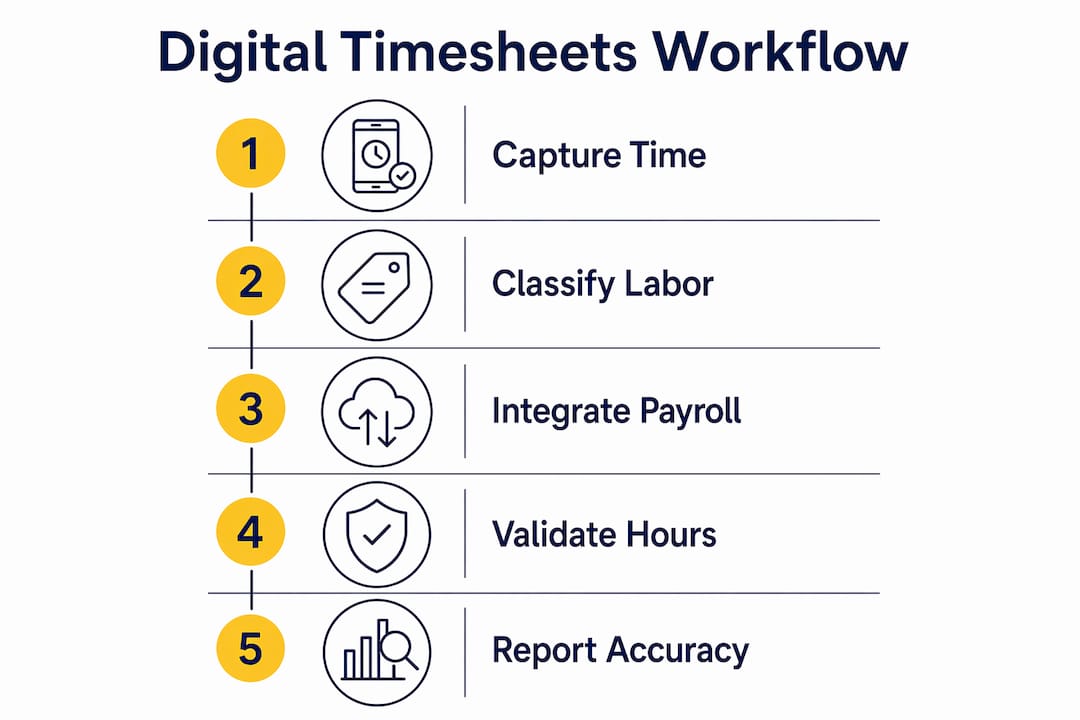
Digital systems break that chain. Automated validation catches overtime rule violations, premium pay mismatches, and missing punches before payroll runs, not after a worker calls to dispute their check. That shift from reactive correction to proactive validation is where most of the payroll accuracy gain comes from.
Real-time reporting gives operations managers a live view of labor costs against budget on every active job. If a project is burning hours faster than the estimate supports, you see it Wednesday, not the following Monday when the job is already closed. That visibility enables decisions, not just documentation.
Key reporting and accuracy benefits:
- Automated overtime validation that applies your specific rules (daily OT, 7th-day rules, piece-rate premiums) without manual calculation
- Audit-ready records with GPS-verified timestamps that satisfy FLSA documentation requirements
- Live labor cost dashboards showing actual hours versus budgeted hours per job in real time
- Faster payroll approval because managers review clean data rather than hunting down discrepancies
- Reduced payroll corrections by catching classification errors at the punch rather than during payroll review
- Compliance documentation for certified payroll on prevailing wage projects, generated automatically from clean source data
The automated reporting that digital platforms provide turns Friday payroll from a data-entry marathon into a review-and-approve step.
Common Implementation Mistakes and How to Avoid Them
Most digital timesheet rollouts in roofing fail for one reason: the tool was designed for an office, not a job site. Roofing-specific software must accommodate field realities like inconsistent internet, offline sync capability, and interfaces simple enough to use with work gloves on. When it does not, foremen route around it, and you end up running two systems simultaneously while paying for one.
The second most common failure is framing. Workers who perceive digital timesheets as surveillance tools resist them, even passively. Transparent communication that frames digital timesheets as payroll accuracy tools rather than monitoring systems increases adoption. The foreman at Cassell Roofing addressed crew concerns directly by explaining that the system was about accurate paychecks, not tracking people. The result was faster adoption and fewer disputes.
Mismatched workflows that add unnecessary steps to the foreman’s day are the primary blocker to successful implementation. A foreman already working a 10-hour day will not absorb extra administrative load. The tool has to reduce their burden, not add to it.
Common mistakes to avoid:
- Selecting office-focused software that lacks offline sync and fails when cell service drops mid-shift
- Skipping the parallel run where you operate both old and new systems for two pay periods to catch configuration errors before they become paycheck disputes
- Rolling out company-wide on day one instead of piloting on one crew or one job site first
- Ignoring language barriers on crews where not every worker reads English fluently
- Underestimating foreman resistance by treating it as obstruction rather than a rational response to added workload
- Failing to configure premium pay rules before go-live, which causes the same overtime errors the system was supposed to eliminate
Pro Tip: Choose a construction-specific tool that lets the foreman clock in the entire crew from one device. That single feature removes the biggest friction point for roofing crews where not every laborer carries a smartphone.
Successful roofing crew technology adoption follows a consistent pattern: pilot on one site, validate payroll accuracy through a parallel run, then expand in waves. Peer endorsement from the pilot site foreman is more persuasive than any directive from the office.
How Terial Unifies Field Time Capture with Your Full Operation
The real cost of fragmented tools is not any single inefficiency. It is the cumulative drag of running timekeeping, payroll, job costing, change orders, and invoicing through disconnected systems that do not talk to each other. Every handoff between those systems is a place where data gets lost, delayed, or re-keyed incorrectly.
Terial was built specifically to eliminate that fragmentation for commercial roofing contractors. The platform connects field time capture to every downstream workflow in a single system, so the hours a crew logs on-site flow directly into job costing, payroll export, and invoice generation without anyone touching a spreadsheet in the middle.
The mobile interface is designed for field conditions, not office desks. Crews can capture labor hours, site photos, and change orders from the roof, and that data reaches the back office in real time. AI-driven automation handles the administrative steps that used to require manual intervention, from flagging budget overruns before they compound to generating invoices in under a minute after a job closes.
What Terial delivers for roofing operations:
- Unified time capture and job costing so labor hours automatically update project budgets as they are logged
- Real-time cost monitoring that alerts managers when a job is trending over budget before it is too late to act
- Mobile-first design built for field conditions, with offline capability for sites with unreliable connectivity
- Automated change order and invoicing workflows that convert field data into billable documents without re-entry
- Crew-level adoption because the interface is fast enough that foremen actually use it instead of reverting to paper
- Integrated safety documentation and photo capture tied directly to the job record
The real-time labor tracking that Terial provides gives operations managers the visibility to make decisions during a project, not after it closes. For commercial roofing companies running multiple active jobs simultaneously, that live cost data is what separates profitable operations from ones that find out too late where the margin went.
Terial’s field service application puts that capability directly in the hands of field crews, with an interface designed to be used by the people actually doing the work, not just the people managing it from the office.
If your operation is still stitching together separate tools for timekeeping, payroll, job costing, and invoicing, the inefficiency is not in any one of those tools. It is in the gaps between them. Terial’s unified platform closes those gaps by design.
Key Takeaways
Digital timesheets drive roofing operations efficiency by automating labor capture, eliminating transcription errors, and connecting field time data directly to job costing, payroll, and compliance workflows.
FAQs
How Do Digital Timesheets Improve Payroll Accuracy?
Digital timesheets capture labor hours at the source and send them directly into payroll systems, removing the manual re-entry that causes many payroll errors. They can also automatically apply overtime rules, premium pay, and labor classifications before payroll is approved.
Can Digital Timesheets Help With Roofing Job Costing?
Yes. Digital timesheets can assign labor hours to specific jobs, cost codes, and phases such as tear-off, flashing, or cleanup. This gives contractors a more accurate view of actual labor costs against budget while the project is still underway.
What Should Roofing Contractors Look for in a Digital Timesheet System?
Look for software designed for field conditions, including simple mobile clock-in, offline capability, GPS or geofencing, job and cost-code tracking, and integrations with payroll and accounting systems. The system should make time capture easier for foremen rather than adding another administrative task.
How Should a Roofing Company Roll Out Digital Timesheets?
Start with one crew or job site rather than deploying the system company-wide immediately. Run the new system alongside the existing process for at least two pay periods, verify payroll accuracy, resolve configuration issues, and then expand the rollout in stages.
Recommended




Book a personalized demo
Get a 30-minute demo tailored to how you run your commercial roofing business

“Making the switch to Terial has greatly exceeded my expectations and has already had a meaningful impact on our team’s productivity. Terial has significantly reduced the amount of time required to complete many of our day-to-day operational tasks, allowing our team to focus more on serving our customers.”

