
Project Scheduling for Commercial Roofing: 2026 Guide
Discover what project scheduling in commercial roofing means. This 2026 guide explains how to deliver projects on time and budget, maximizing profits.
Project scheduling in commercial roofing is the systematic planning and coordination of all project phases, from pre-construction documentation through final closeout, to deliver work on time and within budget. Understanding what project scheduling in commercial roofing means is the first step toward running jobs that protect your margins. A typical commercial roof installation runs 4–12 weeks and requires a crew of 8–30 workers at peak, extensive submittals, permit approvals, and precise trade coordination. Delays in any one phase cascade directly into cost overruns, liquidated damages, and lost referrals. The industry term for this discipline is construction project scheduling, and in commercial roofing it carries more moving parts than most trades.
What Is Project Scheduling in Commercial Roofing?
Project scheduling in commercial roofing is the process of sequencing every task, resource, and milestone across a job from the first permit application to the final warranty submission. It is not a Gantt chart you build once and forget. A commercial roofing schedule is a live, contractually binding exhibit that requires daily management to protect the project from penalties and budget overruns.
The complexity comes from the number of dependencies stacked on top of each other. Permitting alone adds 2–4 weeks to the front end of any job. Submittal packages for mid-size projects run 60–120 pages, and approval cycles take 2–4 weeks with frequent rejections for missing items. That bottleneck shapes every downstream procurement and labor decision. Get the submittal wrong, and your crew sits idle while materials wait in a distributor’s warehouse.
Weather, inspections, and multi-trade coordination add further layers. A roofing schedule must align precisely with mechanical, electrical, and drywall trades. Miss that alignment, and you create conflicts that cost every contractor on the site, not just your crew.
Key Phases of a Commercial Roofing Schedule
A well-built commercial roofing schedule overview breaks into three distinct phases. Each phase builds directly on the one before it, and a delay in any phase compresses the ones that follow.
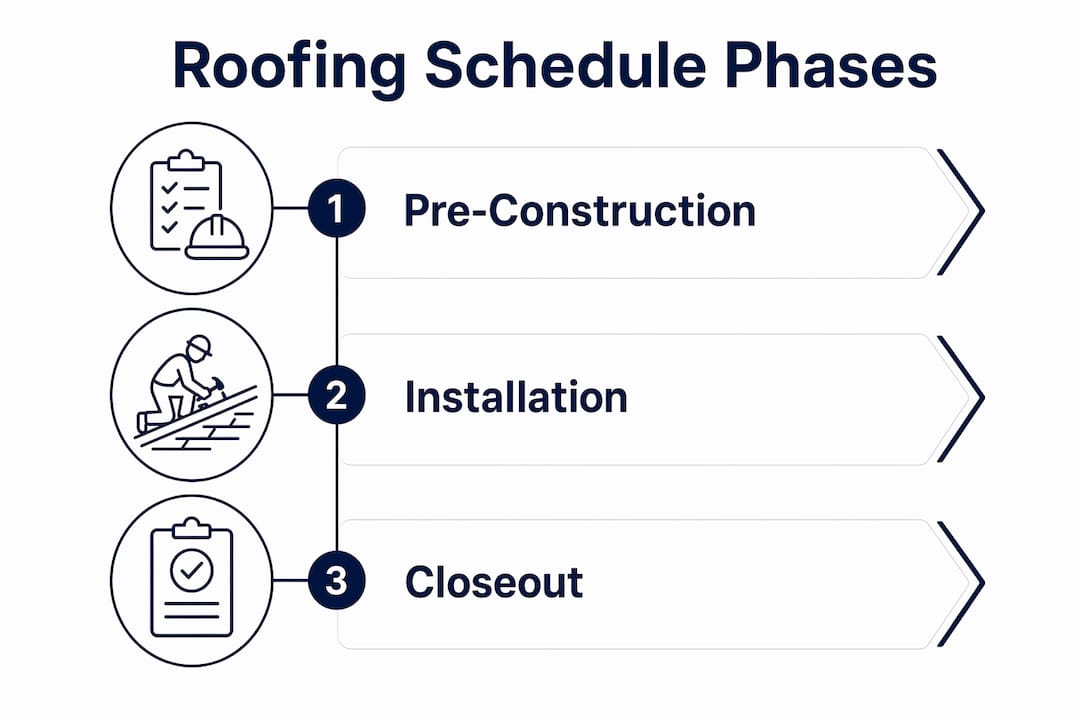
Pre-Construction Phase
The pre-construction phase is where most scheduling failures originate. Project managers must complete permitting applications, prepare submittal packages, secure manufacturer approvals, and plan crew assignments before a single worker sets foot on the roof.
Key pre-construction tasks include:
- Permit applications: Submit early. Permit processing adds 2–4 weeks, and that clock starts only after a complete application lands with the authority having jurisdiction.
- Submittal packages: Assemble the full package, including product data sheets, shop drawings, and safety documentation, before submission. Incomplete packages trigger rejection cycles that push material delivery back by weeks.
- Manufacturer approvals: Many commercial roofing warranties require factory-certified installers and pre-approved material specifications. Confirm these before scheduling the install crew.
- Crew planning: Identify lead foremen, specialty subcontractors, and equipment needs. Large jobs require 8–30 workers at peak, and securing that labor in a tight market takes time.
Pro Tip: Build your submittal package checklist from the manufacturer’s warranty requirements first. Warranty rejections after installation are far more expensive than a delayed submittal approval.
Installation Phase
The installation phase is where sequencing decisions directly affect labor efficiency and material waste. Tear-off, insulation installation, membrane application, and flashing work each require specific conditions and crew configurations.
Daily labor management during installation is not optional. Project managers must track hours against the schedule every day, not every week. A single weather day that goes unlogged against schedule float can trigger liquidated damages clauses by the end of the month.
Closeout Phase
Closeout covers inspections, punch list completion, debris removal, and warranty paperwork submission. Skipping or rushing closeout is where contractors lose the referral. Clients remember the last thing they experienced on a job, and a messy or delayed closeout signals poor management regardless of the quality of the membrane underneath.
How to Build an Effective Commercial Roofing Schedule
Building a schedule that holds under real-world pressure requires starting earlier than most project managers expect.
- Start scheduling 8–12 weeks in advance. Major projects with tenant move-in milestones require up to 6 months of lead time. Summer install season requires 3–4 months of advance booking just to secure contractor availability and competitive pricing.
- Map all submittal and permitting lead times first. These are your longest fixed dependencies. Every other task schedules around them, not the other way around.
- Build weather contingencies in from day one. Schedules that ignore weather become reactive projects that fall behind. Use regional historical rain day data to assign float to each installation week. Scheduling success is built on realistic preparation, not hope for good weather.
- Assign float deliberately. Float is not slack. It is a managed buffer that protects contractual deadlines. Track float daily and communicate changes to the general contractor and owner immediately.
- Centralize all schedule communication. Fragmented communication is the leading cause of inefficiency in construction. A single point of contact and a single scheduling platform prevent cascading delays across trades.
- Review the schedule at every daily crew briefing. The foreman on the roof needs to know the day’s targets, not just the week’s targets. Daily visibility closes the gap between planned and actual progress before it becomes a problem.
Pro Tip: Link your roofing project milestones directly to payment applications. When milestones trigger invoices, your cash flow stays aligned with your schedule progress.
For commercial projects in regulated markets, understanding how to schedule renovation inspections correctly can prevent permit holds that derail an otherwise tight schedule.
Scheduling Challenges Unique to Commercial Roofing
Commercial roofing carries scheduling challenges that general construction project management frameworks do not fully address.
Phased In-Place Reroofing
Phased In-Place (PIP) reroofing is the method of replacing a roof in sections while the facility below remains fully operational. PIP extends project timelines by 50–80% compared to a full tear-off. A 200,000 square foot project that would take 25–40 working days with a full tear-off shifts to 40–75 days under PIP sequencing. That extension comes with a 15–35% cost premium driven by higher crew density and more complex daily coordination.
The scheduling impact of PIP is significant. Each zone requires its own tear-off, insulation, membrane, and weatherproofing sequence before the crew moves to the next zone. Scheduling errors that expose an active facility to weather create immediate liability. Project managers running PIP jobs must treat each zone as a sub-project with its own daily schedule.
Multi-Trade Coordination
Roofing schedules on commercial projects must align with mechanical, electrical, and drywall trades. HVAC curb installations, roof penetrations for electrical conduit, and interior ceiling work all create dependencies that the roofing schedule must accommodate.
Large Portfolio and Multi-Building Projects
Managing roofing schedules across multiple buildings or zones in a large portfolio multiplies coordination demands. Each building may have its own permit jurisdiction, inspection schedule, and trade sequence. Project managers must maintain a master schedule that rolls up individual building timelines while tracking float independently for each structure.
Key challenges in multi-building scheduling include:
- Permit jurisdiction variations across buildings or municipalities
- Staggered material deliveries to avoid site congestion
- Crew rotation between buildings based on weather and inspection readiness
- Consolidated reporting to ownership or property management groups
A commercial buildout planning guide for complex urban projects illustrates how permit sequencing and trade coordination apply across multiple scopes, a useful reference when managing large roofing portfolios.
What Tools Support Commercial Roofing Project Scheduling?
Technology closes the gap between a schedule on paper and a schedule that actually runs the job. Automated scheduling systems coordinate material deliveries, crew shifts, and inspection planning in ways that manual spreadsheets cannot match at scale.
The tools that matter most for commercial roofing scheduling include:
- Automated task triggers: Systems that push alerts when a milestone completes, prompting the next task to begin without manual follow-up. This eliminates the lag between phases that compounds into schedule overruns.
- Centralized communication platforms: A single platform where field crews, project managers, and office staff see the same schedule in real time. This directly addresses fragmented communication, the leading cause of construction inefficiency.
- Real-time dispatching and crew management apps: Mobile-first tools that let foremen confirm crew arrivals, log hours, and flag delays from the roof. Office teams see updates without waiting for end-of-day reports.
- Permit, submittal, and inspection tracking: Integrated tracking that logs submittal submission dates, approval status, and inspection scheduling in the same system as the project schedule. This prevents the common failure of a permit delay going unnoticed until it collapses the install window.
- Time tracking tied to schedule milestones: Labor hours logged against specific schedule phases give project managers real cost-versus-plan visibility daily, not monthly.
Operational predictability built through consistent scheduling is what generates high-margin referrals. Clients do not just hire technical skill. They hire contractors who deliver on the dates they commit to. The crew scheduling workflow that connects field data to office reporting is what separates contractors who grow from those who stay flat.
How Terial Supports Commercial Roofing Scheduling
Disconnected tools are the real scheduling problem for most commercial roofing teams. Spreadsheets, text threads, and separate apps create the exact fragmentation that causes delays and missed milestones. Terial is the unified operating system built specifically for commercial roofing contractors, connecting scheduling, dispatch, field service, time tracking, and invoicing into one real-time system.
With Terial, project managers get automated workflow tools that trigger tasks, alert delays, and keep field crews and office teams on the same page without manual coordination. The platform’s field service application gives foremen mobile access to daily schedules, crew assignments, and job documentation from the roof. Terial’s time tracking ties labor hours directly to schedule milestones, giving operations leaders the cost visibility they need to protect profitability on every job.
Key Takeaways
Effective commercial roofing project scheduling requires proactive planning, daily schedule management, and centralized communication across all phases and trades.
FAQ
What Is Project Scheduling in Commercial Roofing?
Project scheduling in commercial roofing is the systematic planning of all tasks, resources, and milestones from permit application through warranty closeout. It is a live, contractually binding document that requires daily management to protect deadlines and profitability.
How Far in Advance Should a Commercial Roofing Project Be Scheduled?
Most commercial roofing projects require scheduling 8–12 weeks in advance. Major projects with tenant move-in deadlines or summer install windows can require 3–6 months of lead time to secure permits, materials, and crew availability.
What Causes the Most Scheduling Delays in Commercial Roofing?
Late or incomplete submittal packages are the most common cause of scheduling delays. Approval cycles take 2–4 weeks, and a rejected submittal pushes material procurement and crew scheduling back by the same amount.
What Is Phased In-Place Reroofing and How Does It Affect the Schedule?
Phased In-Place (PIP) reroofing replaces a roof in sections while the facility stays operational. It extends project timelines by 50–80% compared to full tear-off and requires each zone to be managed as its own daily schedule.
Why Does Weather Need to Be Built Into a Commercial Roofing Schedule Upfront?
Weather delays are predictable in aggregate even when individual rain days are not. Schedules that treat weather as an exception rather than an expected variable become reactive and fall behind. Building regional rain day float into the schedule from the start keeps the project on track contractually.
Recommended



Book a personalized demo
Get a 30-minute demo tailored to how you run your commercial roofing business

“Making the switch to Terial has greatly exceeded my expectations and has already had a meaningful impact on our team’s productivity. Terial has significantly reduced the amount of time required to complete many of our day-to-day operational tasks, allowing our team to focus more on serving our customers.”

