
How to Reduce Overhead in a Growing Roofing Company
Learn effective strategies to reduce overhead in a growing roofing company. Enhance profitability without sacrificing production capacity.

Overhead reduction is the practice of cutting fixed and variable operating costs without sacrificing the production capacity that drives revenue. For a growing roofing company, getting this right separates a scalable business from one that earns more but keeps less. The sustainable overhead ratio for a $5M roofing company sits at 15–20% of revenue. When overhead climbs above 25%, the business model stops scaling. Automation, workflow discipline, and insurance cost control are the three levers that keep overhead in range as you grow.
What Are the Main Overhead Costs in a Growing Roofing Company?
Overhead in a roofing company falls into four main categories: insurance premiums, office and administrative expenses, equipment and technology subscriptions, and owner or admin salaries. Each category behaves differently as revenue grows, and each requires a different control strategy.
Insurance is typically the largest fixed overhead item. Premiums for small to mid-sized roofing firms can reach $50,000–$150,000 annually. That figure covers general liability, workers’ compensation, and commercial auto. Workers’ comp alone carries class code rates of $24–$80 per $100 of payroll, depending on the type of roofing work. Failing to price labor at fully burdened rates means losing money before a crew sets foot on a roof.
Administrative salaries and owner time form the second major cost block. Most owners underestimate how much time they spend on estimates, disputes, and supplements. Owner time spent on admin tasks at 20 hours per week, valued at $75 per hour, adds up to $78,000 in annual opportunity cost. That is invisible overhead. It does not appear on a P&L, but it erodes net profit just as surely as a bad subcontractor invoice.
Technology and equipment subscriptions are often the most fragmented cost category. Growing companies accumulate disconnected tools for estimating, scheduling, invoicing, and field reporting. Each tool carries a monthly fee, and the gaps between them create duplicate data entry, billing errors, and wasted admin hours.
Here is a typical overhead breakdown for a $5M roofing company:
The key distinction is fixed versus variable overhead. Fixed costs like insurance and office rent stay constant regardless of job volume. Variable overhead, like admin hours and software seats, scales with activity. Controlling fixed costs requires negotiation and risk management. Controlling variable overhead requires process discipline.
How Can Automation Help Cut Overhead Costs in Roofing Operations?
Automation reduces overhead by eliminating the manual steps that cost time and create errors. The most direct gains come from invoicing, scheduling, and crew dispatch.
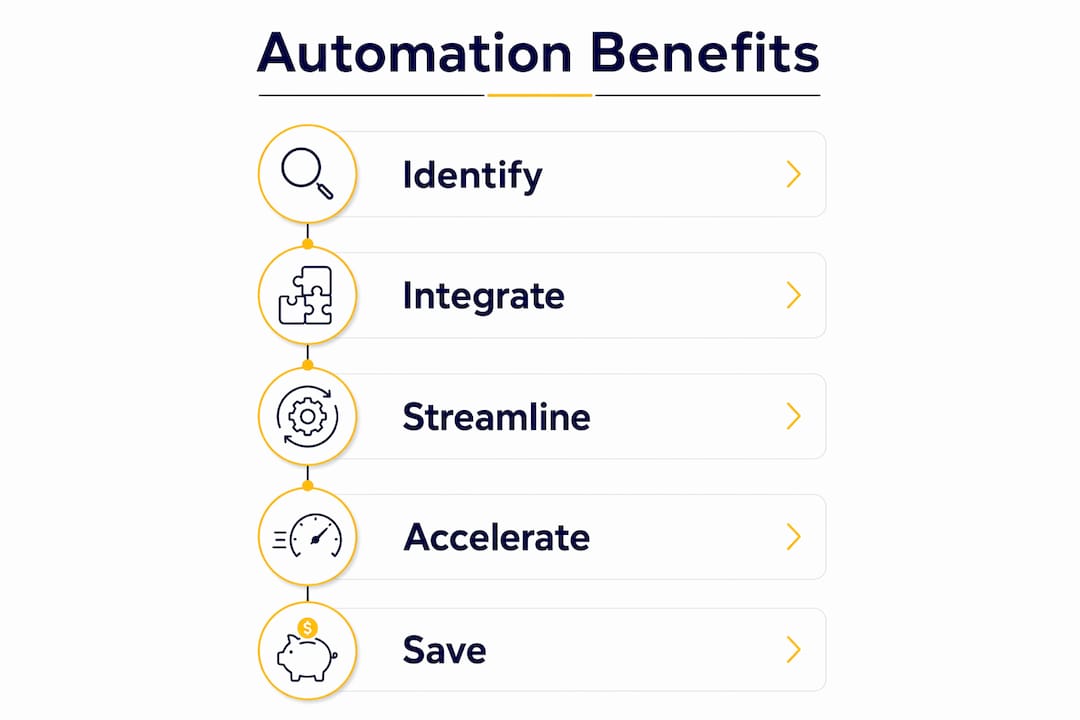
Mobile invoicing at job sites speeds up payment collection by 4–7 days compared to office-generated paper invoices. Faster payment means less cash tied up in receivables, which reduces the need for short-term credit and the interest costs that come with it. Requiring 30–40% deposits at contract signing compounds this effect by front-loading cash flow before work begins.
Automating crew scheduling and dispatch cuts administrative hours significantly. When dispatchers work from a centralized digital system instead of phone calls, texts, and spreadsheets, the coordination time per job drops. Centralizing scheduling and dispatch reduces administrative hours by 15–20%. That translates directly to lower payroll overhead or frees admin staff to handle higher-value tasks.
The path from manual to digital is not instant. Transitioning to centralized digital systems takes 60–90 days. Companies that push through the initial adjustment period reduce overhead by 15–20% by eliminating redundant data entry. The ones who quit early during the learning curve miss the savings entirely.
- Audit every manual process that touches invoicing, scheduling, or field reporting.
- Identify where data gets re-entered more than once across different tools.
- Replace disconnected tools with a single connected system that covers estimating through invoicing.
- Set a 90-day implementation timeline with weekly check-ins on adoption and error rates.
- Measure overhead as a percentage of revenue before and after to confirm actual savings.
Pro Tip: Track billing accuracy rates before and after automation. A 5% reduction in billing errors on $5M in revenue recovers $250,000 in revenue that would otherwise be disputed, written off, or delayed.
The automated workflows guide for roofing profitability covers how these changes compound over a full fiscal year, which is worth reviewing before you set your implementation targets.
What Strategies Can Roofing Companies Use to Control Insurance and Risk-Related Overhead?
Insurance is the overhead category most owners treat as fixed and non-negotiable. It is neither. The premium you pay is directly tied to your claims history, your safety record, and how well you document both.
Maintaining zero OSHA recordable incidents for a full policy year qualifies most roofing firms for safety discount programs that reduce workers’ compensation premiums by 10–15%. On a $150,000 annual premium, that is $15,000–$22,500 back in the business every year. Zero incidents also enable safety discount savings exceeding $25,000 annually for firms that document their loss control programs formally.
Loss control programs are the mechanism that earns those discounts. A loss control program includes documented safety training, pre-job hazard assessments, fall protection protocols, and regular crew safety audits. Carriers reward these programs because they reduce claim frequency. The documentation also protects you in disputes.
- Conduct formal safety training for every crew member at least quarterly.
- Document all pre-job hazard assessments and store them digitally for carrier review.
- Track near-misses, not just recordable incidents, to identify risk patterns before they become claims.
- Review your experience modification rate (EMR) annually and dispute any incorrect claim assignments.
- Negotiate with your carrier using your documented loss control program as evidence of reduced risk.
One critical mistake is cutting insurance limits to lower premiums. Cutting insurance coverage as a cost-reduction strategy risks the entire business. A single uninsured claim can exceed years of premium savings. The goal is to reduce premiums through better risk performance, not through reduced coverage.
Insurance overhead also affects labor costs directly. Work comp rates vary by class code, and misclassifying workers into the wrong code creates audit liability. Pricing every job with fully burdened labor rates, including the correct work comp rate for each crew role, prevents the margin erosion that shows up at year-end audits.
How Can Workflow Optimization and Headcount Management Reduce Overhead?
Overhead bloat in roofing companies comes from broken workflows far more often than from excess headcount. Adding staff without documented processes creates expensive confusion. The new hire inherits a broken system and makes the same errors as the person they replaced.
The correct sequence is to document and standardize workflows first, then hire into those workflows. A process audit typically reveals that 15–20% of overhead is wasted and fixable within 90 days. That is not a small number. On $5M in revenue with 20% overhead, that is $150,000–$200,000 in recoverable cost sitting inside your current operations.
- Map every administrative workflow from lead intake through final invoice collection.
- Identify steps that require manual re-entry, phone follow-up, or supervisor approval for routine tasks.
- Eliminate or automate every step that does not require human judgment.
- Document the remaining steps in a written standard operating procedure before hiring anyone to perform them.
- Apply zero-based budgeting to overhead annually: justify every line item from scratch rather than rolling forward last year’s numbers.
Pro Tip: Value your own time at $75 per hour and track every hour you spend on admin tasks for two weeks. Most owners discover they are spending 15–20 hours per week on work that a documented process and a $25-per-hour admin could handle.
Underfunding overhead creates its own cost spiral. Cutting office staff by 30% caused a 50% increase in scheduling errors and client complaints in one documented case. The savings on payroll were erased by rework, lost contracts, and the time the owner spent resolving disputes. Overhead is not just a cost. It is the infrastructure that makes production possible.
The operational infrastructure guide for roofing companies covers how to build this foundation without overspending, which is the balance most growing contractors struggle to find.
What Are the Best Practices for Monitoring and Sustaining Overhead Reductions?
Overhead reduction is not a one-time project. It requires monthly tracking against revenue to prevent the gradual cost creep that kills margins during growth phases.
The math is unforgiving. Overhead rising from 20% to 32% on $5M in revenue costs $600,000 in annual profit. That shift can happen over 18 months without triggering any single obvious alarm. Monthly ratio tracking catches it early.
- Set a monthly overhead target as a percentage of projected revenue and review actual versus target at month-end.
- Use job costing reports to identify which project types carry the highest overhead burden.
- Adjust your pricing model when overhead ratios shift, rather than absorbing the cost through margin compression.
- Avoid discounting to win volume. High-volume, low-margin work increases overhead burden without improving profitability.
- Review every overhead line item quarterly and eliminate any subscription or service that does not directly support production capacity.
The roofing business growth strategies guide connects overhead monitoring to broader scaling decisions, including when to add headcount and when to invest in technology instead.
Key Takeaways
Reducing overhead in a growing roofing company requires monthly ratio tracking, workflow documentation, automation of billing and dispatch, and active insurance cost management through loss control programs.
How Terial Helps Roofing Companies Control Overhead
Fragmented tools are the root cause of most overhead bloat in commercial roofing operations. Terial replaces disconnected systems with a single operating platform that connects estimating, scheduling, field reporting, and mobile invoicing into one real-time workflow. Crews generate invoices in under a minute from the job site, which accelerates payment and eliminates the billing errors that create disputes. Dispatch automation reduces the administrative hours your office team spends coordinating crews across multiple jobs. Terial also supports safety documentation workflows that help you build the loss control record your insurance carrier needs to reduce your premiums. If you are ready to cut overhead without cutting capacity, Terial’s workflow automation platform is built for exactly that.
FAQ
What Is a Healthy Overhead Ratio for a Roofing Company?
A sustainable overhead ratio for a roofing company at $5M in revenue is 15–20% of total revenue. Overhead above 25% indicates a non-scalable business structure that will compress margins as the company grows.
How Quickly Does Automation Reduce Roofing Overhead?
Transitioning to centralized digital tools takes 60–90 days. Companies that complete the transition reduce administrative overhead by 15–20% by eliminating redundant data entry and manual coordination steps.
What Is the Biggest Hidden Overhead Cost in Roofing?
Owner time spent on estimates, disputes, and supplements is the most underestimated overhead cost. At 20 hours per week valued at $75 per hour, that time represents $78,000 in annual opportunity cost that never appears on a P&L.
How Does Safety Performance Affect Roofing Overhead?
Maintaining zero OSHA recordable incidents qualifies roofing firms for loss control discounts that reduce workers’ compensation premiums by 10–15%. Documented safety programs can generate savings exceeding $25,000 per year.
Should I Cut Office Staff to Lower Overhead?
Cutting office staff without fixing underlying workflows typically increases errors and client complaints. One documented case showed a 30% staff reduction caused a 50% rise in scheduling errors, erasing the payroll savings through rework and lost contracts.
Recommended
- Roofing Business Scaling Checklist for Contractors
- How to Grow a Roofing Business: 2026 Strategies
- How Manual Processes Limit Roofing Scalability
- Build Roofing Company Operational Infrastructure Fast





Book a personalized demo
Get a 30-minute demo tailored to how you run your commercial roofing business

“Making the switch to Terial has greatly exceeded my expectations and has already had a meaningful impact on our team’s productivity. Terial has significantly reduced the amount of time required to complete many of our day-to-day operational tasks, allowing our team to focus more on serving our customers.”

