
Why Low-Slope Roofing Needs Dedicated Service Software
Discover why low-slope roofing needs dedicated service software to eliminate hidden costs, boost efficiency, and improve your bottom line.

If you run a commercial low-slope roofing operation and you’re still stitching together spreadsheets, generic project management tools, and email chains to run your jobs, you are paying a hidden tax every single day. The question of why low-slope roofing needs dedicated service software is not academic. It directly determines whether your margins survive contact with a real project. Most commercial roofers underestimate how much revenue bleeds out of disconnected systems, not from bad craftsmanship but from administrative friction that compounds across every job, every crew, and every billing cycle.
Key Takeaways
- Hidden costs reduce profits: Manual processes and generic software cause significant operational inefficiencies and revenue loss in low-slope roofing businesses.
- Dedicated software boosts margins: Industry-specific platforms cut delays and rework, increasing net profit margins by up to 12% and improving operational efficiency.
- Complex workflows need tailored tools: Low-slope roofing’s multi-phase scheduling require software designed with these unique needs in mind.
- Service-as-software automates execution: Next-generation software goes beyond tools to perform tasks autonomously, allowing human teams to focus on oversight and exceptions.
- Implementation requires workflow mapping: Successful adoption depends on aligning software configuration to actual business processes and phased integration with effective training.
Hidden Costs of Manual and Generic Software Processes in Low-Slope Roofing
The average roofing business spends 32% of its budget on non-value-added tasks, losing up to $18,000 annually for mid-sized contractors. That number does not come from slow crews or bad material pricing. It comes from the office: rekeying job data, chasing down field updates, manually dispatching schedule changes, and reconciling invoices that do not match what actually happened on site.
Fragmented tool stacks make this worse, not just inconvenient. Most owners underestimate the administrative tax of fragmented tools, which can consume up to 12% of revenue in manual data reconciliation and duplicated effort. For a $3 million operation, that is $360,000 per year vanishing into the gap between your CRM, your spreadsheet, your accounting software, and your text thread with the crew foreman.
Here is what that actually looks like in practice:
- A property manager calls for an emergency inspection. Nobody updates the schedule in the shared calendar because the field lead used a different app. The window closes. A competitor handles the call.
- A change order gets agreed to verbally on site, never captured digitally, and falls off the invoice. That labor cost gets absorbed.
- A preventive maintenance visit is missed because nobody tied the roof asset record to the service calendar. The client files a warranty claim you now have to defend.
These are not edge cases. They are Tuesday. The manual processes limiting roofing scalability are the same ones costing you margin on jobs you are already winning.
Pro Tip: Before you evaluate any software, spend one week logging every task your office staff performs that involves re-entering data that already exists somewhere else. Most contractors are shocked to find 15 to 20 hours per week lost to this alone.
The problem gets sharper when you layer in inspection reporting tools that are disconnected from your job records. When field photos live in one place, notes in another, and the invoice in a third system, you are not just slow. You are exposed.
How Dedicated Low-Slope Roofing Software Improves Productivity and Profitability
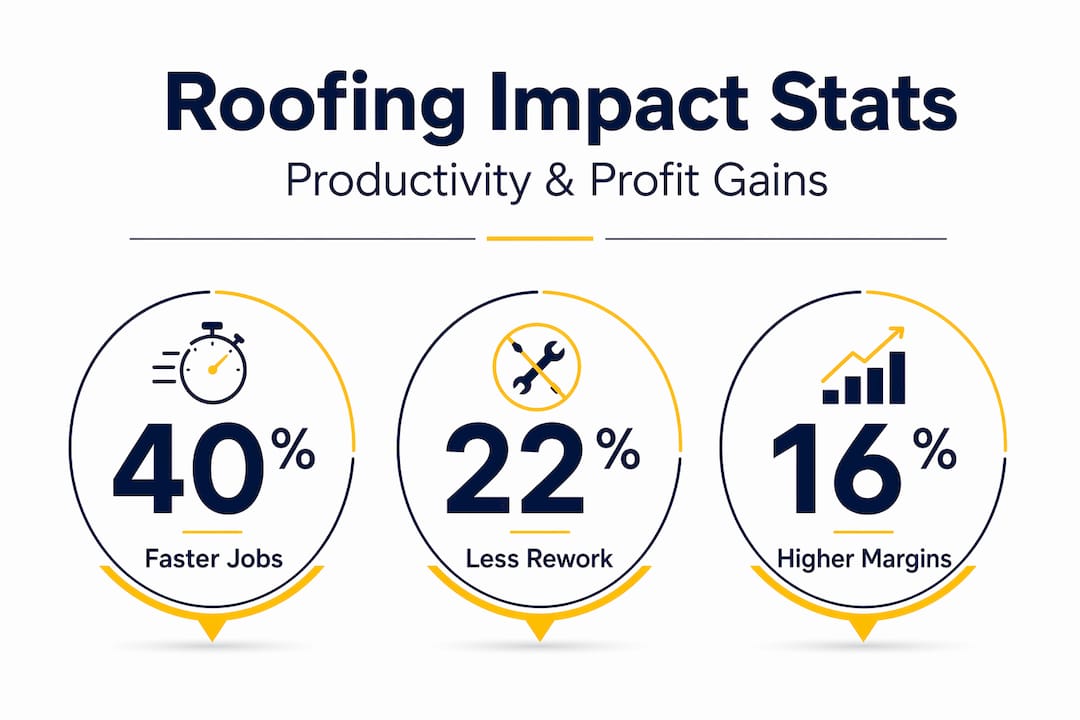
Top-quartile roofing operators using integrated platforms cut job delays by 40%, rework by 22%, and increase net margins by up to 12%. Those numbers are not driven by any single feature. They come from the compounding effect of information flowing without friction from the first site visit through final payment.
Project management software that consolidates lead capture, scheduling, and invoicing into one system directly reduces labor costs and improves compliance. When a foreman closes out a phase on a tablet and that action automatically triggers the next crew’s dispatch notification, you have eliminated a phone call, a calendar update, and a potential miscommunication in one step.
The specific advantages of low-slope roofing software built for commercial workflows include:
- Real-time crew tracking that lets the office see where crews are without calling anyone
- Automated lead assignment that routes new service requests to the right rep based on geography or account ownership
- AI-powered estimating that pulls historical job cost data to improve bid accuracy over time
- Compliance tracking tied directly to job records, not a separate folder nobody opens
Explore the full range of roofing software features purpose-built for commercial workflows, or read how tracking labor hours effectively can protect margin on every phase.
Pro Tip: If your software requires someone to manually trigger the next step in a workflow, that is a gap. Every manual trigger is a place where things get dropped.
Unique Workflow Challenges in Low-Slope Commercial Roofing and Software Solutions
Low-slope commercial roofing is not a simpler version of steep-slope residential work. It is a fundamentally different discipline with multi-phase timelines, heavier compliance exposure, and asset management responsibilities that extend years past installation. Generic tools fail here because they were not designed with any of this in mind.
Software must handle multi-day, multi-phase scheduling to prevent margin erosion in low-slope projects. A TPO or EPDM installation across a 100,000 square foot warehouse roof might span two weeks, involve three subcontractors, require daily moisture readings, and carry a 20-year warranty. A generic project tool sees that as a single task with a due date.
The specific workflow demands that generic platforms cannot meet:
- Separate cost tracking for tear-off labor, disposal fees, insulation board, membrane material, fasteners, and adhesives, each tied to a phase
- Automated inspection scheduling triggered by phase completion, not just calendar dates
- Warranty documentation generated from actual job records, not typed manually afterward
- Safety compliance logs that attach to the job and travel with the roof’s asset history
Without centralized tracking of maintenance and repairs, companies risk premature roof replacements versus data-backed rehab decisions that extend asset lifespan. That is not just a client problem. If you are offering maintenance agreements, your ability to upsell rehab work versus replacement hinges entirely on having that data organized and accessible.
Here is how purpose-built software solves these challenges in sequence:
- Map the phases at job creation, not after the fact, so every cost and task is categorized from day one
- Attach materials to phases so you always know what was used where, and your estimating gets sharper over time
- Trigger inspections automatically at phase completion so nothing falls through when crews move fast
- Generate the roof asset record from the job data itself, which becomes your proof of work and your upsell tool
Explore service management features designed for exactly these complexities, including maintenance scheduling tied to live roof records.
Pro Tip: Every maintenance agreement you sell is only as valuable as your ability to track what you did and when. If that data lives in a spreadsheet, your agreement is a liability, not an asset.
The Shift from Traditional SaaS to Service-as-Software in Roofing Operations
Here is a concept worth understanding, because it explains why even some industry-specific tools still leave contractors doing too much manual work. Traditional SaaS gives you a place to record things. Service-as-software does the work.
“Service-as-software moves from giving access to a tool, to executing workflows and automating complex decision-making.”
In practical roofing terms: traditional software shows you that an inspection is overdue. Service-as-software schedules it, notifies the crew, generates the report template, and flags the result for review. You supervise. The system executes.
The deeper shift is about trust in autonomous software, which is fragile but essential. Businesses must balance automation with human oversight to gain sustained benefits. The contractors winning with this model are not handing everything to an algorithm. They are designing their workflows carefully, delegating the routine steps to software, and keeping human judgment where it belongs: on exceptions, client relationships, and scope decisions.
This is where the advantages of dedicated roofing software become compounding. Every workflow you hand off to the system is a task your office staff stops doing manually. Over a year, that adds up to real capacity.
Implementing Dedicated Service Software: Practical Tips for Low-Slope Roofers
Getting the right software is half the battle. Getting your team to actually use it is the other half. Most failed implementations fail not because the software was wrong but because the rollout treated configuration as adoption.
Successful implementation depends on mapping real workflows before configuration to avoid forcing business adaptation to software limitations. That means sitting down before you touch a single setting and writing out every step from first lead contact to final invoice, including every handoff between office and field.
Follow this sequence:
- Document your current lead-to-invoice workflow with every stage, handoff, and decision point written out
- Identify the three to five places where data gets re-entered or where things most often fall through
- Choose software that solves those specific failure points first, not software with the longest feature list
- Phased rollouts starting with key integrations, like estimating with project management, ease workforce readiness challenges and improve adoption
- Set usage policies with accountability: if it is not in the system, it did not happen
Key metrics to track after rollout:
- Average invoice turnaround
- Baseline - 5-7 days
- 90-day target - Under 24 hours
- Rework rate per project
- Baseline - Track current %
- 90-day target - Reduce by 20%
- Change order capture rate
- Baseline - Estimate current
- 90-day target - 100% digital
- Admin hours per job
- Baseline - Count current
- 90-day target - Reduce by 30%
- Baseline - Count current
Pro Tip: Assign one person as the internal software champion before you launch. This is not the IT person or the owner. It is the most respected field-to-office communicator on your team. Their adoption signals to everyone else that this is real.
Explore workflow automation solutions and sign up for roofing software webinars to accelerate your team’s readiness.
Why Conventional Wisdom About Roofing Software is Backwards: A Fresh Perspective
Most roofing companies evaluate software the wrong way. They ask “what features does it have?” when the real question is “does this software understand how we actually work?”
Feature counts do not run jobs. Workflows do. The biggest gains come not from the software features themselves but from how well companies design workflows that the software can effectively execute. A platform with 200 features that requires your foreman to log in, navigate three screens, and manually assign a task is worse than a platform with 20 features where the foreman taps one button and the office already knows what happened.
The truth is that most contractors who have failed at software adoption did not fail because the software was bad. They failed because they tried to use new software to run old, unmapped processes. Digital transformation in roofing is not about replacing your whiteboard with a screen. It is about shifting your team’s role from doing repetitive tasks to supervising outcomes.
Trust in autonomous software is fragile but essential. The contractors who get the most out of dedicated platforms are the ones who invest time up front in defining what “correct execution” looks like, then let the software enforce it. They do not micromanage the system. They audit the outputs.
The manual processes mindset shift is ultimately the harder change. Once you accept that your competitive advantage is not your crew size or your material relationships but your operational clarity, the software choice becomes obvious.
Streamline Your Low-Slope Roofing Operations with Terial’s Dedicated Service Software
If this article has made one thing clear, it is that fragmentation is the real margin killer in commercial low-slope roofing. Terial was built specifically to solve that problem, not by adding another tool to your stack, but by replacing the stack entirely with one connected operating system. From estimating and scheduling to field service execution and invoicing, everything runs in real time without manual handoffs. Field crews actually use it because it was designed for how they work on site. Explore the Terial platform to see how it unifies your entire operation, check out the field service application built for commercial roofing crews, and watch the CRM strategy webinar to see how leading contractors are closing more work with less chaos.
Frequently Asked Questions
Why can’t generic project management software effectively support low-slope roofing companies?
Generic tools lack roofing compliance fields that low-slope projects require, which leads to errors, missed costs, and eroding margins. Without those built-in structures, you end up building manual workarounds that create the same fragmentation problems you were trying to escape.
How does service-as-software differ from traditional roofing SaaS products?
Service-as-software shifts responsibility from the user operating a tool to the system executing workflows and delivering outcomes with human oversight. Traditional SaaS requires your team to manually drive every step; service-as-software handles the routine execution so your team focuses on judgment calls.
What are the first steps to successfully implement dedicated roofing service software?
Map your workflows in full detail before you configure anything, then select software that solves your specific failure points first. Roll out integrations in phases, starting with estimating and scheduling, and build in clear accountability so the system gets used consistently from day one.
Recommended




Book a personalized demo
Get a 30-minute demo tailored to how you run your commercial roofing business

“Making the switch to Terial has greatly exceeded my expectations and has already had a meaningful impact on our team’s productivity. Terial has significantly reduced the amount of time required to complete many of our day-to-day operational tasks, allowing our team to focus more on serving our customers.”

