
What Is Single-System Roofing Management for Contractors
Discover what single-system roofing management means for contractors. Streamline operations, reduce costs, and enhance project visibility with one platform.

Single-system roofing management is the practice of running all roofing project workflows through one integrated platform that acts as mission control across every department. The industry term for this approach is “unified operational management,” and it covers five core elements: a single customer timeline, structured workflows, connected tool integrations, clear ownership at each stage, and real-time reporting. Most commercial roofing firms still run on a patchwork of spreadsheets, standalone CRMs, and field apps that don’t talk to each other. That fragmentation is not a software problem. It is an architecture problem, and it gets more expensive as you grow.
How Does Single-System Roofing Management Solve Operational Challenges?
Disconnected tools create visibility gaps that cost money. When your estimator works in one platform, your field crew logs hours in another, and your office invoices from a third, no one has the full picture. Disconnected roofing systems lead to operational friction, visibility gaps, and measurable revenue loss as companies grow. That is not a warning about future risk. That is a description of what is already happening on most job sites right now.
The most damaging result of fragmentation is reactive management. When a project manager has to call three people to find out where a job stands, decisions get delayed. Delays compound. Budget overruns follow. A unified roofing management system replaces that reactive cycle with proactive oversight because every team member sees the same data at the same time.
Here is where the operational pain shows up most clearly:
- Accountability gaps. When tasks live in separate tools, ownership blurs. No one knows who approved the change order or when the crew was dispatched.
- Communication breakdowns. Field crews and office teams operate on different information, which produces rework and schedule disruptions.
- Budget drift. Without real-time cost tracking tied to the project record, overruns go undetected until the job is nearly done.
- Delayed invoicing. When field data doesn’t flow directly to billing, invoices sit in a queue. Cash flow suffers.
Pro Tip: Map your current workflow from first customer contact to final invoice. Count how many separate tools touch that process. Each handoff point is a place where data gets lost or delayed.
A single-system approach eliminates those handoff points. Project changes cascade automatically through connected workflows, so a schedule update in the field reflects immediately in the office view. That is the difference between managing chaos and running a repeatable operation.
What Core Features Make Up a Single-System Roofing Platform?
A unified roofing management platform is not just software with more tabs. Its architecture is what separates it from a stack of disconnected tools. Project changes cascade automatically through workflows, maintaining real-time accuracy and accountability across every department. That cascade effect is the structural feature that makes the system work.
The five components that define a true single-system platform are:
- Unified customer and project timeline. Every interaction, document, photo, and status update lives in one record. Anyone on the team can pull up a job and see exactly where it stands without asking.
- Structured, standardized workflows. Each phase of a project follows a defined sequence. Estimating feeds into scheduling. Scheduling feeds into dispatch. Dispatch feeds into invoicing. Nothing falls through the cracks because the system enforces the process.
- Connected tool and data integrations. Estimating, field service, scheduling, and accounting share a common data layer. A cost entered in the field updates the job budget automatically.
- Defined roles and ownership. Every task has an assigned owner. The system tracks who approved what and when, which creates a clear audit trail for every project.
- Real-time operational reporting. Profitability, labor hours, and project status are visible at any moment. Contractors can catch budget drift before it becomes a loss.
Terial is built around this exact architecture. Its field service application connects crew activity directly to the project record, so photos, labor hours, and change orders update the office view in real time. That connection is what makes field crew adoption the most important variable in any deployment. Without it, the system has no live data to work with.
Pro Tip: Before evaluating any platform, ask one question: “If a crew member logs a change order in the field, does the project budget and invoice update automatically?” If the answer is no, the system is not truly unified.
How Does Single-System Management Differ from CRM or Siloed Tools?
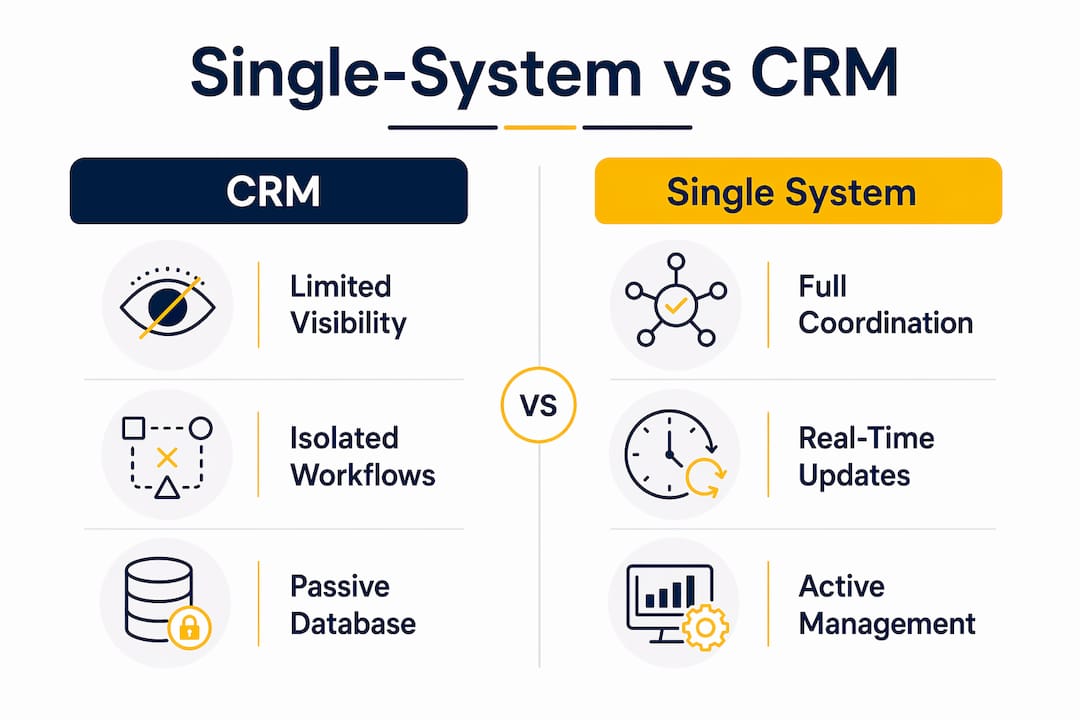
The biggest misconception in commercial roofing is that a better CRM fixes operational fragmentation. It does not. Successful firms view their system as an active coordination hub, the single source of truth for all project phases. A CRM is a passive database. It stores contacts and tracks leads. It does not manage job costs, dispatch crews, or generate invoices.
The structural difference matters more than the feature list. A CRM sits at the front of the sales process and stops there. A unified roofing management system spans the entire project lifecycle, from the first site visit to the final payment. When you add a standalone scheduling tool, a separate field app, and a third-party accounting integration on top of a CRM, you have not built a system. You have built a more complicated version of the same fragmentation problem.
Standardizing workflows company-wide is more effective than layering new tools over disconnected legacy systems. That principle is architectural, not philosophical. Every new integration point is a new place where data can break, sync can fail, or a team member can bypass the process entirely.
The table below compares how these two approaches handle the same operational functions:
The contrast is not about which tool has more features. It is about whether the system is designed to coordinate work or just record it.
What Benefits Can Contractors Expect from Adopting This Approach?
The practical advantages of single-system roofing solutions show up in three areas: profitability, scalability, and accountability. Growth breaks many roofing businesses because adding projects multiplies chaos instead of multiplying revenue. The contractors who scale successfully build shared visibility into their operations before they need it.
Here is what changes when you move to a unified system:
- Fewer errors and less rework. Standardized workflows mean every crew follows the same process. Variation drops. Quality improves.
- Faster invoicing and better cash flow. When field data flows directly to billing, invoices go out the same day the work is done. Terial generates invoices in under a minute from live project data.
- Real-time budget control. Cost monitoring during the project, not after it, lets you catch overruns before they close out a job at a loss.
- Cleaner subcontractor coordination. When subcontractor management runs through the same system as scheduling and invoicing, scope gaps and billing disputes drop significantly.
- Scalable operations without adding admin staff. Repeatable workflows mean you can take on more projects without hiring more coordinators to manage the chaos.
Pro Tip: Track your average time from job completion to invoice sent. If it is more than 24 hours, you have a workflow gap that a unified system can close immediately.
One underappreciated benefit is risk reduction. Clear ownership at every project stage means there is always a named person responsible for each task. When something goes wrong, you know exactly where the breakdown occurred and can fix the process, not just the symptom. That kind of proactive oversight is what separates contractors who grow from contractors who grind.
Terial: Built for Contractors Who Are Done with Fragmentation
Fragmentation is the real competitor for every commercial roofing contractor. Terial is the unified operating system built to replace it. The platform connects estimating, sales pipeline management, field service, scheduling, and invoicing in one real-time system, so your office and field teams always work from the same information. Terial’s AI-driven automation handles change orders, crew dispatch, and invoice generation without manual data entry. Field crews actually use it because it was designed with them in mind, not around them. If you are ready to run your operation from a single source of truth, explore Terial and see what unified management looks like in practice.
Key Takeaways
Single-system roofing management works because it replaces disconnected tools with one connected architecture that links estimating, field operations, and invoicing into a single source of truth.
FAQ
What Is Single-System Roofing Management?
Single-system roofing management is a centralized operational framework that manages the entire roofing project lifecycle, from estimating to invoicing, through one connected platform. It replaces fragmented tools with unified workflows, shared data, and real-time reporting.
How Does a Single-System Platform Differ From a CRM?
A CRM is a passive database that tracks leads and contacts. A single-system roofing platform actively coordinates estimating, scheduling, field service, and billing in one connected workflow, making it the single source of truth for every project phase.
What are the Main Benefits of Single-System Roofing Management?
The primary benefits include faster invoicing, real-time budget control, reduced rework, cleaner subcontractor coordination, and the ability to scale operations without multiplying administrative overhead.
Why Do Disconnected Roofing Tools Cause Problems As Companies Grow?
Growth multiplies the number of handoff points between tools, which multiplies the places where data breaks, syncs fail, or team members bypass the process. Disconnected systems create measurable revenue loss precisely because chaos scales faster than revenue when workflows are fragmented.
What Makes Field Crew Adoption So Important In Single-System Management?
Without field crew buy-in, the system has no live data. Without user adoption, even advanced platforms fail to deliver real-time information and become unused software that sits on a shelf while the old fragmented habits continue.
Recommended
- What Is a Roofing Operating System? A 2026 Guide
- Terial | Workflow Automation for Commercial Roofers
- Subcontractor Management for Commercial Roofing Projects
- Commercial Roofing Crew Scheduling Workflow Guide


More articles



Book a personalized demo
Get a 30-minute demo tailored to how you run your commercial roofing business

“Making the switch to Terial has greatly exceeded my expectations and has already had a meaningful impact on our team’s productivity. Terial has significantly reduced the amount of time required to complete many of our day-to-day operational tasks, allowing our team to focus more on serving our customers.”

