
Reactive Roofing Is Expensive Roofing: The Real Cost
Discover why reactive roofing is expensive roofing. Learn how planned maintenance saves costs by avoiding emergency repairs and unexpected damage.
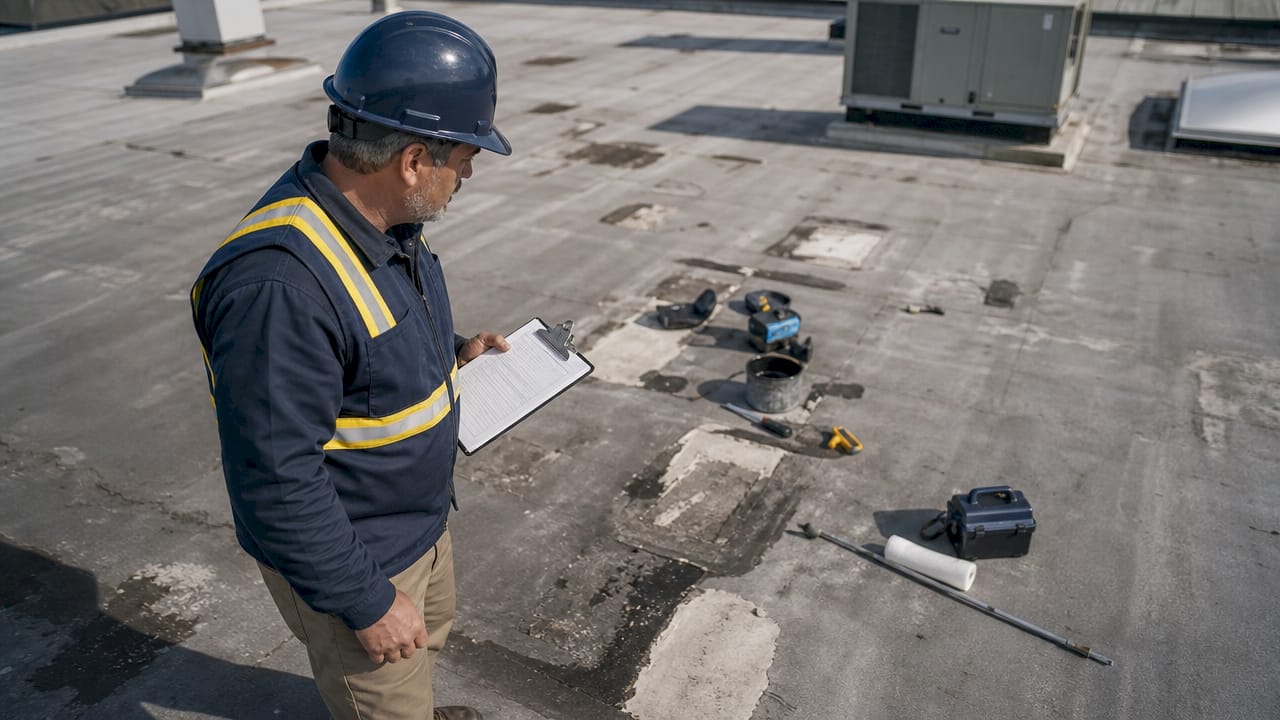
Reactive roofing is defined as the practice of repairing or replacing roof systems only after visible failure occurs, and it is the most expensive roofing strategy available to commercial contractors. The industry term for the alternative is planned preventive maintenance, and the cost gap between the two approaches is not marginal. Reactive roof maintenance costs 50%–82% more over a 10-year period compared to structured preventive programs. That gap compounds through emergency labor premiums, secondary damage, and premature replacements that strip capital from your business before you see them coming.
Why Reactive Roofing Is Expensive Roofing
The cost of reactive roofing does not come from a single line item. It accumulates across several categories, each one avoidable with a planned program.
Emergency Labor and Rush Materials
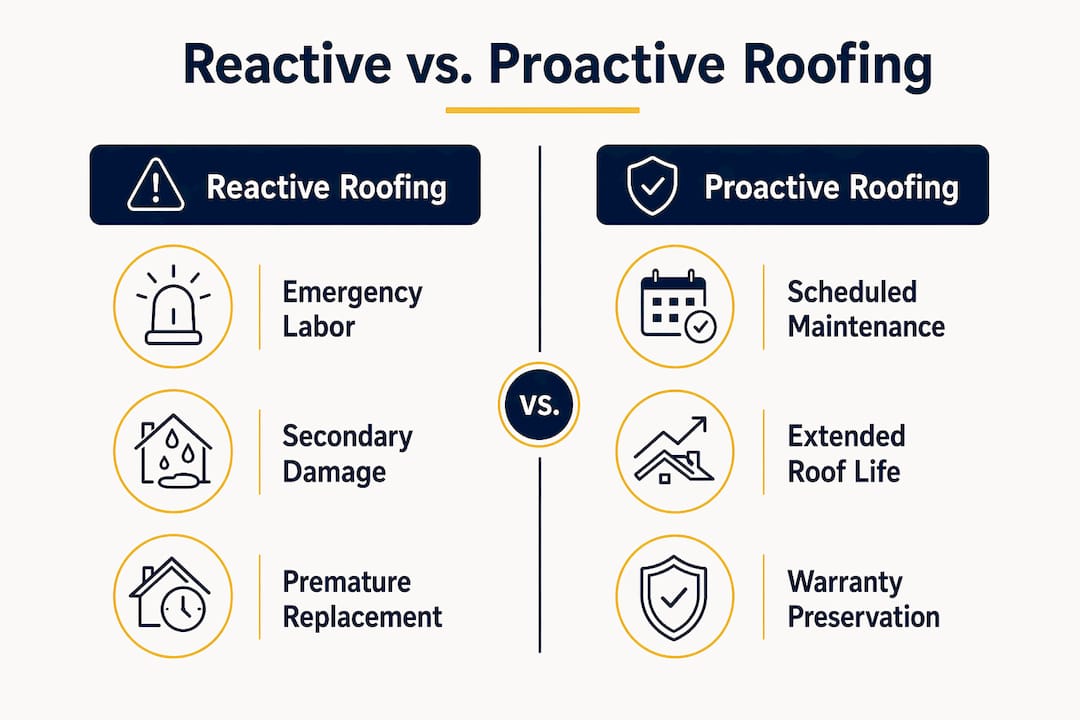
Emergency repairs cost 50%–100% more than scheduled maintenance visits because of after-hours labor rates and rush material sourcing. When a roof fails during a storm or during occupied business hours, you lose the ability to bid the work competitively. You call whoever is available, pay whatever rate they charge, and accept whatever materials are in stock. That is not a contractor problem. That is a structural cost created by the reactive model itself.
Pro Tip: Document every emergency call with time stamps, labor rates, and material costs. That data becomes the financial case you present to property managers when proposing a preventive contract.
Secondary Damage: The Hidden Multiplier
Secondary damage accounts for 35%–40% of total reactive roofing costs. Drywall, paint, flooring, and business interruption costs add $800–$3,000 per leak event. Those costs do not appear on your invoice, but they appear on your client’s balance sheet. Property managers who absorb those losses repeatedly start questioning whether their roofing contractor is managing their asset or just responding to it.
Premature Replacements
Repeated patch repairs without a replacement budget create a cumulative cost trap. Deferred maintenance leads to roof replacements 10 years ahead of schedule, generating avoidable capital expenditures of $50,000–$200,000 or more per roof. Annual preventive maintenance costs a few hundred to a few thousand dollars. The return on that investment exceeds 600% over a 10-year lifecycle. No other line item in a roofing budget produces that kind of return.
- Emergency labor premiums: 50%–100% above scheduled rates
- Secondary damage per leak event: $800–$3,000
- Premature replacement cost: $50,000–$200,000+
- Annual preventive maintenance cost: a few hundred to a few thousand dollars
How Does Reactive Roofing Affect Long-Term Asset Performance?
Reactive roofing does not just cost more per repair. It degrades the financial performance of the entire property portfolio over time.
Budgeting Volatility and Capital Disruption
Reactive roofing creates budgeting volatility and unpredictable capital expenses that disrupt portfolio planning. Emergency repairs and unplanned replacements force capital reallocation mid-year. Reserve adequacy modeling becomes unreliable. Property owners cannot plan for roof capital expenditures because the timing and cost are unknown until a failure occurs.
That quote reflects a shift in how sophisticated property managers now evaluate their roofing contractors. They are not just buying repairs. They are buying financial predictability. Contractors who offer that predictability win longer contracts and face less price competition.
Compressed Decision Timelines
Reactive decisions under stress reduce option sets and elevate costs because urgent timelines eliminate competitive bidding. When a roof is actively leaking, a property manager cannot wait two weeks for three bids. They call the first available contractor and accept the first price offered. That dynamic benefits the contractor in the short term but erodes trust over time. Clients who feel they had no choice during a crisis will look for alternatives when the crisis passes.
Accelerated Depreciation and Portfolio Valuation
Reactive roofing strategies erode asset valuation and complicate portfolio planning by increasing cost variance. A roof that reaches end of life 10 years early is not just a replacement cost. It is a depreciation event that affects the property’s appraised value, its insurance classification, and its attractiveness to investors. For contractors managing multi-property portfolios, this is the argument that lands with asset managers and CFOs.
What Evidence Supports Proactive Roofing as a Better Investment?
The financial case for proactive maintenance is not theoretical. The numbers are specific and consistent across multiple industry analyses.
Cost Comparison: Reactive vs. Proactive
A structured roof care program prevents $10,000–$12,000 in reactive costs annually. When hidden costs are included, reactive spending exceeds $20,000 per year per roof, compared to $3,000–$4,000 for planned maintenance. That is a 66%–82% cost reduction across every key metric.
Proactive maintenance extends roof life by 30%–50%. That extension alone justifies the program cost many times over, before accounting for emergency savings or secondary damage avoidance.
Warranty Preservation and Risk Management
Proactive maintenance preserves manufacturer warranties that reactive neglect voids. Most commercial roofing warranties require documented annual inspections. A single missed inspection cycle can void a warranty worth tens of thousands of dollars. Contractors who build roof inspection documentation into their service contracts protect both their clients and their own liability exposure.
Pro Tip: Present the warranty preservation argument to property managers before discussing cost savings. Warranty protection is a concrete, immediate benefit they can verify in their existing documents.
Stable Contracts Replace Emergency Calls
Proactivity enables contractors to move from unpredictable emergency jobs to stable, planned contracts that improve profitability and client trust. A contractor running 20 preventive maintenance contracts generates predictable monthly revenue. A contractor running 20 reactive accounts generates unpredictable emergency calls, premium labor costs, and client relationships built on crisis rather than confidence.
How Can Contractors Transition from Reactive to Proactive Programs?
The shift from reactive to proactive roofing is an operational change, not just a philosophical one. It requires specific workflow adjustments.
Build a Systematic Inspection Schedule
Start with a twice-yearly inspection program for every active account. Spring inspections catch winter damage before it worsens. Fall inspections prepare roofs for freeze-thaw cycles. Each inspection generates a condition report with photos, findings, and recommended actions. That report is both a service deliverable and a sales tool for future work.
- Schedule inspections in march and september for all active accounts
- Use a standardized service call checklist to capture consistent condition data
- Photograph every finding with GPS-tagged images
- Generate a written condition report within 24 hours of each visit
- Present findings with cost estimates for recommended repairs
Use Technology to Automate Condition Tracking
Manual reporting creates gaps. Crews forget details. Office staff re-enter data from paper forms. Automated reporting eliminates those gaps by capturing field data in real time and generating reports without manual re-entry. When condition data is consistent and timestamped, you build a maintenance history that supports both warranty claims and future contract renewals.
Key technology capabilities that support proactive programs:
- Mobile field apps for photo capture and condition logging
- Automated report generation from field data
- Scheduled maintenance reminders and crew dispatch
- Real-time cost tracking against contract budgets
- Real-time labor tracking to monitor field hours against estimates
Educate Property Managers on Budget Stability
Property managers respond to financial arguments. Present the annual cost comparison between reactive and proactive spending using their own building data. Show them the reactive vs. proactive cost data and translate it into their specific portfolio. A property manager who understands that reactive spending costs $20,000 per year versus $3,500 for a preventive contract will sign the contract. The math is not complicated. The presentation just needs to be clear.
Terial Helps Contractors Run Proactive Programs at Scale
Running proactive roofing programs across multiple accounts requires operational infrastructure that disconnected tools cannot provide. Terial is the unified operating system built specifically for commercial roofing contractors. It connects estimating, scheduling, field service, and invoicing into one real-time system. Crews log condition data in the field. Reports generate automatically. Invoices go out in under a minute. Terial’s field service application gives field crews the tools to capture photos, log findings, and complete service documentation without returning to the office. If you are ready to move your business from reactive chaos to planned profitability, explore Terial’s platform and see how contractors are building stable, scalable maintenance programs.
Key Takeaways
Reactive roofing costs 50%–82% more over 10 years than planned preventive maintenance, making proactive programs the only financially sound strategy for commercial roofing contractors.
FAQ
What Is Reactive Roofing?
Reactive roofing is the practice of repairing or replacing a roof only after a failure or visible damage occurs. It is the opposite of planned preventive maintenance, which addresses issues before they cause damage.
Why Is Reactive Roofing So Costly?
Emergency repairs cost 50%–100% more than scheduled visits due to after-hours labor and rush materials. Secondary damage from leaks adds $800–$3,000 per event on top of repair costs.
Is Reactive Roofing Ever Worth It?
Reactive roofing is not worth it as a primary strategy. Over a 10-year period, it costs 50%–82% more than a planned preventive program and shortens roof lifespan by up to 10 years.
What Are Affordable Alternatives To Reactive Roofing?
Planned preventive maintenance programs cost $3,000–$4,000 annually per roof and deliver 66%–82% cost savings compared to reactive spending. Twice-yearly inspections with documented condition reports are the standard starting point.
How Does Proactive Roofing Improve Contractor Profitability?
Proactive maintenance converts unpredictable emergency jobs into stable, recurring contracts. That shift improves cash flow predictability, reduces premium labor costs, and builds client relationships based on consistent service rather than crisis response.
Recommended
- Real-Time Labor Tracking Benefits for Roofing Contractors
- The Role of Real-Time Dispatching in Low-Slope Roofing
- Why Residential-First Roofing Software Fails on Commercial Jobs
- Why Low-Slope Roofing Needs Dedicated Service Software



Book a personalized demo
Get a 30-minute demo tailored to how you run your commercial roofing business

“Making the switch to Terial has greatly exceeded my expectations and has already had a meaningful impact on our team’s productivity. Terial has significantly reduced the amount of time required to complete many of our day-to-day operational tasks, allowing our team to focus more on serving our customers.”

