
Subcontractor Management for Commercial Roofing Projects
Master subcontractor management for commercial roofing projects with our comprehensive guide. Streamline contracts, improve compliance, and maximize profits!

Subcontractor management on commercial roofing projects is where margins get made or lost. Most project managers know this in theory, yet the day-to-day reality reveals gaps: unsigned contracts sitting in email inboxes, missing certificates of insurance, OSHA violations that trace back to a sub you assumed was handling their own safety program. The consequences compound fast. Delays bleed into liquidated damages, compliance failures become legal exposure, and rework eats the profit you built into the estimate. This guide gives you a systematic approach to managing roofing subcontractors from contract setup through final billing, with no steps skipped.
Key Takeaways
- Lock in contract language early: Poorly negotiated schedule and indemnity clauses are the top driver of uncompensated losses on roofing subcontracts.
- Verify licensing and insurance before mobilization: Subs must carry independent licenses and name you as additional insured before they set foot on the roof.
- Monitor certified payroll weekly: On Davis-Bacon projects, weekly submissions catch misclassifications before they become federal compliance violations.
- Use OSHA-specific fall protection controls: Trigger points differ by roof slope. Standardized, documented site controls reduce violations across all sub crews.
- Automate document workflows: Contract approvals, safety documentation, and change orders handled manually create bottlenecks that delay projects and generate errors.
Subcontractor Management on Commercial Roofing Projects: The Foundation
Before you can oversee a subcontractor, you need a clear legal and operational structure in place. Prime contractors retain overall responsibility for the project while subs perform work under formal subcontract agreements that flow down the prime’s obligations. That flow-down structure is not just boilerplate. It is how you transfer accountability for scope, schedule, safety, and insurance to the party actually performing the work.
What your subcontract must include
A subcontract that leaves gaps is a liability waiting to trigger. At minimum, every subcontract on a commercial roofing project should cover:
- Scope of work: Defined in writing, with drawings and specifications attached as exhibits
- Schedule obligations: Specific start and completion dates with milestones tied to payment
- Payment terms: Progress billing cycles, retainage percentages, and conditions for final payment
- Insurance requirements: Coverage types, minimum limits, and additional insured endorsements naming the prime
- Indemnity clauses: Who bears liability for what, spelled out clearly
- Safety obligations: Reference to site-specific safety plans and applicable OSHA standards
Licensing requirements vary by state, but subs generally need their own independent qualifications. You cannot assume your prime contractor license covers their work. Verify the license, then verify it is current.
Certificate of insurance
- Provided by: Subcontractor
- Required: Before mobilization
Additional insured endorsement
- Provided by: Subcontractor's insurer
- Required: Before mobilization
State roofing license copy
- Provided by: Subcontractor
- Required: Before contract execution
Signed subcontract
- Provided by: Both parties
- Required: Before mobilization
Site-specific safety plan
- Provided by: Subcontractor
- Required: Before work begins
Certified payroll reports
- Provided by: Subcontractor
- Required: Weekly (for Davis-Bacon projects)
Pro Tip: Build a pre-mobilization checklist into your contract workflow so no sub gets a notice to proceed until every item in that table is verified and filed.
Onboarding Subcontractors Without The Chaos
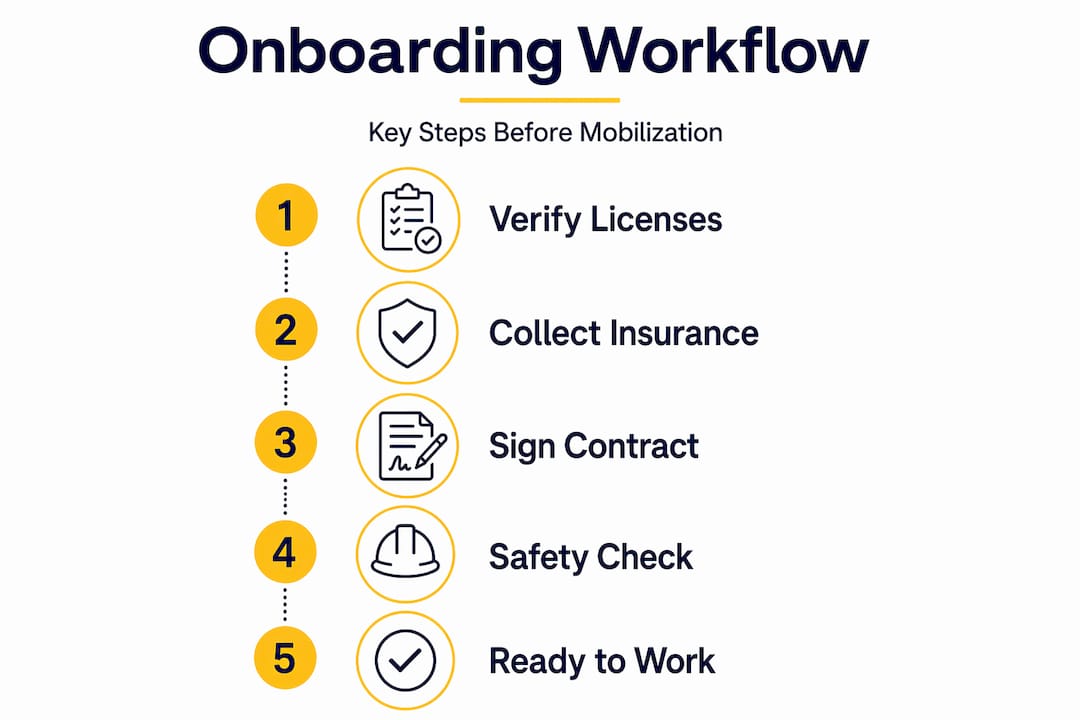
Onboarding is where good intentions fall apart. A sub shows up Monday morning and the contract is not fully executed, the safety documentation is missing, and the foreman does not know who to report to. That scenario plays out constantly on commercial roofing jobs. Here is a process that prevents it.
- Issue the subcontract draft at least two weeks before mobilization. This gives time for review, negotiation, and execution without rushing signatures on the first day of work.
- Create a document collection checklist. License copy, insurance certificate, additional insured endorsement, and any required safety certifications should all be received and logged before you return a countersigned contract.
- Schedule a pre-mobilization meeting. Cover project scope, site access rules, sequencing relative to other trades, reporting lines, and the change order process. Document attendance.
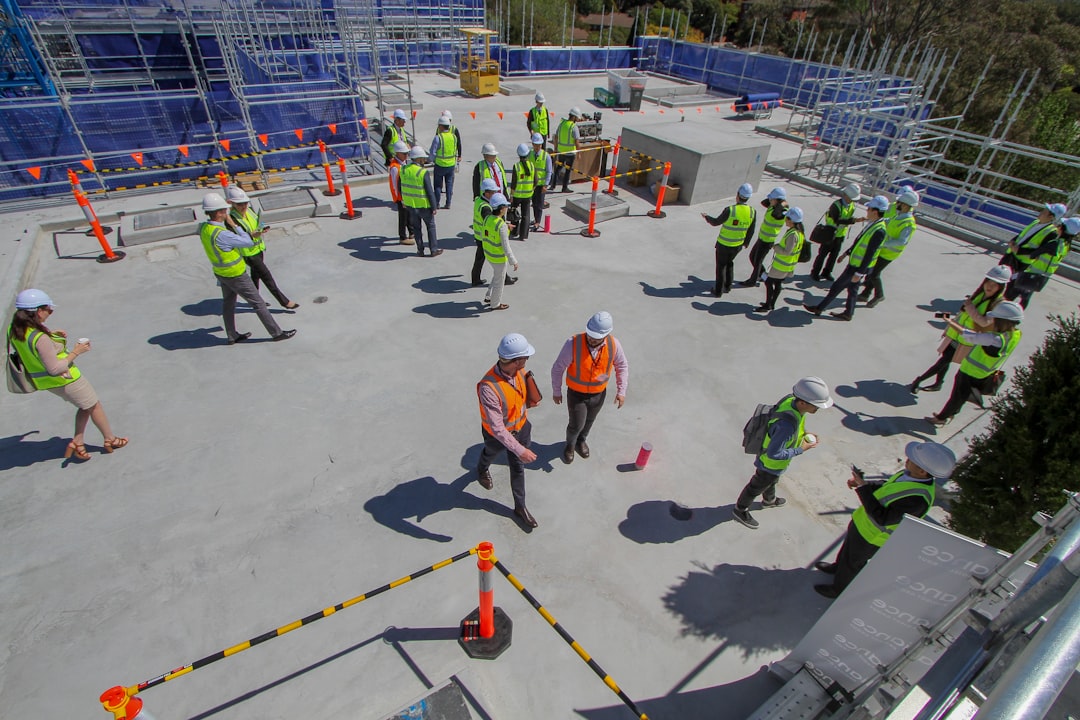
- Walk the sub foreman through the site safety plan. Do not assume they read it. Show them the fall protection setup, the warning line positions, and the location of emergency contacts.
- Set up communication channels. Define who the sub’s point of contact is for schedule changes, RFIs, and daily reporting. Ambiguity in communication structures costs time.
- Confirm permit status. If the sub is pulling their own permits, verify they have been obtained. If you are pulling them, confirm the sub understands what is covered and what requires separate approval.
Workflow automation reduces delays in contract approvals, onboarding, change orders, and document management, which directly improves project timelines. That improvement compounds across every sub you manage on a single job.
Pro Tip: Use digital signature tools to send subcontracts and safety acknowledgments. Automated reminders eliminate the back-and-forth of chasing down wet signatures and create a timestamped audit trail you can point to if disputes arise.
Oversight During Execution: Compliance, Safety, and Schedule
Once work begins, your job shifts from preparation to active monitoring. The three areas that demand consistent attention are payroll compliance, fall protection, and schedule adherence.
Certified Payroll and Davis-Bacon Compliance
On federally funded projects, certified payroll reporting is a mandatory weekly process. The prime contractor is responsible for collecting submissions from every subcontracting tier, not just direct subs. Payroll records must be retained for three years. The bigger risk is employee misclassification, because if a sub misclassifies a journeyman roofer as an apprentice to pay lower prevailing wages, your organization shares the compliance exposure. Weekly submissions catch misclassifications early rather than letting problems pile up until a federal audit surfaces them months later.
OSHA Fall Protection Requirements
OSHA fall protection triggers at 6 feet in construction. For low-slope roofs, warning lines must be set at least 6 feet back from the roof edge, with specific height and placement requirements. Steep-slope work requires different control systems entirely. What most GCs underestimate is that the multi-employer worksite doctrine holds you accountable for subcontractor safety violations, not just your own crew’s behavior. That means your oversight program needs to include sub crews, not just prime employees.
Warning line system
- Applicable roof type: Low-slope roofs only
- Key requirements:
- Warning lines must be placed at least 6 feet from the roof edge
- No work is permitted between the line and the edge without a designated monitor
Safety monitoring system
- Applicable roof type: Low-slope roofs only
- Key requirements:
- A designated safety monitor must be assigned
- The monitor cannot have other duties while monitoring
- The monitor must be a competent person
Personal fall arrest system (PFAS)
- Applicable roof type: All roof types
- Key requirements:
- Anchor strength must be verified
- Harnesses must be regularly inspected
- Tie-off points must be documented
Guardrails
- Applicable roof type: All roof types
- Key requirements:
- Top rail height must be 39–45 inches
- System must withstand 200 lbs of force applied outward or downward
Pro Tip: Consistent inspection documentation is your best defense in an OSHA investigation. Use a standardized daily safety checklist for each sub crew and store it with your project file.
The financial stakes are real. A recent workers’ compensation fraud case showed a subcontractor charged for $172,000 in premium avoidance on a roofing contract worth over $650,000. That liability traces directly back to the prime’s failure to verify insurance compliance before and during the project.
You can use labor tracking tools to cross-reference subcontractor reported hours against site activity and catch discrepancies before they become disputes or audit findings.
Contractual Pitfalls That Cost Real Money
The biggest hidden driver of subcontractor project failures is not site conditions or weather. It is inadequate contract language around schedule, site conditions, and indemnity. Failure to manage these terms can generate hundreds of thousands of dollars in financial exposure on a single project.
Here are the provisions that most often get negotiated away too quickly:
- Schedule-change clauses: If the owner pushes the start date and your subcontract does not include a mechanism for schedule adjustments, the sub has no obligation to honor original pricing or crew availability.
- Differing site conditions: Concealed condition clauses determine whether the sub can claim additional compensation when they encounter something not shown in the contract documents. If yours are silent on this, you absorb the argument.
- Payment contingency language: “Pay-when-paid” and “pay-if-paid” clauses have meaningfully different legal implications in most states. Know the difference and know what your subcontract actually says.
- Indemnity scope: Broad indemnity clauses that extend to the indemnitee’s own negligence are unenforceable in many states. If yours are overly broad, you may not have the protection you think you do.
- Notice requirements: Most subcontracts require written notice of claims within a specific window. A sub who misses that window may lose their right to recover, even if the underlying claim is legitimate.
Reviewing subcontract language with legal counsel before you sign is not a bureaucratic step. It is the least expensive insurance you can buy on a commercial roofing project.
Document every change in scope or schedule with a written change order, even when the relationship with the sub is strong. Verbal agreements become very expensive when a project ends over budget and everyone is reconstructing what was agreed.
Technology’s Role in Subcontractor Coordination
Managing roofing subcontractors across multiple active jobs with spreadsheets and email chains creates the exact fragmentation that delays projects and buries compliance problems. The manual process problem is not just inefficiency. It is risk, because the thing that falls through the cracks is usually the thing that becomes a claim.
Platforms built for commercial roofing project coordination deliver specific advantages in subcontractor management:
- Centralized contract storage with version control so every party is working from the same executed document
- Automated alerts for expiring insurance certificates, overdue payroll submissions, and unsigned change orders
- Digital safety documentation with date and time stamps that hold up to scrutiny in a dispute or OSHA inspection
- Integrated scheduling that shows how sub delays cascade into other trades and helps you intervene before a one-day slip becomes a week
- Real-time cost tracking that connects sub billing to budget so you see overruns as they develop, not after closeout
Pro Tip: Before adopting any platform, confirm that field crews will actually use it. The best workflow tool is the one your sub foremen open on their phones without being asked. Adoption is the metric that matters, not feature count.
How Terial Supports Your Subcontractor Workflows
If you are managing subcontractors across multiple commercial roofing projects with disconnected tools, the fragmentation itself is the problem. Separate spreadsheets for contracts, a different inbox thread for insurance certificates, manual reminders for payroll deadlines. Each gap is a place where something gets missed and a missed thing in subcontractor compliance roofing becomes a financial or legal event.
Terial was built specifically for commercial roofing contractors to replace that fragmentation with a single connected system. Automated alerts for expiring certificates, digital signatures on subcontracts, real-time cost tracking tied to sub billing, and safety documentation features that create audit-ready records without extra admin work. Explore Terial’s workflow automation platform and see how leading commercial roofing contractors are managing subcontractors without the manual overhead.
FAQ
What documents do you need before a sub starts work?
At minimum: a signed subcontract, a current certificate of insurance with additional insured endorsement, a copy of the sub’s state roofing license, and a site-specific safety plan. On Davis-Bacon projects, also confirm certified payroll setup before work begins.
How does the multi-employer worksite rule affect roofing GCs?
Under OSHA’s multi-employer worksite doctrine, general contractors can be cited for subcontractor safety violations even if the GC’s own employees were not involved. Proactive oversight and documented safety inspections are your primary defense.
What is the biggest contract risk in roofing subcontracts?
Poorly negotiated schedule and indemnity clauses create the most exposure. Schedule-change provisions, pay-if-paid versus pay-when-paid language, and overly broad indemnity terms have all led to six-figure disputes on commercial roofing projects.
How often should you collect certified payroll on a Davis-Bacon project?
Certified payroll must be submitted weekly from every tier of subcontractor. The prime contractor bears ongoing compliance responsibility for collecting and verifying those submissions throughout the project.
When does OSHA require fall protection on roofing work?
OSHA requires fall protection when workers are at or above 6 feet on construction sites. For low-slope roofs, warning line systems must be positioned at least 6 feet from the roof edge, with additional requirements based on slope and work type.
Recommended
- How to Track Labor Hours for Maximum Project Profit
- How Manual Processes Limit Roofing Scalability
- Terial | Workflow Automation for Commercial Roofers
- Level Up Your CRM Strategy | Terial Webinar




Book a personalized demo
Get a 30-minute demo tailored to how you run your commercial roofing business

“Making the switch to Terial has greatly exceeded my expectations and has already had a meaningful impact on our team’s productivity. Terial has significantly reduced the amount of time required to complete many of our day-to-day operational tasks, allowing our team to focus more on serving our customers.”

