
Low-Slope Service Workflow Best Practices for Contractors
Discover essential low-slope service workflow best practices for contractors. Boost efficiency, profitability, and compliance with expert insights.
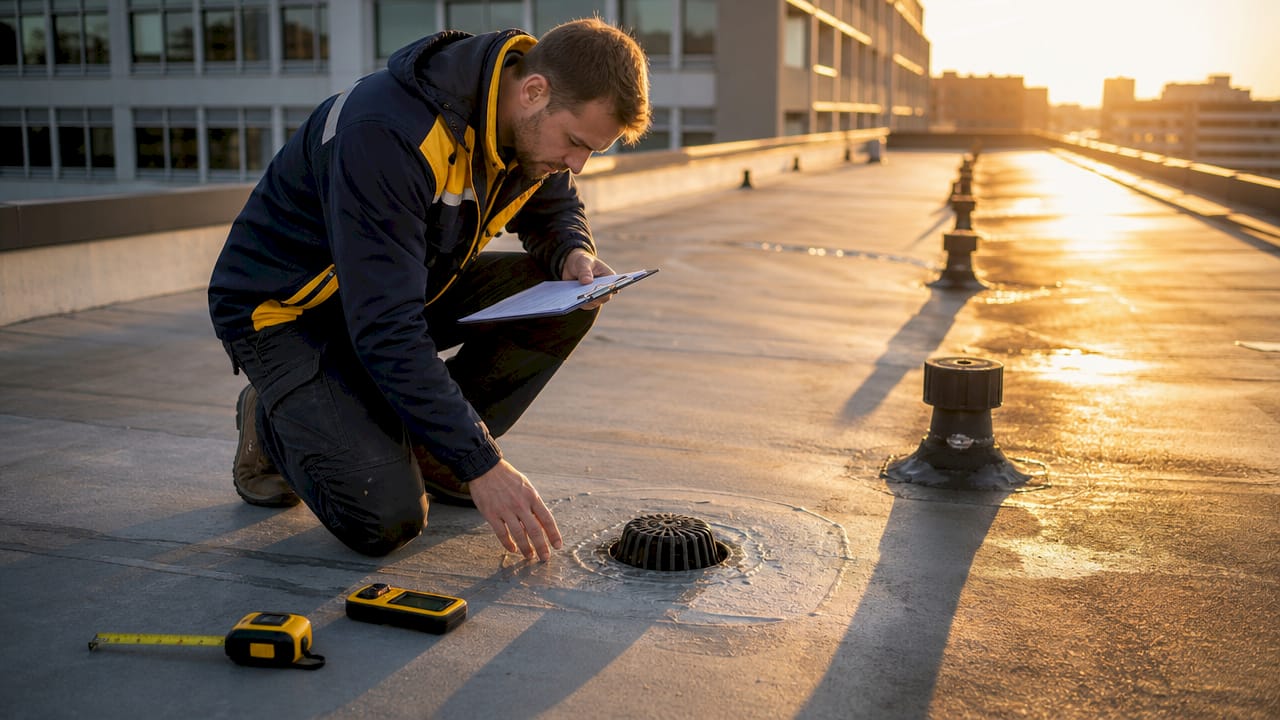
Low-slope service workflow best practices are standardized, repeatable processes that keep commercial roofing operations efficient, profitable, and compliant with NRCA drainage standards. For contractors managing flat and low-slope membrane systems, disconnected tools and inconsistent field procedures are the real profit killers. A missed drain inspection, an undocumented leak path, or a scheduling gap costs more than the repair itself. The practices covered here address the full service cycle, from initial site assessment through invoicing, so your crews deliver consistent results and your customers stay on contract.
1. What Are the Top Low-Slope Service Workflow Best Practices?
Standardized processes are the foundation of every efficient low-slope service operation. Without them, each technician makes independent judgment calls, quality varies by crew, and callbacks multiply. The most effective low-slope management strategies start with written procedures that every team member follows on every job.
The core best practices for low-slope roofing service include:
- Standardized inspection checklists covering membrane condition, flashing integrity, drain clearance, and ponding zones
- Phased rollout of new procedures to test changes on a subset of jobs before full deployment
- Digital dispatching and real-time crew communication to eliminate phone tag and missed assignments
- Routine maintenance protocols focused on debris clearance, drain inspection, and overflow pathway verification
- Scheduled crew productivity reviews to identify bottlenecks before they affect customer commitments
- Documented proposal and contract templates to set clear scope expectations before work begins
- Post-service customer satisfaction tracking to measure service quality and catch issues early
A phased rollout of new triage procedures minimizes disruption when you change documentation or dispatch workflows. Track handle time and time to resolution during the pilot phase to confirm the new process actually improves throughput before you roll it out company-wide.
Pro Tip: Build your inspection checklist directly into your dispatch workflow. When a technician accepts a job, the checklist opens automatically. This removes the step of remembering to pull it up on site.
2. How Positive Drainage Shapes Workflow Efficiency and Roof Longevity
Positive drainage is the single most important engineering factor in low-slope roof performance. NRCA recommends a minimum slope of 1/4 inch per foot to achieve positive drainage, meaning standing water must clear within 48 hours of rainfall. Roofs that fail this standard accumulate ponding water, which adds structural load and accelerates membrane breakdown.
Your service workflow must include a drainage assessment at every visit. Technicians who skip this step miss the most common cause of premature membrane failure. Document slope conditions, identify low spots, and flag any area where water has visibly pooled since the last inspection.
Key drainage workflow checkpoints
- Slope verification at drain locations and field areas using a digital level or slope gauge"
- Drain condition assessment including clamping ring tightness, strainer condition, and overflow drain clearance
- Ponding zone mapping with photos and GPS coordinates logged to the job record
- Tapered insulation recommendation when reroofing is triggered by chronic ponding
Tapered insulation during reroofing costs $3.00–$5.00 per square foot and prevents the membrane failures that come from long-term ponding. That cost is a fraction of an early membrane replacement.
Pro Tip: Photograph every drain at the start and end of each service visit. Time-stamped photos create a defensible record if a customer disputes whether a drain was cleared.
3. What Technology and Communication Practices Improve Low-Slope Roof Service?
Fragmented tools are the most common reason commercial roofing service operations underperform. When your CRM, scheduling app, and field documentation live in separate systems, data falls through the gaps and crews operate without full context. Integrating CRM, project management, and field service apps reduces human error and gives every team member a shared view of job status.
The technology practices that most directly improve service workflow outcomes include:
- Real-time dispatching so office staff can reassign crews instantly when priorities shift
- Automated reporting that generates service summaries without manual data entry after each visit
- Digital signatures collected on-site to confirm scope completion before a technician leaves
- Standardized proposal templates that define scope, exclusions, and warranty terms clearly
- Post-service CSAT surveys sent automatically within 24 hours of job close
Automated reporting removes a step that most field crews skip under time pressure. When the report generates itself from field inputs, the customer receives documentation the same day. That speed builds trust and reduces disputes over what was completed.
Real-time dispatching improves crew communication and customer satisfaction by eliminating the lag between office decisions and field execution. A technician who knows about a priority change immediately can adjust without a phone call chain.
Terial connects all of these functions in a single platform built specifically for commercial roofing. Field crews capture photos, log hours, and close jobs from a mobile interface. The office sees every update in real time without chasing status calls.
4. How to Implement Proactive Maintenance to Reduce Emergency Calls
Reactive maintenance costs more than scheduled maintenance every time. Emergency calls carry premium labor rates, disrupt crew schedules, and often reveal damage that a routine inspection would have caught months earlier. The contractors who reduce emergency call volume do it through formal inspection programs, not luck.
Proactive maintenance requires formal inspection logs and visual checks after storms to clear debris and verify membrane integrity. Debris buildup around drains is a primary cause of low-slope system failures. A single storm can deposit enough material to block a drain and trigger ponding within hours.
Effective proactive maintenance protocols include:
- Bi-annual scheduled inspections in spring and fall, timed around storm season transitions
- Post-storm visual checks within 48 hours of any significant weather event
- Drain and overflow clearing at every visit, logged with before-and-after photos
- Membrane condition scoring using a consistent rating scale so trends are visible across visits
- Leak path documentation that correlates interior stains with roof surface conditions
Routine inspections and documented leak paths identify hidden water intrusion points that are typically far from visible interior stains. Water on a low-slope roof moves slowly and travels before it finds a penetration point. Repairs that ignore this dynamic fix the symptom and miss the cause.
Pro Tip: Add a proactive maintenance checklist to every service agreement. Customers who see a structured inspection schedule renew contracts at higher rates than those receiving reactive-only service.
5. Which Organizational and Team Management Strategies Enhance Service Workflows?
Crew consistency is a workflow problem before it is a personnel problem. When technicians follow different procedures on the same roof type, quality becomes unpredictable and training costs rise. The contractors who run the tightest low-slope service operations build consistency into the system, not into individual habits.
The organizational strategies that most directly improve low-slope project management include:
- Detailed job checklists that leave no step to memory or individual interpretation
- Regular training on manufacturer specifications and OSHA safety protocols for low-slope geometry
- Crew scheduling built around travel zones to reduce drive time and overtime exposure
- Weekly production meetings that review open jobs, flag delays, and confirm upcoming assignments
- Leadership development for lead technicians so on-site decisions get made correctly without office escalation
OSHA classifies any roof with less than a 4/12 slope as low-slope, which triggers specific fall protection requirements. Training that ignores this distinction creates compliance risk on every job. Your workflow must include a safety protocol review as part of job setup, not as an afterthought.
Efficient scheduling reduces travel time and overtime, which directly improves profitability on service contracts. Assigning crews by geographic zone rather than by availability alone cuts non-billable hours without adding headcount. A crew scheduling workflow that accounts for drive time, skill match, and job duration keeps projects on track and margins intact.
Standardized workflows simplify training and strengthen quality control across crews. When a new technician joins, a documented process gets them productive faster than shadowing alone. Checklists and templates also reduce the misunderstandings between crews and customers that cause costly delays.
Key Takeaways
Consistent low-slope service workflow best practices require standardized inspection processes, positive drainage management, and connected technology to deliver reliable results and protect roof longevity.
How Terial Helps Contractors Run Tighter Service Operations
Fragmented tools are the root cause of most service workflow failures in commercial roofing. When dispatch lives in one app, documentation in another, and invoicing in a spreadsheet, information gets lost and jobs take longer than they should. Terial is the unified operating system built to replace that fragmentation. The field service application connects dispatching, site documentation, and customer communication in a single mobile interface that field crews actually use. Automated reporting, digital signatures, and real-time job status give your office team full visibility without status calls. See how Terial’s workflow automation for commercial roofers fits your service operation.
FAQ
What Is the Minimum Slope for a Low-Slope Commercial Roof?
NRCA recommends a minimum slope of 1/4 inch per foot for positive drainage on commercial low-slope roofs. Standing water must clear within 48 hours to avoid structural loads and membrane damage.
How Does OSHA Define a Low-Slope Roof?
OSHA classifies any roof with less than a 4/12 slope as low-slope, which triggers specific fall protection requirements that differ from steep-slope work.
What Causes Most Low-Slope Roof Failures?
Debris buildup around drains is a primary cause of low-slope system failures. Blocked drains lead to ponding, which adds structural load and accelerates membrane breakdown over time.
How Often Should Low-Slope Roofs Be Inspected?
Bi-annual inspections in spring and fall, combined with visual checks within 48 hours of significant storms, form the baseline for an effective proactive maintenance program.
What Is the Most Cost-Effective Fix for Chronic Ponding?
Tapered insulation during reroofing costs $3.00–$5.00 per square foot and prevents the membrane failures caused by long-term ponding. It is significantly less expensive than premature membrane replacement.
Recommended


More articles



Book a personalized demo
Get a 30-minute demo tailored to how you run your commercial roofing business

“Making the switch to Terial has greatly exceeded my expectations and has already had a meaningful impact on our team’s productivity. Terial has significantly reduced the amount of time required to complete many of our day-to-day operational tasks, allowing our team to focus more on serving our customers.”

