
What Is a Roofing Operating System? A 2026 Guide
Discover what is a roofing operating system and how it can unify your roofing business operations, replacing chaos with efficiency.
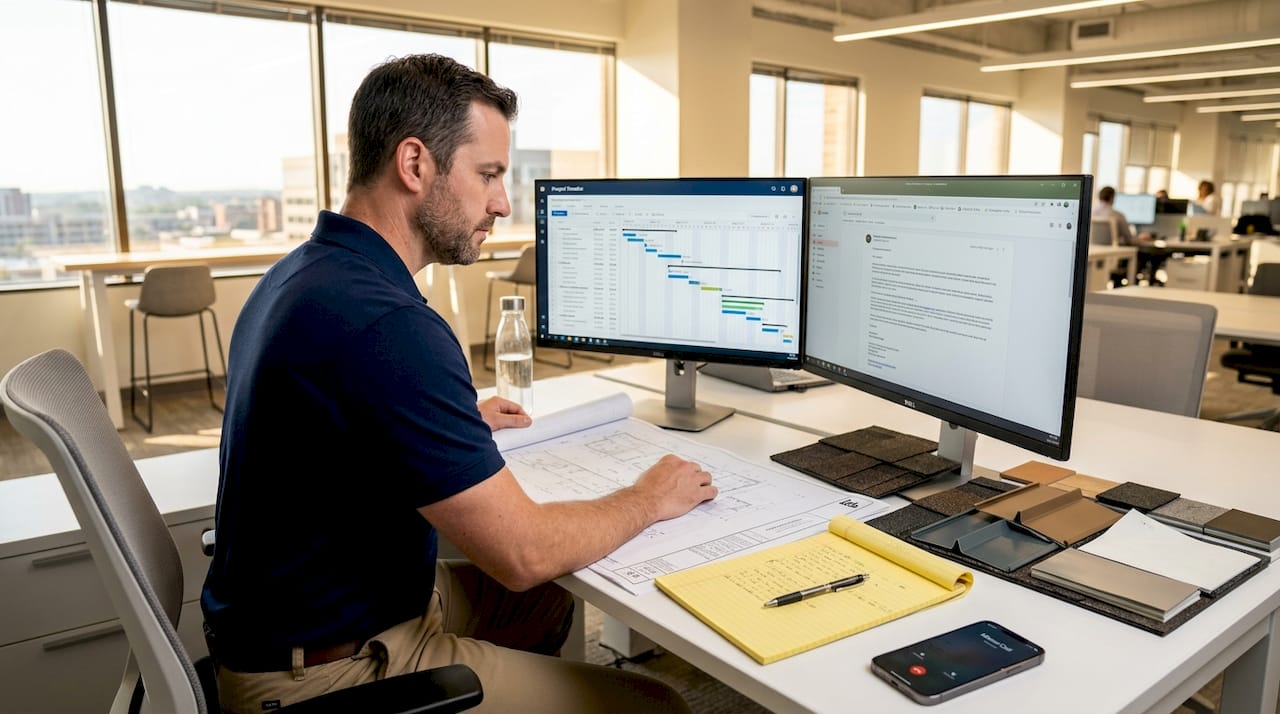
Most commercial roofing companies are running five, six, sometimes seven software tools that were never meant to work together. There’s a CRM over here, an estimating tool over there, accounting in a third system, and a spreadsheet holding the whole thing together with tape and hope. Understanding what is a roofing operating system means understanding the alternative to that chaos. It’s not another app to add to the pile. It’s a unified operational model, sometimes called an integrated workflow platform, that connects every stage of a commercial roofing job from first inspection to final invoice.
Key Takeaways
- Not just another app: A roofing operating system unifies every workflow stage, replacing the fragmented tool stack entirely.
- Built for commercial complexity: Generic or residential-focused software cannot handle multi-building campuses, system-level pricing, or GC documentation.
- AI requires standardization first: Automation only works when your underlying workflows are consistent and structured across every job.
- Fragmentation has a real cost: Manual data re-entry and spreadsheet bridges drain office staff time and introduce errors that hurt margins.
- Evaluate fit before you buy: Look for platforms purpose-built for commercial roofing with real-time job costing, crew dispatch, and multi-phase scheduling.
What a Roofing Operating System Actually Is
The term “roofing operating system” is an informal but useful way to describe what the industry formally calls a unified workflow platform or integrated roofing management system. Think of it like the operating system on your phone. Your individual apps don’t each manage their own memory, connectivity, and processing independently. The OS coordinates everything underneath. A roofing operating system does the same thing for your business.
At its core, it integrates sales, estimating, production scheduling, field execution, and financial closeout into one consistent flow. No manual handoffs. No re-keying a job number from your CRM into your accounting software. The workflow carries the data forward automatically.
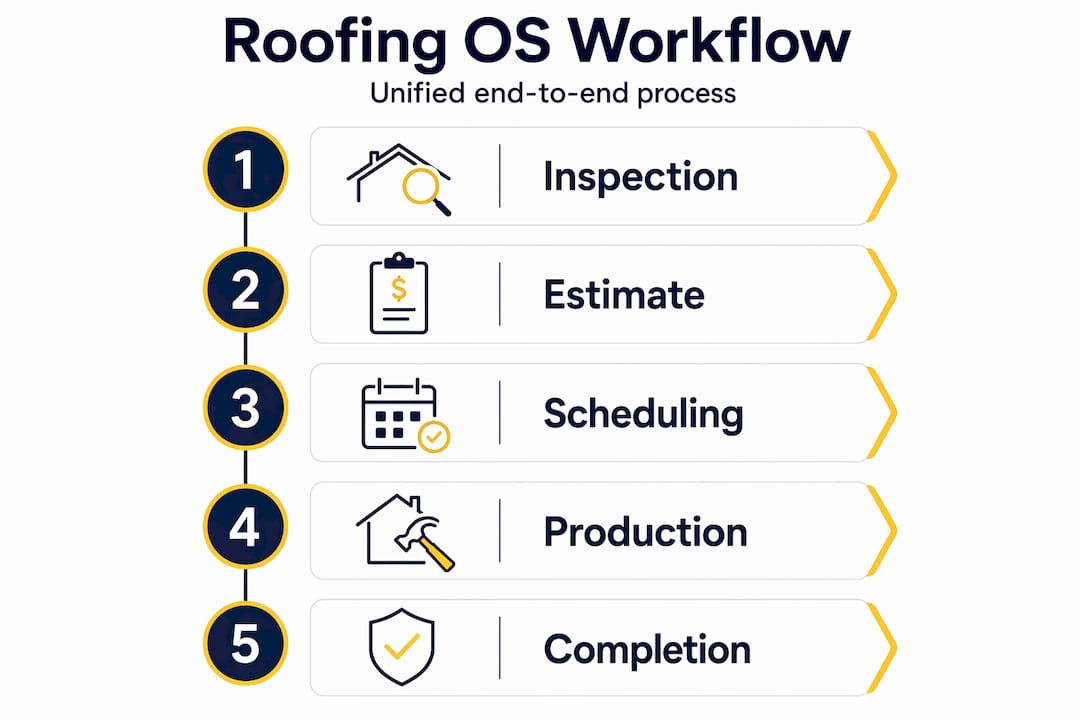
What makes this different from a point solution like a standalone CRM or proposal tool is the end-to-end scope. A well-designed roofing business system maps the full job lifecycle through a repeatable loop:
- Inspection: Document site conditions with structured data and photos
- Evidence: Capture proof of problem, scope, and existing conditions
- Scope: Build the proposal from standardized line items and system specs
- Dispute: Manage change orders, insurance claims, or scope conflicts
- Build: Dispatch crews, track labor, monitor materials and costs in real time
- Closeout: Generate final documentation, collect signatures, send invoices
- Reputation: Trigger review requests and client follow-up automatically
That loop is not just a workflow. It’s a business asset. When every job runs through the same structure, repeatable execution becomes scalable, and you stop losing institutional knowledge every time a project manager leaves.
The Fragmentation Problem No One Talks About Honestly
Here’s the version of the tool-stack problem that most vendors won’t tell you: the issue isn’t that your CRM is bad or that your estimating software is wrong. The issue is that 5 to 7 disconnected tools create manual work that compounds across every single job you run. And the manual work is always slightly wrong.
Most companies deal with this through what’s known as the spreadsheet bridge. Someone on the office team maintains a master sheet that pulls job status from one tool, payment status from another, and material orders from a third. It works until it doesn’t. And when it breaks, you find out at the worst possible time, usually when a client asks a question you can’t answer or when a crew shows up at a job that wasn’t ready.
Roofing software solutions that take a true operating-system approach solve this with an orchestration layer. Rather than connecting tools point-to-point with integrations that require constant maintenance, workflow becomes the integration layer itself. When an estimate gets approved, it automatically triggers a job in the scheduling module, notifies the procurement team, and creates a draft invoice in accounting. No human touches any of that.
Here is how that plays out practically across a typical job:
- A site inspection is logged in the field via mobile app, including photos and structured condition notes
- The system generates a draft scope from templated line items tied to that roof system type
- An estimator reviews and sends the proposal directly from the same platform, with e-signature built in
- Approval triggers crew scheduling, material ordering, and a project kickoff notification to the client
- Labor hours log against the job in real time as the crew works, with GPS and time-stamp verification
- At closeout, the invoice is generated from actual job data, not a separate manual entry
Pro Tip: If your team is re-entering the same job information into more than two systems, you don’t have a software problem. You have an orchestration problem. That’s the exact gap a roofing operating system is designed to close.
The productivity gain here is not marginal. When office staff stop acting as manual synchronization agents between disconnected tools, they can focus on customer communication, upsell opportunities, and actual problem-solving.
Why Commercial Roofing Needs Its Own System
This is where a lot of companies go wrong. They adopt a home-services CRM or a residential estimating platform and spend the next six months trying to force it to work for commercial jobs. It never fully does.
Commercial roofing operations involve multi-building campuses, proposals organized by roofing system rather than by square foot, and documentation packages that satisfy property managers and general contractors. These are not features you can bolt onto a residential platform. They require a fundamentally different data model.
Consider the practical differences between what a generic home-services tool handles and what a commercial job actually demands:
- Generic Home-Services Software: Single address per job
- Commercial Roofing OS: Multiple buildings and systems per site
- Generic Home-Services Software: Per-square or flat-rate pricing
- Commercial Roofing OS: System-level pricing with spec variations
- Generic Home-Services Software: Single crew, single-day projects
- Commercial Roofing OS: Multi-phase, multi-crew, multi-week projects
- Generic Home-Services Software: Basic work orders
- Commercial Roofing OS: GC-ready submittals, warranties, and closeout packages
- Generic Home-Services Software: Estimate vs. invoice tracking
- Commercial Roofing OS: Real-time cost tracking by phase and trade
- Generic Home-Services Software: Not supported
- Commercial Roofing OS: Integrated labor and subcontractor management
Choosing a system that doesn’t reflect these complexities leads to margin bleed you can’t always trace back to a single cause. You just know jobs are taking longer and costing more than they should.
Commercial roofing also requires managing the relationship with property managers and general contractors at a documentation level. These clients don’t just want a completed roof. They want a paper trail, digital or otherwise, that protects them in case of a warranty claim or insurance dispute. A purpose-built commercial platform handles job costing, subcontractor tracking, and multi-day scheduling natively, not as workarounds. That’s a significant operational advantage when you’re running 30 or 40 active jobs simultaneously.
You can read more about why residential-first software falls short in contexts like yours, particularly when it comes to documentation and proposal complexity.
AI and the Next Level of Operational Management
The most advanced roofing software solutions today don’t just connect your tools. They monitor your business and act on what they find.
AI-powered operations platforms are shifting the role of office managers from reactive coordinators to strategic overseers. When the system can detect an aging estimate and trigger a follow-up automatically, your team’s time goes to the jobs that actually need human judgment.
AI-driven monitoring can flag an estimate that’s been sitting for 12 days without a response, automatically send a follow-up, and alert the sales rep if there’s still no engagement. The same logic applies to invoicing. One commercial-focused AI operations platform reports recovering between $50,000 and $150,000 per month from aging estimates and unpaid invoices simply by automating follow-up workflows that were previously handled manually or not at all.
That kind of outcome is only possible when the underlying data is structured and continuous. AI dashboards built on top of messy, fragmented data can show you charts, but they can’t act on what they see. For AI to drive real outcomes, operational data must flow through a single system in a consistent format.
This is why standardized workflows come first. Capital City Roofing built their operations around AI compatibility from day one and saw dramatic improvements in timeline adherence and crew utilization. Companies that try to retrofit AI on top of existing fragmented processes get dashboards that look impressive and do very little. The sequence matters: standardize the workflow, then layer in automation, then add AI monitoring and agents on top of that foundation.
For commercial roofers, this means the decision to adopt a roofing operating system is also, increasingly, a decision about whether your business will be AI-ready in two years.
How to Choose the Right Platform
Evaluating roofing management software is not primarily a feature comparison exercise. It’s a diagnosis of where your current operation is losing time and money.
Start by asking your team a few direct questions:
- How many times does a job number get entered manually into different systems before a job closes?
- When a client asks for the current status of their project, how long does it take to find an accurate answer?
- How often do invoices go out late because someone had to compile information from multiple places?
- Can your project managers see real-time labor costs against budget from their phone?
If any of those questions surfaces a painful answer, you’re feeling the cost of fragmentation. From there, look for platforms with these specific capabilities built natively, not through third-party integrations:
- Real-time job costing with labor, material, and subcontractor tracking in one view
- Multi-phase scheduling with crew dispatch and mobile clock-in
- Proposal tools that handle system-level commercial pricing and tiered options
- Automated invoicing that pulls from actual job data
- Field mobile apps that crews actually use, not ones that require training sessions every quarter
Scalability matters too. A platform that works for 15 active jobs should work for 150 without requiring a rebuild of your workflows. Ask vendors specifically how their architecture handles growth and what happens to your data if you need to migrate.
Pro Tip: Before committing to any platform, ask the vendor for a live demo using a real commercial job scenario, not their scripted walkthrough. Give them a multi-building job with a change order mid-project and see how the system handles it. That test will tell you more than any feature checklist.
Finally, change management is the part most companies underestimate. The best roofing operating system in the world does nothing if your crews ignore the mobile app and your estimators keep using spreadsheets. Budget time for training, assign internal champions, and track adoption metrics in the first 90 days. Managing manual process limitations proactively is how you protect your investment.
How Terial Brings This All Together For Commercial Roofers
If your diagnosis points to fragmentation, Terial was built specifically for this moment. It’s the unified operating system for commercial roofing contractors, connecting estimating, sales pipeline management, field service, project scheduling, and invoicing in one real-time platform. Not a collection of integrations. One system.
Terial’s field service application is built for actual crew adoption, with mobile interfaces that make logging hours, photos, and change orders fast enough that people actually use them. On the back end, automated invoicing pulls from real job data, so your billing goes out accurately and fast. Contractors like Damschroder Roofing have used Terial to close 15% more jobs while improving operational clarity across the board. If you’re ready to see what a purpose-built commercial roofing OS looks like in practice, explore Terial.
FAQ
What is a roofing operating system?
A roofing operating system is a unified platform that connects every stage of a commercial roofing job, from inspection and estimating to scheduling, field execution, and invoicing, into one consistent workflow. It replaces the fragmented stack of disconnected tools most roofing companies rely on.
How is a roofing OS different from a standard CRM?
A CRM manages contacts and sales activity. A roofing operating system manages the entire job lifecycle, including production, field operations, real-time job costing, and financial closeout, going far beyond what any CRM is designed to do.
Why do commercial roofers need a separate system from residential platforms?
Commercial jobs involve multi-building sites, system-level pricing, multi-phase scheduling, and documentation requirements for property managers and general contractors. These needs are structurally different from residential work and require purpose-built tools that reflect that complexity.
What does roofing software do when it’s AI-powered?
AI-powered roofing platforms monitor aging estimates, unpaid invoices, and crew performance in real time, then automate follow-up and dispatch tasks without manual input. This kind of automation requires structured, continuous data flowing through a single system to be effective.
How do I know if my company needs a roofing operating system?
If your team re-enters job data into multiple systems, struggles to get real-time project status, or consistently invoices late because information lives in different places, your operation is fragmented enough that a unified roofing business system would generate immediate and measurable returns.
Recommended




Book a personalized demo
Get a 30-minute demo tailored to how you run your commercial roofing business

“Making the switch to Terial has greatly exceeded my expectations and has already had a meaningful impact on our team’s productivity. Terial has significantly reduced the amount of time required to complete many of our day-to-day operational tasks, allowing our team to focus more on serving our customers.”

