
How Technology Drives Roofing Platform Value Creation
Discover the role of technology in roofing platform value creation. Learn how tech drives efficiency and boosts profits in the roofing industry.

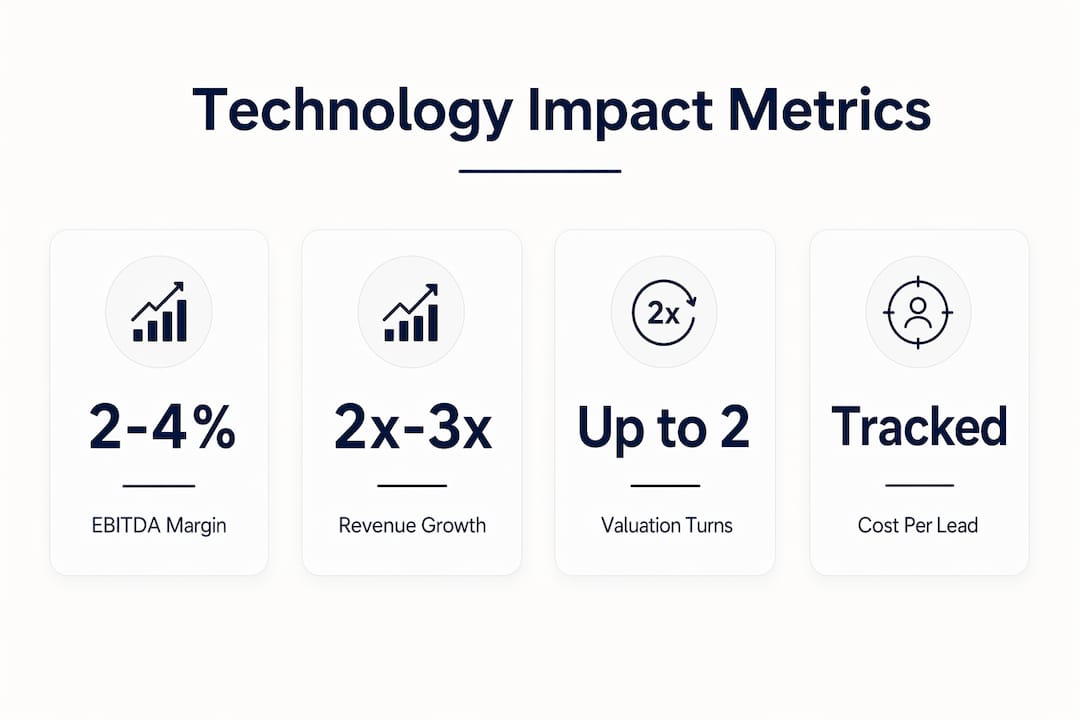
Technology is the primary driver of value creation in commercial roofing platforms, turning fragmented field operations into measurable, scalable businesses that attract capital and command higher sale prices. The role of technology in roofing platform value creation goes far beyond software adoption. It determines whether your business runs on clean data or costly guesswork, whether your crews execute consistently or improvise daily, and whether a buyer sees a scalable asset or an integration liability. Private equity playbooks from 2026 confirm that unified CRM and automated documentation drive 2–4 percentage points of EBITDA margin expansion within the first year. That is not a rounding error. For a $5 million EBITDA business, that gap is $100,000 to $200,000 in annual profit.
How Technology Enhances Operational Efficiency and Drives EBITDA Margin Expansion
Disconnected tools are the single biggest margin killer in commercial roofing. When estimating lives in one spreadsheet, scheduling in a text thread, and invoicing in a separate system, every handoff creates waste. Pricing errors slip through. Crews show up to jobs without current scopes. Change orders get forgotten. The result is shrinking margins on jobs that should have been profitable.
Standardized operational platforms that unify CRM and automate documentation consistently deliver 2–4 percentage points of EBITDA margin expansion in year one. Those gains come from three specific sources: improved pricing discipline through standardized quoting, reduced labor waste from better crew management, and fewer billing errors from automated documentation. Each source is small on its own. Together, they compound into a structurally more profitable business.
Pricing discipline is where most contractors leave the most money behind. When every estimator builds quotes from the same templates and labor rates, you stop underpricing jobs to win work. Automated quoting removes the human tendency to shave margins under competitive pressure. The system enforces the floor.
Crew management inefficiencies are equally costly and harder to see. When dispatch runs through phone calls and text messages, you pay for coordination time that produces no billable output. Automating crew dispatch cuts that overhead and gives field supervisors real-time visibility into job status without calling the office.
Pro Tip: Stacking small, consistent technology improvements in communication and documentation reduces overhead faster than any single large initiative. Prioritize one workflow fix per quarter and measure the margin impact before moving to the next.
What Is the Impact of Digital Marketing Technology on Revenue Growth?
Digital marketing infrastructure is the fastest revenue lever in a roofing platform, and most contractors are not using it. The gap between a contractor running fragmented marketing and one running an integrated digital system is not incremental. Sophisticated digital marketing infrastructure produces 2x to 3x higher customer acquisition volume compared to fragmented baseline approaches. That difference fuels 30%–50% year-one revenue growth for newly acquired branches.
The mechanism is straightforward. Most commercial roofing markets have significant local search volume that goes uncaptured because contractors lack the infrastructure to convert it. An integrated system connects paid search, local SEO, lead routing, and CRM follow-up into a single pipeline. Every lead gets tracked, scored, and followed up automatically. Nothing falls through the cracks.
PE-backed roofing platforms typically invest $50,000 to $150,000 in year one to overhaul digital marketing and CRM infrastructure. That investment prioritizes standardized quoting and crew documentation over headcount cuts. The logic is clear: fix the revenue engine first, then let operational efficiency gains follow.
Here is what that investment typically covers:
- Local SEO and Google Business Profile optimization to capture existing search demand in each market
- Paid search campaigns with standardized landing pages tied directly to CRM lead intake
- Automated lead follow-up sequences that contact prospects within minutes of inquiry
- Close rate tracking by lead source to identify which channels produce the highest-value jobs
- Service data reporting that connects marketing spend to actual contract revenue
The contractors who scale fastest are not the ones with the biggest crews. They are the ones who can predict where the next job is coming from and close it before a competitor even responds.
What Are the Key Technology Components Driving Value Creation?
The technology stack that creates the most value in a roofing platform is not the most feature-rich one. It is the one your crews actually use. Effective platform adoption depends more on usability and crew acceptance than on selecting the most feature-loaded software. A system that sits unused in the office creates zero value.
The components that matter most, in order of impact:
- Unified CRM with centralized customer data. Every lead, job, and customer interaction lives in one place. Unified reporting and centralized data are non-negotiable for roofing companies that want to operate as data-driven enterprises. Without this foundation, every other tool produces siloed information that cannot be acted on at scale.
- AI-powered measurement and estimating. AI tools that generate roof measurements from aerial imagery and auto-populate estimate templates cut proposal time from hours to minutes. Most contractors have not yet adopted AI features embedded in CRM platforms, which means early adopters hold a real competitive advantage right now.
- Mobile work order completion. Field crews need tools that work on a phone, on a roof, in the rain. Mobile work order apps that let crews close out jobs, capture photos, and collect signatures on-site eliminate the end-of-day paperwork backlog that delays invoicing and distorts job cost data.
- Automated scheduling and dispatch. Scheduling software that accounts for crew certifications, equipment availability, and job location reduces the coordination overhead that burns office staff time. Real-time schedule visibility also reduces the “where is my crew?” calls that interrupt project managers.
- Automated reporting for operations leaders. Automated reporting tools give operations leaders daily visibility into job cost variance, crew productivity, and pipeline health without manual data pulls. That visibility is what separates reactive management from proactive decision-making.
Pro Tip: Before committing to any platform, run a self-guided trial on a real job. Put the app in the hands of your field crew for two weeks. If they are not using it by day ten, the software will not create value at scale regardless of its feature list.
How Does Technology Maturity Affect Roofing Business Valuation?
Technology maturity is now a direct input to roofing business valuation, not a secondary consideration. Roofing businesses operating on spreadsheets and text messages face valuation penalties of up to two full EBITDA turns. On a business earning $3 million in EBITDA at a 6x multiple, that penalty is $6 million in lost enterprise value.
Buyers treat manual workflows as integration liabilities. When a buyer acquires a roofing business, they need to re-engineer every manual process before they can scale it. That re-engineering costs time and money, and buyers price that risk into their offer. A business that already runs on clean, documented workflows commands a premium because the buyer can scale immediately.
The metrics that move multiples are specific. Companies that can demonstrate cost per lead, close rate by lead source, job cost variance, and crew productivity through technology-enabled reporting can model their own growth. Buyers pay more for predictability than for raw revenue.
Roofing operators who build operational discipline into software well before a sale significantly enhance their valuation by giving buyers clean, reliable metrics from day one. The time to start is not six months before a sale. It is now, so the data has depth and credibility when it matters.
Key Takeaways
Technology-driven operational discipline is the single most reliable path to higher margins, faster revenue growth, and stronger valuations in commercial roofing platforms.
Terial Gives Commercial Roofers the Operating System to Compete
Fragmented tools are not a minor inconvenience. They are a direct tax on your margins, your valuation, and your ability to scale. Terial is the unified operating system built specifically for commercial roofing contractors, connecting estimating, scheduling, field service, and invoicing into one real-time system. Field crews complete mobile work orders on-site, office teams get instant job cost visibility, and invoices go out in under a minute. The result is the kind of clean, documented operation that commands premium valuations and supports real growth. Visit Terial’s workflow automation platform to see how it fits your operation.
FAQ
What Is the Role of Technology in Roofing Platform Value Creation?
Technology creates value in roofing platforms by improving pricing discipline, reducing labor waste, and enabling the clean metrics that buyers and investors require. Unified systems that connect CRM, field operations, and reporting are the foundation of every high-performing roofing platform.
How Much EBITDA Margin Can Technology Add to a Roofing Business?
Standardized operational platforms with unified CRM and automated documentation typically add 2–4 percentage points of EBITDA margin within the first year of implementation. Those gains come from better pricing discipline, standardized quoting, and reduced crew management inefficiencies.
How Does Digital Marketing Technology Drive Revenue Growth in Roofing?
Integrated digital marketing infrastructure produces 2x to 3x higher customer acquisition volume compared to fragmented approaches, often fueling 30%–50% revenue growth in year one for newly acquired branches. The key is connecting lead capture, CRM follow-up, and close rate tracking into a single pipeline.
How Does Technology Maturity Affect a Roofing Company’s Sale Price?
Roofing businesses that rely on manual workflows face valuation penalties of up to two full EBITDA turns because buyers price in the cost of re-engineering those processes post-acquisition. Companies with tech-enabled reporting and clean operational metrics command higher multiples.
What Technology Should Commercial Roofing Contractors Prioritize First?
Start with a unified CRM that centralizes customer data and reporting, then add mobile work order completion for field crews. These two components deliver the fastest margin impact and create the data foundation every other technology investment depends on.
Recommended
- Terial | Workflow Automation for Commercial Roofers
- How Roofing Service Data Drives New Contracts
- Automated Workflows and Roofing Profitability: 2026 Guide
- What Is a Roofing Operating System? A 2026 Guide




Book a personalized demo
Get a 30-minute demo tailored to how you run your commercial roofing business

“Making the switch to Terial has greatly exceeded my expectations and has already had a meaningful impact on our team’s productivity. Terial has significantly reduced the amount of time required to complete many of our day-to-day operational tasks, allowing our team to focus more on serving our customers.”

