
How Manual Processes Limit Roofing Scalability
Discover why manual processes limit roofing scalability. Uncover bottlenecks to unlock growth and boost your roofing company’s efficiency.
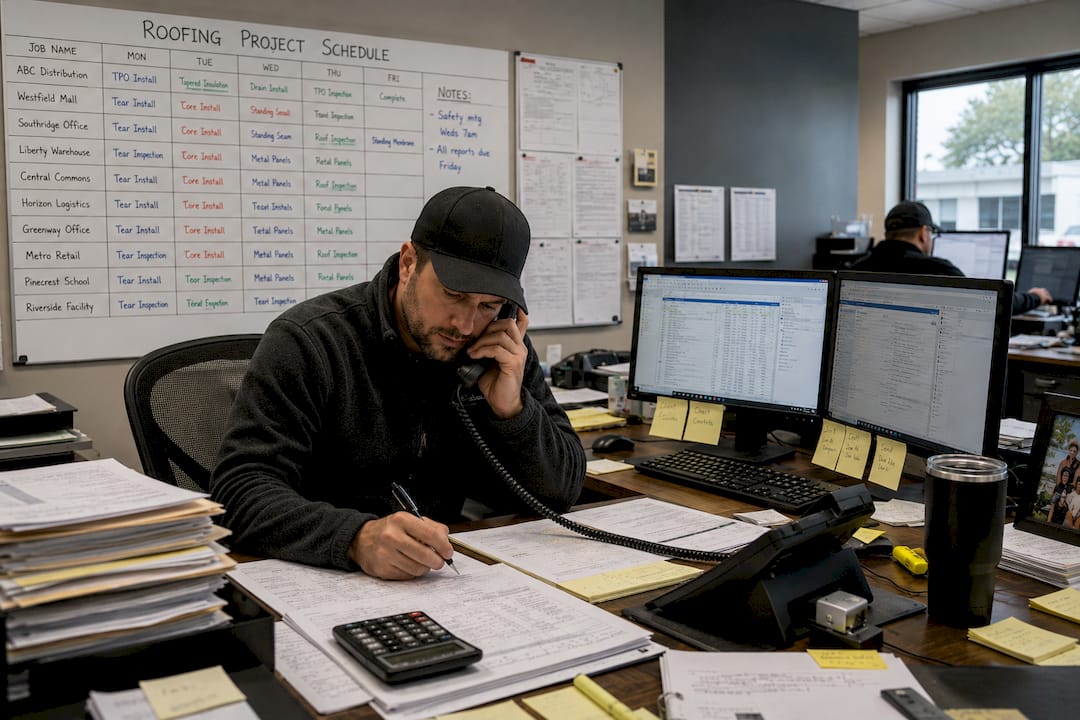
At some point, every commercial roofing company that hits $5M in revenue faces the same invisible ceiling. The work keeps coming in, you keep hiring, and yet margins stay flat or shrink. The culprit is rarely the market or your crew quality. Manual workflows create scalability bottlenecks by forcing your staff to spend enormous shares of time on administrative work rather than production. This article breaks down exactly where those bottlenecks form, how they compound as you grow, and what the data says about the only reliable path through them.
Key Takeaways
- Manual workflows drain productivity. Paper-based processes use far more admin time and create bottlenecks as companies grow.
- Errors scale with volume. Manual systems cause more mistakes and costly rework as projects and teams increase.
- Standardization is the key. Scalable growth comes from connected, standardized digital workflows, not just more staff.
- Operational debt is risky. Reliance on manual controls builds up unseen risk that can threaten business stability during change or spikes.
- Workflow automation unlocks growth. Adopting digital solutions enables seamless scaling, error reduction, and a strong competitive edge.
How Manual Processes Bottleneck Roofing Company Growth
The first sign that manual processes are limiting you usually isn’t a dramatic failure. It’s a slow drag. Estimates take longer than they should. Scheduling requires three phone calls instead of one. Someone has to manually pull compliance documents before every job. None of these feel catastrophic in isolation, but together they consume a staggering amount of your organization’s capacity.
Research shows that manual administration eats labor hours at roughly triple the rate of digitally supported workflows. That’s not a rounding error. On a 20-person team, that difference translates to the equivalent of several full-time employees spending their days on tasks that generate zero billable output.
The pattern repeats across every administrative function. Estimating and takeoffs absorb roughly 22% of admin hours under manual processes and drop to 7% with digital workflows. Scheduling and dispatch falls from 18% to 6%. Compliance tracking goes from 14% to 4%. Invoicing and follow-up shrinks from 16% to 5%. Reporting and closeout drops from 12% to 4%. In every case, the digital allocation is roughly a third of the manual one — which is where the “triple the rate” statistic at the top of this section actually comes from.
The three biggest bottlenecks in commercial roofing operations are:
- Paper-based estimating: Every estimate built from scratch in a spreadsheet or on paper introduces variability, slows turnaround, and creates version-control chaos when scopes change.
- Manual scheduling: Coordinating crews, equipment, and subcontractors without a connected system means your project managers spend hours each week on tasks that software handles in seconds.
- Disconnected compliance tracking: Safety documentation, certifications, and inspection records stored in filing cabinets or separate inboxes become a liability as project volume grows.
Construction productivity has stagnated for decades, with slow progress attributed to inefficiencies in daily administrative processes.
Pro Tip: Hidden admin time increases silently with every new project you take on. Most owners don’t notice until growth stalls and they can’t figure out why adding headcount isn’t moving the needle.
The compounding effect matters here. Adding a tenth project to your pipeline doesn’t add 10% more administrative load. It adds more than that, because each new project creates new coordination points, new compliance requirements, and new opportunities for manual errors to cascade. Roofing workflow automation isn’t a luxury at this stage. It’s the only mechanism that keeps administrative load from growing faster than your revenue.
Compounding Risks and Errors with Scale
Manual bottlenecks slow you down. Manual errors cost you money. At scale, both problems get dramatically worse.
The numbers are stark. Manual estimate errors carry roughly a 14% failure rate, and rework from those errors averages $12,000 per 1,000 sqare feet of affected area. On a commercial job, that’s not a minor line item. It’s a project that went from profitable to break-even or worse. Manual processes increase errors and rework, which reduces scalability because quality issues and change-order friction scale directly with growth.
Compare the error profiles side by side:
Manual estimation carries roughly a 14% error rate, with rework costs of $12,000 or more per incident. Data accuracy is variable, callback rates run at baseline, and a single estimate typically takes 3 to 5 hours to generate.
Software-based estimation runs at approximately a 1.3% error rate, with minimal rework cost when issues do occur. Data accuracy lands around 98.7%, callback rates drop by 62%, and estimates generate in 20 to 40 minutes rather than hours.
One mistake in initial data entry doesn’t stay contained. Here’s how it flows through your operation:
- Estimating: An incorrect material quantity gets entered. The estimate looks right because no one has a system to cross-check it against historical job data.
- Procurement: Materials are ordered based on the flawed estimate. Either too much is purchased (waste) or too little (delay).
- Execution: Crews arrive on site and discover the discrepancy. Work stops while someone tracks down a solution. Labor hours accumulate with no output.
- Change orders: A change order gets generated, but because the process is manual, it takes days to get approved and documented properly.
- Invoicing: The final invoice doesn’t match the original contract. The client pushes back. Collections slow down. Cash flow takes a hit.
That entire chain starts with one data entry error. Construction data is often collected manually and retrospectively, remains siloed and inconsistent, and limits any meaningful productivity insights you could use to prevent the next mistake.
The statistical callout here is worth sitting with: AI-driven estimation systems achieve 98.7% accuracy and reduce callbacks by 62%. That’s not a marginal improvement. That’s a fundamentally different risk profile for your business. When you look at your service process features and project management workflows, the question isn’t whether software reduces errors. It’s how much error-driven cost you’re currently absorbing without realizing it.
Error costs are also not linear. As lead volume and project scale increase, the probability of errors compounds, the severity of individual errors grows, and your ability to catch them manually diminishes. Digital invoicing alone, by automating the final step of the revenue cycle, eliminates one of the most common error-prone handoffs in commercial roofing operations.
Standardization and Connected Data: The Actual Sscalability Unlock
Here’s the insight that most growing roofing companies miss: scaling isn’t primarily a headcount problem. It’s a standardization problem.
When your processes aren’t standardized, every new employee you hire learns a slightly different version of how things get done. Every new project manager brings their own system for tracking costs, communicating with crews, and closing out jobs. Over time, your company doesn’t have one operation. It has dozens of micro-operations running loosely in parallel. That’s not a business that scales. That’s a business that fragments.
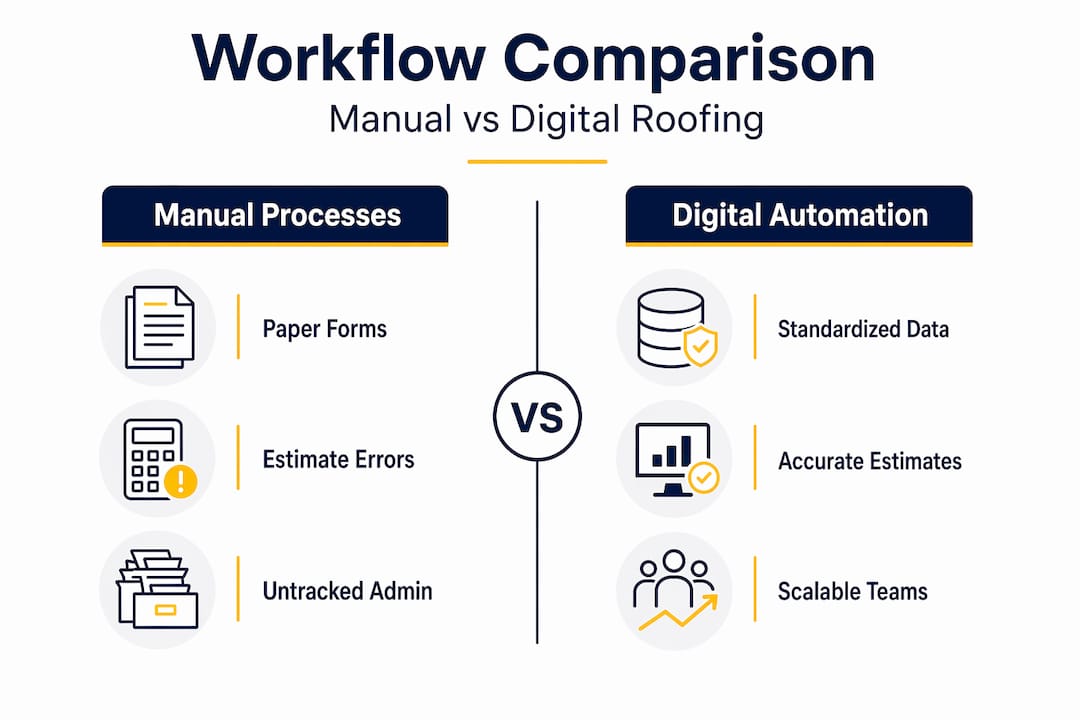
Lack of standardization and measurement consistency prevents organizations from learning and scaling process improvements across projects and teams. You can’t benchmark what you can’t measure consistently. You can’t improve what you can’t benchmark. The cycle of inefficiency just continues, invisible to leadership until something breaks.
The benefits of digitally connected workflows are concrete and measurable:
- Real-time measurement: When every job runs through the same system, you can see actual vs. estimated costs at any point during a project, not just after closeout.
- Consistent compliance: Safety documentation, certifications, and inspection records follow a standard format across every job, every crew, every branch.
- Single data source: Estimating, scheduling, field execution, and invoicing all pull from and write to the same data set, eliminating the version-control chaos of spreadsheets and email chains.
- Cross-job learning: When you complete 200 jobs through the same system, you accumulate data that tells you which job types are most profitable, which crews close out fastest, and where your estimates consistently drift.
- Onboarding speed: New hires learn one system, one process. The learning curve compresses dramatically.
Pro Tip: If you can’t quickly answer “How long does X task take across all teams?” you’re data-disconnected. That question should have an answer in under 60 seconds. If it requires someone to pull spreadsheets and make phone calls, you’re flying blind at scale.
For commercial roofing executives, the key scalability mechanism is not more headcount but standardized, data-connected processes. That’s the difference between a company that doubles revenue and a company that doubles revenue while doubling its problems. Understanding why workflow automation works isn’t about being a technology enthusiast. It’s about recognizing that your competitors who figure this out first will be able to bid more jobs, execute them more consistently, and retain better margins at higher volume.
Standardization also fuels learning across years and branches. A company running three regional offices through disconnected tools has three separate data sets that can’t be compared. A company running three offices through a unified platform has one data set that gets richer and more actionable with every job completed. That compounding organizational intelligence is a genuine competitive advantage that no amount of manual effort can replicate.
When Manual Processes Lead to Operational Debt
There’s a concept from software development called “technical debt,” which describes shortcuts taken today that create larger problems tomorrow. Commercial roofing has its own version. Call it operational debt.
Operational debt is the cumulative workflow risk that builds up when you rely on manual methods, tribal knowledge, and informal processes to run your business. It doesn’t show up on your balance sheet. It doesn’t appear in your weekly numbers. But it accumulates silently, and it reveals itself at the worst possible moments: during a rapid growth phase, a key leadership transition, or a sudden spike in project volume.
Manual processes raise operational risk by relying on people’s memory and judgment and after-the-fact controls; this operational debt tends to surface only when conditions change or volume grows.
The signals that you’ve accumulated significant operational debt are usually visible if you know what to look for:
- Slow project closeouts: Jobs that should wrap up in days take weeks because someone has to manually compile documentation, chase approvals, and reconcile invoices.
- Key-person dependencies: If one estimator, one project manager, or one office coordinator leaving would create genuine operational chaos, your processes live inside people rather than systems.
- Invisible backlog: Work in progress that no one has a clear, real-time view of. Leadership finds out about problems after they’ve already cost money.
- Inconsistent customer experience: Some clients get fast responses and clean documentation. Others get delays and confusion. The difference is which team member handled their job.
- Margin erosion without a clear cause: Revenue grows but profit doesn’t. The culprit is usually accumulated operational friction that no one has quantified.
The edge case worth addressing directly: some companies do manage to scale manually for a period. Usually it’s because they have one or two exceptionally organized individuals holding everything together through sheer personal discipline. That works until it doesn’t. The moment that person leaves, burns out, or the volume exceeds what any individual can manage, the whole system becomes fragile. Manual scaling is a false positive. It looks like it’s working right up until it stops working entirely.
What Most Experts Overlook: The Real Cost of Manual Scaling
Most conversations about operational efficiency in commercial roofing focus on time savings. That framing undersells the actual problem.
Yes, manual processes waste time. But the deeper cost is organizational learning. When your workflows live in people’s heads and in disconnected spreadsheets, your company can’t learn from itself. Every mistake gets made fresh. Every new hire reinvents the wheel. Every branch operates as its own island. You’re not building a company. You’re building a collection of individual contributors who happen to share a logo.
The real cost of manual scaling is brand integrity. When a client gets a different experience depending on which project manager handles their job, your brand is inconsistent. Inconsistency at scale is a reputation problem. And in commercial roofing, where referrals and repeat contracts drive a huge share of revenue, reputation is everything.
Short-term manual scaling is a false positive that experienced operators mistake for proof that their systems work. The issues don’t surface until a volume spike, a leadership transition, or a competitive market forces the cracks open. By then, the cost of fixing the problem is dramatically higher than it would have been to address it earlier.
Pro Tip: Track how many people “touch” a project from estimate to invoice. Count every handoff, every approval, every data re-entry step. The higher that number, the less scalable your operation. A well-designed system cuts that number by more than half.
Digital standardization isn’t just an efficiency play. It’s your insurance policy against future volatility. Markets shift. Key people leave. Demand spikes unexpectedly. The companies that navigate those moments without losing ground are the ones whose processes live in systems, not in individuals. Feature-based automation is what makes that possible at the operational level.
Unlocking Scalability: How Workflow Automation Transforms Commercial Roofing
The bottlenecks, errors, and operational debt described throughout this article share a common solution: a unified system where every workflow connects to every other workflow in real time. That’s exactly what Terial workflow automation is built to deliver for commercial roofing contractors.
Terial addresses the specific friction points that limit growth, from estimate accuracy and crew dispatch to change order management and same-day invoicing. The Terial feature set was built alongside leading contractors, which means it reflects the actual operational reality of commercial roofing rather than generic project management logic. And because the platform is designed for high field crew adoption, the data flowing into your dashboards is real, current, and complete. If you want to see how this works in practice for your operation, the field service application is a strong starting point to understand how the field-to-office connection changes everything.
Frequently Asked Questions
What are the most common manual bottlenecks in commercial roofing?
The biggest bottlenecks are paper-based estimating, manual scheduling, compliance tracking, and error-prone data silos, all of which force staff to spend disproportionate time on administrative work rather than production.
Why do manual workflows hurt scalability more as my business grows?
Manual errors, delays, and lack of process standardization multiply with more leads and projects, causing quality and profit to fall because operational inefficiency compounds as volume increases and manual measurement workflows slow lead response and reduce throughput.
Is there a point where manual methods temporarily outperform digital?
Manual methods may appear to work short-term under disciplined management, but during rapid lead spikes, manual inspection and coordination approaches typically collapse under peak demand, exposing the hidden fragility of people-dependent systems.
How do digital systems directly improve scalability?
They standardize workflows, connect data across teams, reduce errors and admin time, and enable quick scaling with less headcount because the key scalability mechanism is standardized, data-connected processes rather than adding more staff.
What is operational debt and why is it dangerous?
Operational debt is hidden risk from outdated manual methods, and it’s dangerous because this debt tends to surface only when conditions change or volume grows, precisely when your business can least afford to absorb the disruption.
Recommended




Book a personalized demo
Get a 30-minute demo tailored to how you run your commercial roofing business

“Making the switch to Terial has greatly exceeded my expectations and has already had a meaningful impact on our team’s productivity. Terial has significantly reduced the amount of time required to complete many of our day-to-day operational tasks, allowing our team to focus more on serving our customers.”

