
Automated Follow-Up's Role in Roofing Service Retention
Discover the vital role of automated follow-up in roofing service retention. Boost conversions and loyalty with streamlined communication today!
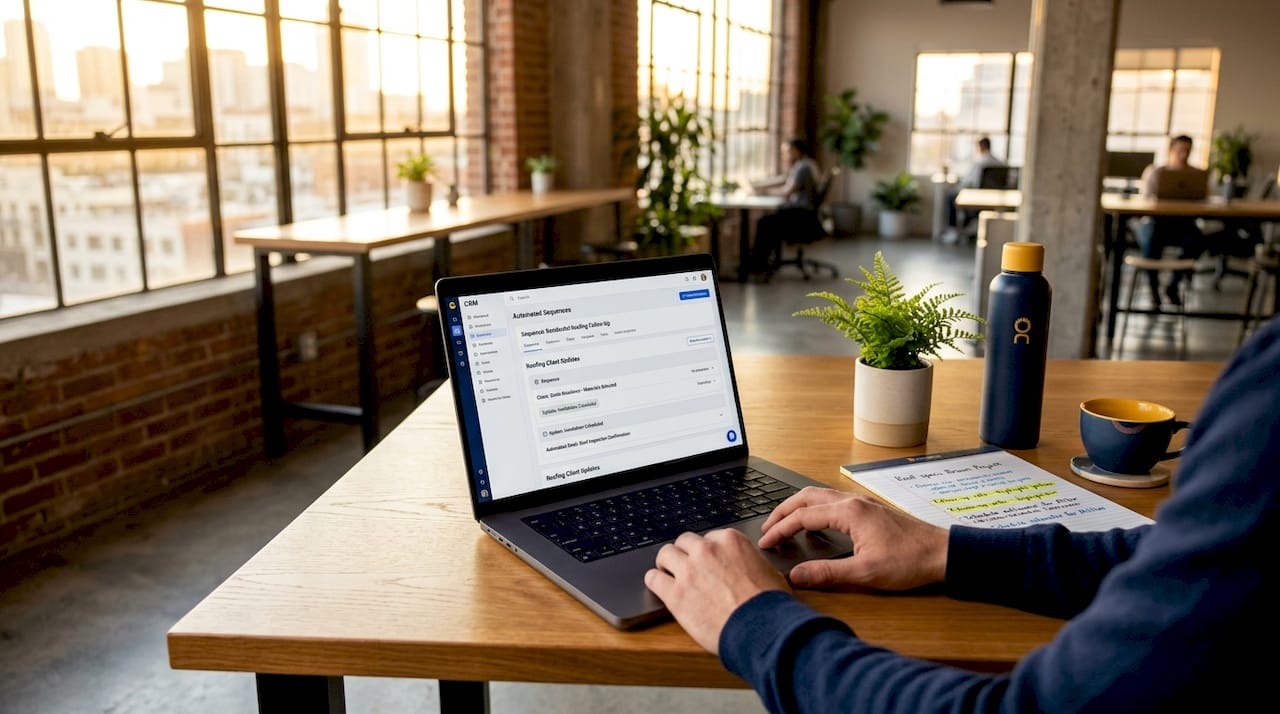
Automated follow-up in roofing service retention is the systematic use of CRM-triggered communication sequences to ensure every lead and customer receives timely, relevant contact that maximizes conversions and long-term loyalty without manual effort. The role of automated follow-up in roofing service retention goes far beyond sending a reminder text. It closes the gap between a submitted estimate and a signed contract, keeps completed-job customers engaged through periodic check-ins, and scales your outreach during storm season without adding a single person to your payroll. For commercial roofing owners running complex sales cycles with insurance timelines and multi-site clients, this is not a nice-to-have. It is the operational floor your revenue depends on.
How Does Automated Follow-Up Improve Roofing Estimate Close Rates?
Most commercial roofing contractors lose revenue not because their estimates are wrong, but because their follow-up stops too early. 80% of roofing sales require five or more contacts before a customer commits, yet most contractors make only one or two attempts. That gap is where competitors win your jobs.
Consistent, multi-touch automated follow-up directly addresses this problem. Close rates improve from 25-30% to approximately 35-40% when contractors deploy structured automation sequences instead of relying on a salesperson to remember to call. On a $2 million annual estimate volume, that 10-point improvement translates to hundreds of thousands in recovered revenue.
A well-designed estimate follow-up sequence for commercial roofing looks like this:
- Same day (within 60 seconds of lead capture): An automated text confirms receipt of the inquiry and sets expectations for the next step.
- Day 3: A reinforcement message highlights your company’s credentials, past commercial projects, or warranty terms.
- Day 7: A message anchored to the insurance claim process, acknowledging that approvals take time and offering to assist with documentation.
- Day 14: A value-add touch, such as a link to a maintenance checklist or a case study from a similar property type.
- Day 21-28: A soft close that creates mild urgency around scheduling windows or material lead times.
The sequence stops the moment a customer replies or books a call. Continuing automation after a reply is one of the fastest ways to lose a warm lead. Reply detection is not optional. It is the mechanism that converts automated engagement into an actual sale.
Pro Tip: Set your CRM to flag any reply, including a one-word response, as a trigger to pause all automated messages and alert a sales rep within five minutes. Speed of human handoff after automation engagement is where close rates are actually won.
What Are the Key Automated Follow-Up Workflows for Roofing Service Retention Beyond Estimate Closing?
Winning the job is only the first retention checkpoint. The customers who become repeat clients and referral sources are the ones who hear from you after the job is done, not just before it starts. Post-job automation is where most commercial roofing contractors leave money on the table.
The highest-value retention workflows after job completion include:
- Immediate post-job check-in (within 2 hours): Immediate post-job check-ins catch problems before they become negative reviews and reinforce goodwill while the crew is still on-site. This single touchpoint has the highest return of any retention automation.
- Day 5 review request: Timing a review request five days after completion captures peak satisfaction before the memory fades. Delayed review outreach lowers response rates and misses the sentiment freshness window entirely.
- Day 30 and Day 45 service reminders: A message referencing the specific job completed, with an offer to inspect adjacent areas or schedule preventive maintenance, converts one-time clients into service agreement holders.
- Referral request at Day 60: A short, direct message asking if the client knows another property manager or facility director who needs roof work. Referrals from satisfied commercial clients carry enormous credibility in the B2B roofing market.
- Annual inspection reminder: Timed to the anniversary of the original job, this message demonstrates professionalism and keeps your company top of mind when the next capital project comes up.
Retention is built through cumulative positive interactions, not a single great experience. Each automated touchpoint adds to a pattern of reliability that competitors who rely on manual follow-up simply cannot match at scale.
Pro Tip: Reference the specific job in every post-completion message. “Following up on your TPO replacement at 4200 Commerce Drive” outperforms “checking in on your recent project” every time. Personalization at this level requires your CRM to capture job address and type at booking, so build that data discipline from day one.
How to Design Effective Automated Follow-Up Sequences for Roofing Customers
The difference between automated follow-up that converts and automated follow-up that generates opt-outs is context. Generic sequences treat every lead the same. Effective sequences align with where the customer actually is in their decision process.
For commercial roofing, that means building triggers around status changes and timing events specific to the industry. Status and timing-specific messages keyed to insurance claim progress and scheduling urgency consistently outperform generic follow-up and reduce opt-outs. A property manager waiting on adjuster approval needs a different message than one who has already received their claim number.
The below compares generic versus context-aware follow-up approaches across the key decision stages in a commercial roofing sale:
- Post-estimate, Day 3:
Generic follow-up: “Just checking in on your quote.”
Context-aware follow-up: “Your estimate includes a 10-year labor warranty. Happy to walk through the scope with your facilities team.” - Insurance claim pending:
Generic follow-up: “Let us know if you have questions.”
Context-aware follow-up: “Most adjusters complete commercial inspections within 7–10 business days. We can coordinate directly with yours.” - Material lead time window:
Generic follow-up: “Ready to schedule when you are.”
Context-aware follow-up: “Current lead times on TPO membrane are running 3 weeks. Booking now secures your spot before the busy season.” - Post-job, Day 5:
Generic follow-up: “Hope everything went well.”
Context-aware follow-up: “Your new roof at [address] has a 2-year workmanship warranty. Here is how to submit a service request if needed.”
Compliance is non-negotiable in this design process. Every sequence must include a clear opt-out mechanism, and your CRM must honor opt-outs immediately across all channels. SMS campaigns in particular require explicit consent under TCPA regulations. Building compliance into your sequence design from the start protects your business and your sender reputation.
Channel preference also matters. Some commercial clients respond faster to email. Others prefer text. A well-configured CRM captures channel preference at first contact and routes subsequent messages accordingly, which AI-managed retention systems can handle in real time based on engagement signals.
What Metrics and Technology Should Commercial Roofers Track for Follow-Up Effectiveness?
Automation without measurement is just noise. The contractors who get the most from their follow-up systems are the ones who track a small set of high-signal metrics and act on them monthly.

The three metrics that matter most are lead response time, estimate-to-close rate, and 12-month customer retention rate. Lead response time measures how quickly your first automated message reaches a new inquiry. Trigger-based sequences that fire within 60 seconds of lead capture set the standard. Estimate-to-close rate tracks whether your follow-up cadence is actually moving leads to contracts. Retention rate measures whether your post-job workflows are converting one-time clients into repeat buyers.
Scalability is the technology argument that matters most for commercial roofing. Automation handles 5 or 500 leads identically, which means your storm season surge becomes an organized pipeline instead of a chaotic backlog. A manual follow-up process breaks at exactly the moment you need it most.
For integration, the most effective technology stacks connect your CRM to your job management software so that status changes in the field, such as job completion or a signed change order, automatically trigger the next communication in the customer sequence. This is where manual processes limit scalability most visibly. When your CRM does not know what your field team just completed, your follow-up sequences fire on the wrong timing or not at all.
The integration priorities for $5M+ commercial roofers consistently point to CRM-to-field-service connectivity as the highest-leverage connection in the technology stack, precisely because it makes every downstream automation more accurate and timely.
Key Takeaways
Automated follow-up in commercial roofing is the single most scalable tool for improving close rates, retaining clients, and building a referral pipeline without adding headcount.
- Close rate impact: Structured automation can improve estimate close rates from 25–30% to 35–40%, recovering significant revenue from bids already submitted.
- Multi-touch requirement: 80% of roofing sales require five or more contacts, making single-touch manual follow-up structurally insufficient.
- Post-job retention: A 2-hour post-job check-in is the highest-value retention touchpoint, catching problems before they become negative reviews.
- Context over volume: Status-specific and timing-specific messages outperform generic sequences and reduce opt-outs across every stage of the sales cycle.
- Scalability advantage: Automation handles storm season lead surges without added staff, turning volume spikes into organized, trackable pipelines.
How Terial Connects Follow-Up Automation to Your Field Operations
Fragmented tools are the reason most commercial roofing follow-up sequences fail. Your CRM fires a “job complete” message before the crew has left the site, or your post-job check-in goes out three days late because no one updated the status in the system. Terial eliminates that gap by connecting field operations and customer communication in a single platform. When a crew marks a job complete in the field, the retention sequence starts automatically, with the right timing and the right job details already populated. Explore Terial’s workflow automation for commercial roofers to see how connected operations make every follow-up more accurate, more timely, and more likely to convert a completed job into a long-term client relationship.
FAQ
What is automated follow-up in roofing service retention?
Automated follow-up in roofing service retention is the use of CRM-triggered communication sequences that contact leads and customers at defined intervals based on timing or status changes. The goal is to maintain consistent engagement from first inquiry through post-job retention without relying on manual outreach.
How many follow-up contacts does a roofing sale typically require?
80% of roofing sales require five or more follow-up contacts before a customer commits. Most contractors make only one or two attempts, which is the primary reason estimates go unsigned.
When should automated follow-up stop?
Automated follow-up should stop immediately when a customer replies or takes a qualifying action such as booking a call. Reply detection triggers a human handoff, which is the mechanism that converts automated engagement into a closed sale.
What is the best time to send a post-job review request?
Sending a review request within five days of job completion captures peak customer satisfaction and maximizes response rates. Waiting longer reduces both the likelihood of a response and the emotional freshness of the feedback.
How does automation handle storm season lead surges?
CRM automation scales identically whether you receive 5 or 500 leads, maintaining rapid response times and organized pipelines without additional staff. This scalability is the primary operational advantage of automation over manual follow-up during high-volume periods.
Recommended
- Running a Profitable Commercial Roof Service Department
- Automate Crew Dispatch for Commercial Roofing Teams
- The Integration Stack a $5M+ Commercial Roofer Should Build First
- Why Low-Slope Roofing Needs Dedicated Service Software




Book a personalized demo
Get a 30-minute demo tailored to how you run your commercial roofing business

“Making the switch to Terial has greatly exceeded my expectations and has already had a meaningful impact on our team’s productivity. Terial has significantly reduced the amount of time required to complete many of our day-to-day operational tasks, allowing our team to focus more on serving our customers.”

