
API Connectivity and Roofing Platform Integration: 2026 Guide
Discover the role of API connectivity in roofing platform integration. Enhance project profitability and streamline operations in this 2026 guide.

API connectivity is the technical backbone that makes roofing platform integration possible, enabling real-time data exchange across estimating, scheduling, ERP, and field service systems without manual intervention. Commercial roofing operations run on at least four to six software tools simultaneously, and the cost of keeping those tools disconnected shows up in duplicate data entry, billing delays, and crew coordination failures. The role of API connectivity in roofing platform integration is not a back-office IT concern. It is a direct driver of project profitability, cash flow speed, and field execution quality. This guide explains how APIs work in a roofing context, what integration patterns produce the best results, and what executives need to watch for when building a connected operation.
How Does API Connectivity Improve Roofing Platform Integration?
API connectivity improves roofing platform integration by eliminating the manual handoffs that cause errors between systems. When your estimating tool, scheduling platform, ERP, and field service application each hold separate copies of the same project data, discrepancies multiply fast. A change order entered in the field never reaches the billing system. A labor cost update in the ERP does not reflect in the project dashboard. These gaps are not workflow problems. They are data architecture problems.
API-first integrations eliminate redundant data entry by synchronizing critical project fields across estimating, scheduling, and ERP systems, reducing transcription errors and accelerating month-end closing. That acceleration matters because delayed billing directly delays cash collection on commercial jobs that already carry long payment cycles.
The value executives extract from software does not come from the software alone. It comes from integrating different systems to produce accurate and consistent data flow across the operation. A single source of truth, where every system reads from and writes to the same authoritative data set, removes the guesswork from project cost tracking and crew scheduling.
One industrial construction firm automated manual data workflows with an API-driven ETL pipeline, saving 30 hours weekly and approximately $45,000 annually in labor costs. For a commercial roofing company running 20 to 50 active projects, that kind of reclaimed capacity translates directly into faster bids and tighter job cost control.
Pro Tip: Map every manual data transfer your team performs in a week before selecting an integration approach. That map reveals exactly where API connectivity will deliver the fastest return.
- Duplicate data entry between estimating and billing creates billing errors that delay payment.
- Labor hours entered manually in the field and re-entered in the ERP inflate administrative overhead.
- Disconnected scheduling and procurement systems cause material delays that extend project timelines.
- Inconsistent job cost data across systems makes profitability analysis unreliable at month-end.
What Are the Best API Integration Patterns for Roofing Platforms?
The two primary integration patterns in commercial roofing are point-to-point connections and middleware-based platforms. Point-to-point APIs link two systems directly. They work for simple, stable relationships between two tools, but they become unmanageable as the number of connected systems grows. Each new tool added to a point-to-point network requires a new set of custom connections, and a single system change can break multiple integrations at once.
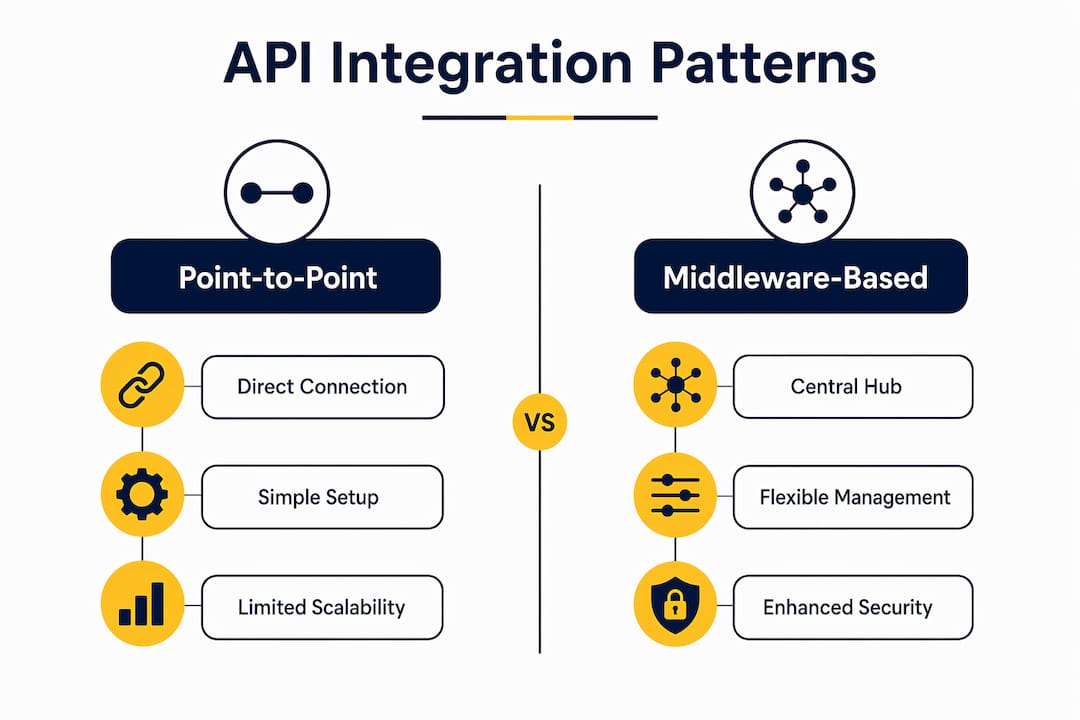
Middleware platforms, specifically Integration Platform as a Service (iPaaS) solutions, sit between systems and manage data transformation, error handling, and routing centrally. Middleware layers like iPaaS manage error logging, retry logic, and data transformation to produce resilient and scalable API integrations in construction platforms. That centralized control is what separates a fragile integration from one that holds up under real operational load.
The choice between synchronous and event-driven API calls also determines how well your integration performs under field conditions.
- Synchronous APIs handle real-time validation tasks. Use them for inventory checks before material orders, contract status verification before dispatching crews, and payment authorization before issuing invoices.
- Event-driven messaging handles status updates that do not require an immediate response. Technician location updates, job status changes, and safety incident flags all work better as asynchronous events.
- Hybrid patterns combine both approaches. Synchronous calls suit real-time validation; event-driven messaging suits updates like technician status and GPS tracking.
- API-first design requires defining the data contract between systems before building the connection. This prevents semantic mismatches where one system calls a field “phase code” and another calls it “cost category.”
- Idempotency rules prevent duplicate records when a message is delivered more than once. Without idempotency, a retry after a network failure can create duplicate labor entries or double-counted invoices.
Cloud ERP platforms enforce API-based access with stronger authentication and versioning, requiring integration strategies to plan for future changes in the API contract. Roofing executives who treat integration as a one-time project rather than an ongoing architecture decision consistently face expensive rework when a vendor updates their platform.
Pro Tip: Require every software vendor in your stack to publish a versioned API with documented change logs. A vendor who cannot provide this creates a hidden maintenance liability for your integration.
What Strategic Benefits Does API Connectivity Deliver for Roofing Executives?
The strategic case for API connectivity in commercial roofing goes beyond error reduction. Connected platforms change how fast your operation can respond to field conditions, how accurately you can forecast labor costs, and how quickly you can close out a project financially.
API-first architecture transforms construction workforce technology by enabling real-time communication and unified digital ecosystems across field and office. When a crew supervisor logs a change order on a mobile device, that change should appear in the project budget, the scheduling board, and the billing queue within seconds. Without API connectivity, that update travels through email, phone calls, and manual re-entry, arriving late and often incomplete.
The downstream benefits compound across the project lifecycle:
- Faster billing cycles. Integrated field data flows directly into invoicing, cutting the time between job completion and invoice delivery from days to hours.
- Better crew coordination. Scheduling systems that read from a live project status feed dispatch crews based on actual progress, not yesterday’s report.
- Accurate safety reporting. Safety incidents logged in the field sync automatically to compliance records, removing the gap between what happened and what was documented.
- Labor forecasting. Connected labor data across multiple projects lets operations managers identify crew utilization patterns and predict staffing needs weeks in advance.
- Real-time cost monitoring. Budget variance alerts fire the moment a cost threshold is crossed, not at month-end when the damage is already done.
API-first strategies elevate administrative operations into assets that drive predictive analytics in safety and labor planning. That shift from reactive reporting to predictive insight is where connected platforms create a durable competitive advantage for commercial roofing companies.
Executives should treat integration as an enterprise capability, not a technology project. Monitoring both business and technical health of API connections produces a clearer picture of whether the integration is actually delivering operational value. A technically healthy API that feeds inaccurate data into your ERP is worse than no integration at all.
Pro Tip: Track integration performance using business KPIs alongside technical metrics. Measure invoice cycle time, change order processing speed, and labor entry lag, not just API uptime.
What Challenges Should You Expect When Integrating Roofing Platforms?
Integration challenges in commercial roofing fall into three categories: data quality, governance, and maintenance. Each one can undermine an otherwise well-designed API architecture.
Semantic mismatches are the most common and least visible problem. Consistent mapping of phase codes, approval states, and units of measure prevents the propagation of poor data quality throughout integrated systems. When your estimating tool uses “square feet” and your ERP uses “roofing squares,” every data transfer introduces a conversion error unless the mapping is explicitly defined and enforced.
Governance defines who owns each data field and which system wins when two systems disagree. Establishing survivorship rules prevents data corruption caused by two-way syncing errors in API integrations. Without clear ownership, a two-way sync between your field app and your ERP can overwrite accurate data with stale data, and neither system flags the error.
- Legacy system constraints. Older platforms often lack published APIs, forcing workarounds like file-based transfers or screen scraping that break under load.
- Vendor lock-in. Proprietary data formats from single-vendor suites make it difficult to connect best-of-breed tools without custom middleware.
- Maintenance overhead. Every vendor update is a potential breaking change. Integration health requires ongoing monitoring, not a one-time setup.
- Scalability gaps. An integration that handles 10 projects cleanly may fail under the data volume of 50 concurrent projects.
Integration is an ongoing operational commitment requiring defined survivorship rules to manage master data ownership and prevent syncing errors. Roofing companies that treat integration as a finished project rather than a managed capability consistently encounter data quality failures at the worst possible time, typically during a high-volume project push.
Monitoring integration health through a system integrator framework that tracks both business impact and technical performance gives executives the visibility to catch failures before they affect project delivery.
Pro Tip: Assign a named owner for each integrated data field in your master data governance policy. When a sync conflict occurs, the ownership rule resolves it automatically without manual intervention.
Key Takeaways
API connectivity is the foundational capability that transforms disconnected roofing software into a unified operation, and companies that treat integration as an ongoing enterprise function outperform those that treat it as a one-time project.
Terial Connects Your Roofing Operation in Real Time
Fragmented software is the most expensive tool in your stack. Terial is built specifically for commercial roofing contractors who need their estimating, scheduling, field service, and invoicing to operate as one connected system, not four separate tools that require manual reconciliation. Terial’s workflow automation features push data from the field to the office in real time, generate invoices in under a minute, and give project managers live cost visibility without waiting for month-end reports. The field service application keeps crews connected to the office through mobile-first tools built for how roofing teams actually work. If your operation is ready to move from fragmented tools to a unified roofing platform, Terial is where that shift starts.
FAQ
What Is the Role of API Connectivity in Roofing Platform Integration?
API connectivity is the mechanism that allows separate roofing software systems, such as estimating tools, ERP platforms, and field service apps, to exchange data automatically and in real time. Without it, data moves manually between systems, creating errors and delays across the project lifecycle.
How Does API Integration Reduce Errors in Commercial Roofing Operations?
API-first integrations eliminate duplicate data entry by synchronizing project fields across systems, which removes the transcription errors that occur when staff re-enter data manually. A centralized data warehouse then aggregates standardized roofing data for consistent analytics and reporting.
What Is the Difference Between Synchronous and Event-Driven APIs in Roofing?
Synchronous APIs handle real-time tasks like inventory checks and contract validation, while event-driven APIs handle status updates like crew location and job progress. Most effective roofing integrations use a hybrid of both patterns depending on the urgency of the data exchange.
How Should Roofing Executives Govern Integrated Platform Data?
Executives should define survivorship rules that assign a system of record for each data field, so that when two systems produce conflicting values, the authoritative source wins automatically. Governance also requires mapping phase codes, approval states, and units of measure consistently across all connected platforms.
What Is the Biggest Risk of Poorly Managed API Integrations in Roofing?
The biggest risk is data corruption from two-way syncing errors, where stale or incorrect data overwrites accurate records without triggering an alert. Middleware layers with built-in retry logic and error logging reduce this risk by catching failures before they propagate through the operation.
Recommended
- Roofing Contractor Technology: 2026 Guide for Commercial Teams
- The Integration Stack a $5M+ Commercial Roofer Should Build First
- Automated Workflows and Roofing Profitability: 2026 Guide
- What Is a Roofing Operating System? A 2026 Guide




Book a personalized demo
Get a 30-minute demo tailored to how you run your commercial roofing business

“Making the switch to Terial has greatly exceeded my expectations and has already had a meaningful impact on our team’s productivity. Terial has significantly reduced the amount of time required to complete many of our day-to-day operational tasks, allowing our team to focus more on serving our customers.”

