
Why Roofing Platform Exits Depend on Systems Infrastructure
Discover why roofing platform exits depend on systems infrastructure. Learn how integrating operations can boost your valuation significantly.

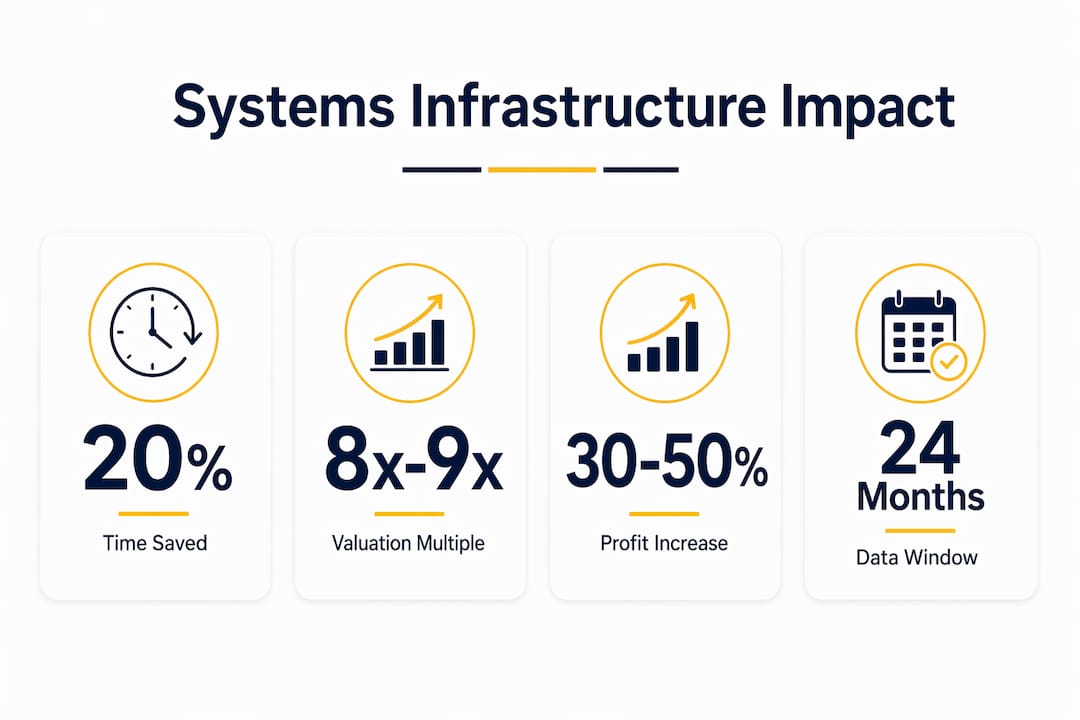
Roofing platform exits depend on systems infrastructure because buyers price what they can verify, and fragmented operations give them nothing to trust. Commercial roofing companies with integrated operational systems achieve valuation multiples of 8x–9x EBITDA, while companies running manual or disconnected processes typically land between 2.5x and 7x. That gap is not a negotiating footnote. It is the direct result of whether your business can produce clean, auditable data on demand. Three factors drive buyer confidence during diligence: operational metrics visibility, key-person risk mitigation, and data-room speed. All three trace back to one root cause: the maturity of your systems infrastructure.
Why Roofing Platform Exits Depend on Systems Infrastructure
The term “systems infrastructure” refers to the integrated stack of digital tools that capture, store, and report every operational event in your business. In commercial roofing, that stack typically includes an ERP or field management platform, a CRM for pipeline tracking, mobile data capture for field crews, job costing modules, and KPI reporting dashboards. When these tools connect in real time, the business runs on collective intelligence rather than on the memory of its senior principals.
Systems are no longer back-office tools but core value drivers that reflect scalability and operational control during M&A. Buyers assess your technology stack the same way they assess your balance sheet. Spreadsheet reliance and manual data adjustments signal risk and reduce offer price. An integrated platform signals a business that can run without its founder in the room.
The practical difference shows up in due diligence speed. A company running on connected systems can populate a data room in days. A company running on spreadsheets and tribal knowledge takes weeks, and the data it produces is still questioned. Every delay and every data gap gives a buyer a reason to lower the multiple or walk away.
What Does a Modern Roofing Systems Stack Look Like?
A mature roofing infrastructure stack covers five functional layers. Each layer feeds the next, and gaps in any one of them create blind spots that buyers will find.
- Field data capture: Mobile apps that allow crews to log labor hours, capture site photos, record material usage, and submit change orders from the job site. This is the foundation. Without reliable field data, every downstream report is an estimate.
- Job costing: Real-time cost tracking against budget at the job level. Buyers want to see gross margin by job type, crew, and geography. If your job costing lives in a spreadsheet, it is not defensible.
- CRM and pipeline management: A documented sales pipeline with stage-by-stage conversion data. Private equity consolidators expect 60 to 90 days of contracted backlog visibility. Vague pipelines are discounted heavily during diligence.
- ERP or operations platform: The connective layer that ties estimating, scheduling, dispatch, invoicing, and payroll into one system of record. Platforms like ServiceTitan, JobNimbus, AccuLynx, and Roofr each serve different segments of the market, and buyer preference for specific platforms varies by acquirer.
- KPI dashboards: Live reporting on metrics like revenue per truck, jobs per crew, close rate, and days sales outstanding. Dashboards that update in real time remove the need for manual reporting and give buyers confidence that management has genuine visibility.
Pro Tip: When evaluating your current stack, map every workflow that still touches a spreadsheet. Each one is a valuation risk. Prioritize replacing the highest-volume manual processes first.
How Systems Infrastructure Drives Exit Valuation Multiples
The valuation math is direct. Unified systems generate a 0.3x to 0.5x EBITDA multiple uplift by accelerating data-room speed and improving KPI defendability during buyer diligence. On a $3 million EBITDA business, that is $900,000 to $1.5 million in additional deal value from systems readiness alone.
‘Buyers perceive firms where collective intelligence is stored in searchable systems as significantly less risky than those relying on senior principals’ knowledge.’ This concept, sometimes called the “AI Gap” in roofing M&A circles, explains why system-dependent businesses command premium multiples. The risk is not just operational. It is human capital risk. If your best project manager leaves the week after closing, a buyer needs to know the business keeps running.
Cloud-native digital systems reduce time spent searching for operational data by 20%, which translates directly into EBITDA improvement. That efficiency gain is not theoretical. It shows up in labor costs, billing cycle times, and the speed at which your team can respond to a buyer’s diligence request list.
Buyers also look for what acquisition professionals call a “blood-type match” between their existing tech stack and yours. A private equity platform that has standardized on a specific ERP will pay more for a target already running that system. Mismatched stacks create integration costs that buyers subtract from the offer price. Choosing your platform with an eye toward your likely acquirer’s preferences is not a minor detail. It is a negotiating lever.
Common Pitfalls in Building Roofing Systems Infrastructure Before Exit
Most commercial roofing executives underestimate how long it takes to produce clean, buyer-ready operational data. The timeline is longer than it feels.
- Starting too late. Owners who prepare systems infrastructure at least 18–24 months before sale achieve 30–50% better after-tax deal outcomes. Systems need time to accumulate clean trailing data. A platform you installed six months ago produces six months of data. That is not enough for a buyer to underwrite a premium multiple.
- Voluntary field adoption. Partial adoption is the most common failure mode. If field crews log data inconsistently, the data is unreliable. Linking payroll to job-completion data in the system forces daily field entry and produces authentic operational records that buyers can trust.
- Technical debt from legacy software. Older, unsupported systems create diligence problems. Buyers require documented IT support models to assess the cost of maintaining or replacing legacy infrastructure. Undocumented technical debt is discounted from the offer.
- Data silos between departments. When estimating, field operations, and accounting each run separate tools with no integration, buyers cannot trace a job from quote to cash. That traceability is exactly what diligence requires.
- Key-person dependency on system administration. If one person in your office is the only one who knows how to pull reports or maintain the platform, that is a risk buyers will price. Formalizing IT support and training multiple team members on system administration removes this vulnerability.
Pro Tip: Before going to market, run a mock diligence exercise. Ask your CFO or controller to produce 24 months of job-level gross margin data within 48 hours. If they cannot, you have a systems gap to close.
An often-overlooked dimension is the acquisition diligence process itself. Buyers in construction-adjacent sectors increasingly run parallel assessments of physical assets and digital infrastructure. A roofing company that passes the financial audit but fails the systems audit loses negotiating leverage at the worst possible moment.
Strategic Steps to Build Exit-Ready Systems Infrastructure
Building infrastructure with exit goals in mind requires a sequenced plan, not a technology shopping spree. The following framework applies to commercial roofing companies targeting a sale within 24–36 months.
- Start the clock now. Begin software migration and data cleansing at least 24 months before your target sale date. The trailing data window is the most valuable asset you will bring to the data room. Clean data from a connected system is worth more than audited financials from a spreadsheet.
- Choose platforms your likely buyer already uses. Research which ERP and CRM platforms your target acquirer has standardized across its portfolio. Alignment reduces integration cost and increases your attractiveness as a target. This is one of the most underused levers in roofing platform exit strategies.
- Build validated KPI dashboards before you need them. The dashboards that matter most to buyers include jobs per crew per month, revenue per truck, contract backlog by month, close rate by lead source, and gross margin by job type. Build these dashboards 18 months before sale so you can demonstrate trend lines, not just snapshots.
- Tie payroll to job completion data. This single policy change produces the field data integrity that buyers require. It is not a technology problem. It is a management decision.
- Document your IT support model. Identify who manages each system, what the escalation path is for outages, and what the vendor support agreements cover. This documentation belongs in your data room alongside your financial statements.
Field software adoption is the variable that determines whether your KPI data is real or reconstructed. Reconstructed data does not survive diligence. Real data, captured daily by field crews in a connected system, does.
Terial Gives You the Data Buyers Actually Want
Terial is the unified operating system built specifically for commercial roofing contractors. It connects estimating, field service, job costing, scheduling, and invoicing into one real-time system, so every job produces clean, traceable data from the moment it is sold to the moment it is invoiced. Field crews use Terial’s mobile app to log hours, capture photos, and submit change orders on site, which means your KPI dashboards reflect what actually happened, not what someone remembered to enter later.
For executives building toward a platform exit, Terial removes the fragmentation that buyers discount. You get live gross margin by job, contract backlog visibility, and billing cycle data that holds up in a data room. Explore Terial’s workflow automation features to see how the platform supports the operational infrastructure that commands premium exit multiples.
Key Takeaways
Roofing platform exits that command 8x–9x EBITDA multiples share one common foundation: integrated systems infrastructure that produces clean, auditable operational data across field, finance, and sales functions.
FAQ
What Valuation Multiple Can Integrated Roofing Systems Unlock?
Roofing companies with integrated operational systems achieve 8x–9x EBITDA multiples, compared to 2.5x–7x for companies running manual or fragmented processes.
How Far In Advance Should I Build Systems Infrastructure Before a Sale?
Prepare systems at least 18–24 months before your target sale date. Owners who follow this timeline achieve 30–50% better after-tax deal outcomes.
Why Do Buyers Care About Field Data Capture Specifically?
Field data is the source of every downstream KPI. Buyers discount operational data that cannot be traced to daily field entries in a connected system, because reconstructed data does not hold up under diligence scrutiny.
What is the “AI Gap” in Roofing M&A?
The AI Gap describes the risk difference between firms whose operational knowledge lives in searchable systems versus those where it lives in senior principals’ heads. System-dependent businesses are priced as less risky and command higher multiples.
What KPIs do Private Equity Buyers Prioritize in Roofing Diligence?
PE buyers focus on contract backlog (60–90 days minimum), gross margin by job, revenue per truck, close rate by lead source, and days sales outstanding. All five require connected operational infrastructure to produce reliably.
Recommended




Book a personalized demo
Get a 30-minute demo tailored to how you run your commercial roofing business

“Making the switch to Terial has greatly exceeded my expectations and has already had a meaningful impact on our team’s productivity. Terial has significantly reduced the amount of time required to complete many of our day-to-day operational tasks, allowing our team to focus more on serving our customers.”

