
Software Integration in Roofing Acquisitions: 2026 Guide
Discover what is software integration roofing acquisition explained. Learn how effective integration boosts financial returns in your roofing business.

Software integration in roofing acquisitions is defined as the process of connecting and unifying disparate technology systems across two or more roofing businesses to create a single, coordinated operational platform. When a buyer acquires a roofing company, they inherit that company’s CRM, estimating tools, project management software, fleet tracking, and safety documentation systems. Those systems rarely match. Understanding what software integration in a roofing acquisition means, and executing it well, determines whether the deal generates the synergies projected at signing or bleeds cash for the next 18 months. The difference between those two outcomes is not the size of the deal. It is the quality of the integration plan.
What Are the Key Benefits of Software Integration in Roofing Acquisitions?
Software integration for roofing acquisitions delivers measurable financial returns, not just operational tidiness. One 2024 case study showed that integrating fleet management software reduced per-job fuel costs from $38 to $27 and saved $45,000 annually by eliminating duplicate software subscriptions. Total Year 1 synergies in that deal exceeded $1.2 million through shared vendor contracts and bulk purchasing. Those numbers come from a single mid-market acquisition. The pattern repeats across the industry.
The advantages of roofing software integration fall into three clear categories:
- Cost reduction. Duplicate subscriptions disappear. Bulk licensing agreements replace individual contracts. Shared procurement platforms cut material costs across both entities.
- Operational efficiency. Unified crew dispatch eliminates the scheduling conflicts that arise when two companies run separate calendars. Real-time labor tracking gives project managers a single view of field activity across all job sites.
- Data accuracy. When estimating, invoicing, and job costing run on one platform, reporting reflects reality. Buyers can make capital allocation decisions based on actual job cost variance rather than reconciled spreadsheets.
Roof management software that connects field data to back-office reporting also reduces the time between project completion and invoice generation. Faster invoicing means faster cash collection. For a company running $10 million in annual revenue, even a modest reduction in days sales outstanding produces a material improvement in working capital.
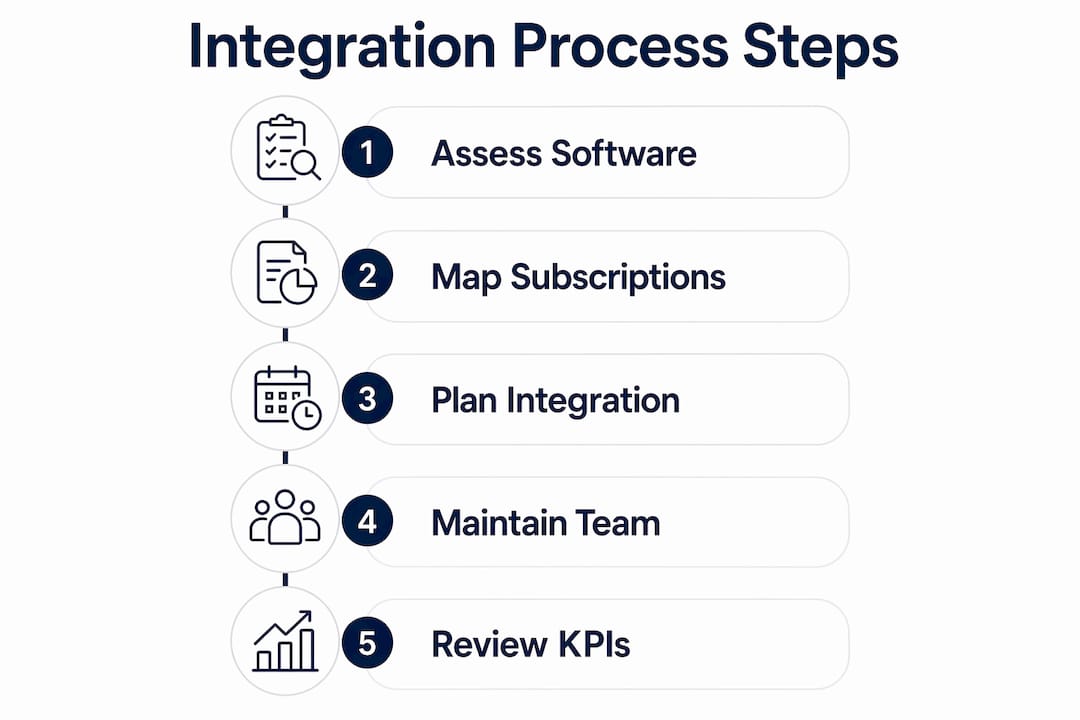
Pro Tip: Before closing a deal, map every software subscription the target company pays for. That list becomes your integration cost baseline and your first source of quick savings.
How Do Roofing Companies Successfully Integrate Software Systems During an Acquisition?
Successful software integration for roofing follows a phased approach, not a single cutover. Attempting to migrate all systems simultaneously creates operational gaps that cost contracts. The industry’s most effective integration models share a common structure.
- Audit both tech stacks before day one. Identify every tool in use, its license cost, its user count, and its data format. This audit surfaces incompatibilities early, before they become emergencies.
- Start with non-disruptive systems. Integrate back-office functions first: accounting, payroll, and HR platforms. These changes are invisible to field crews and customers, which means they carry low disruption risk.
- Budget accurately for IT labor. Software licensing fees run $500–$1,500 per user, and integration setup requires roughly 20–30 labor hours per system. Underestimating these costs is the most common budget error in roofing acquisitions.
- Run dual systems briefly. Keep the acquired company’s scheduling and CRM tools active for 30–60 days post-close. This protects customer relationships and crew workflows while the new platform is configured.
- Align safety documentation early. Safety software and OSHA compliance records must be unified before field operations merge. Misaligned safety policies create liability exposure that no amount of operational efficiency can offset.
- Preserve local identity on the customer-facing side. Buyers retain local branding and local leadership to protect customer loyalty while integrating backend systems. Roofing is a relationship business. Customers notice when phone numbers change.
The distinction between horizontal and vertical integration also matters here. Horizontal integration connects systems that perform the same function across two companies, such as merging two estimating platforms into one. Vertical integration connects systems that perform different functions within a single workflow, such as linking estimating to project scheduling to invoicing. Most roofing acquisitions require both, which is why the integration priority list for a $5M+ operator looks different from a smaller deal.
Pro Tip: Maintain your integration team for at least 180 days post-close. Weekly KPI reviews should target job cost variance within ±5% and customer retention above 90%. Disbanding the team early is the single most common cause of missed synergy targets.
What Are Common Challenges and Risks in Software Integration for Roofing Acquisitions?
The risks in roofing software integration are specific, and most of them are underestimated at the letter of intent stage. Add-on buyers often assume familiarity with the industry makes integration straightforward. It does not. System frictions surface quickly after close, and they can trigger acquisition repricing if they are severe enough.
The most damaging risks include:
- Legacy system incompatibility. Older scheduling or estimating platforms often cannot export data in formats that modern platforms accept. Retrofitting these systems costs time and money. One documented case required a $35,000 technology investment just to make the acquired company’s software readable by the buyer’s platform.
- Safety culture misalignment. Failing to unify safety policies and safety software post-acquisition produced a 40% spike in OSHA 300 Log incidents for one firm. That spike creates regulatory exposure and drives up insurance premiums. Reviewing industrial roof safety practices across both entities before integration begins reduces this risk materially.
- Crew turnover. Software and culture mismatches contribute to crew turnover of about 30% within six months post-acquisition. Losing experienced field crews erases the labor capacity that made the target company valuable in the first place.
- Storm response delays. Failure to align legacy scheduling software with a buyer’s platform caused a 14-day storm response delay for one roofing company, resulting in $200,000 in lost contracts. In a weather-driven business, scheduling system failures translate directly to lost revenue.
Disparate tools do not just slow you down. They create blind spots in safety, scheduling, and cash flow that compound over time. The cost of poor integration is not a one-time expense. It is a recurring tax on every job the combined company runs.
Poor integration also shortens the runway for realizing the synergies that justified the deal price. When integration teams disband early, KPI monitoring stops. Without weekly job cost variance tracking, budget overruns go undetected until they show up in quarterly financials. By then, the damage is done. The risks of disparate tools in a roofing roll-up are well documented, and they follow a predictable pattern.
How Does Software Integration Affect Acquisition Valuation and Scalability?
Software integration readiness directly affects how buyers price roofing acquisitions. Roofing companies with digitized CRM, estimating, and project management software are preferred acquisition targets because they reduce buyer risk and increase scalability. A seller who runs disconnected tools forces the buyer to price in integration costs, which reduces the offer.
Technology adoption also advances ESG goals and supports labor shortage mitigation by improving operational scalability. Standardized CRM and job management platforms are increasingly core post-acquisition strategies for buyers who plan to grow through multiple deals. A platform that works across 3 locations works across 10, provided the integration was done correctly the first time.
Centralizing purchasing and marketing functions post-acquisition also reduces overhead and enhances regional efficiency. Shared procurement agreements enable material cost savings across the combined entity. Centralized marketing broadens customer reach without proportional increases in marketing spend. These benefits compound as the buyer adds more locations, which is why technology adoption is core to modern acquisition strategies rather than an afterthought.
Key Takeaways
Software integration in roofing acquisitions is the primary driver of whether a deal delivers its projected synergies or erodes value through operational fragmentation and hidden costs.
Terial Gives Commercial Roofers a Unified Operating System
Fragmented software is the most common reason roofing acquisitions underperform. Terial is built to fix that. As the unified operating system for commercial roofing contractors, Terial connects estimating, project scheduling, field service, and invoicing into a single real-time platform. Field crews adopt it because it is built for the job site, not the back office. Executives trust it because it delivers real-time cost monitoring and job profitability data without manual reconciliation. For companies managing post-acquisition integration, Terial eliminates the duplicate subscriptions and disconnected workflows that drain cash and slow growth. See how Terial’s workflow automation consolidates your operations, or review the full platform feature set to identify where integration gains are largest for your business.
FAQ
What Is Software Integration in a Roofing Acquisition?
Software integration in a roofing acquisition is the process of connecting the technology systems of two roofing companies into a unified platform after a deal closes. It covers CRM, estimating, scheduling, fleet management, safety documentation, and invoicing.
How Much Does Software Integration Cost in a Roofing Acquisition?
IT integration budgets should account for $500–$1,500 per user in licensing fees and roughly 20–30 labor hours per system for setup. Hidden costs include legacy system retrofits, which can add $35,000 or more to the total.
What Are the Biggest Risks of Poor Software Integration After a Roofing Acquisition?
The most damaging risks include a 40% spike in OSHA incidents from misaligned safety systems, crew turnover of about 30% within six months, and scheduling failures that can cost $200,000 or more in lost storm-response contracts.
How Does Software Integration Affect Roofing Acquisition Valuation?
Sellers with digitized CRM, estimating, and project management tools command higher valuations because they reduce buyer risk and lower integration costs. Buyers price in integration complexity when evaluating targets with disconnected systems.
How Long Should a Roofing Company Maintain Its Integration Team Post-Acquisition?
Integration teams should remain active for at least 180 days, with weekly KPI reviews targeting job cost variance within ±5% and customer retention above 90%. Disbanding the team earlier reduces operational visibility and increases the risk of missed synergy targets.
Recommended




Book a personalized demo
Get a 30-minute demo tailored to how you run your commercial roofing business

“Making the switch to Terial has greatly exceeded my expectations and has already had a meaningful impact on our team’s productivity. Terial has significantly reduced the amount of time required to complete many of our day-to-day operational tasks, allowing our team to focus more on serving our customers.”

