
Roofing Project Milestone Workflow: A Contractor's Guide
Discover what a roofing project milestone workflow is and how it helps contractors ensure project success. Streamline your process today!

Most commercial roofing projects don’t fall apart because of bad crews or wrong materials. They fall apart because nobody agreed on what “done” meant at each stage. Understanding what is a roofing project milestone workflow, and more precisely what the industry calls a milestone schedule, gives you a structured series of binary checkpoints mapped across a project’s phases. Each one answers a single question: can we proceed? Miss a few of those checkpoints and you’re authorizing work on a substrate that hasn’t passed inspection, or closing out a job without signed warranty documentation. Both cost you money.
Key Takeaways
- Milestones are binary checkpoints: A milestone is either complete or not. There are no percentages, which removes ambiguity from project reporting.
- Five phases structure the workflow: Commercial roofing projects follow pre-bid, planning, mobilization, execution, and closeout phases, each with distinct milestones.
- Dependencies prevent costly sequencing errors: Mapping predecessor milestones stops crews from advancing before critical conditions like deck inspections are verified.
- Change orders are milestone gates: No additional work should begin until a signed change order is in place, making approval a formal checkpoint.
- Weekly updates catch slippage early: Comparing your current schedule against the baseline every week is what separates proactive management from reactive fire-fighting.
What is a Roofing Project Milestone Workflow
A roofing project milestone workflow is the structured sequence of outcome-based checkpoints that govern how a commercial roofing project moves from contract award to final closeout. The formal term used in project management is a milestone schedule, and it sits one level above your task list. Where a task describes work being done, a milestone marks that a verifiable condition has been reached.
Milestones are binary: completed or not. They carry no duration and no percentage. That binary nature is exactly what makes them powerful for governance and reporting. When a client, inspector, or lender asks where a project stands, you point to milestones, not to a foreman’s gut feeling.
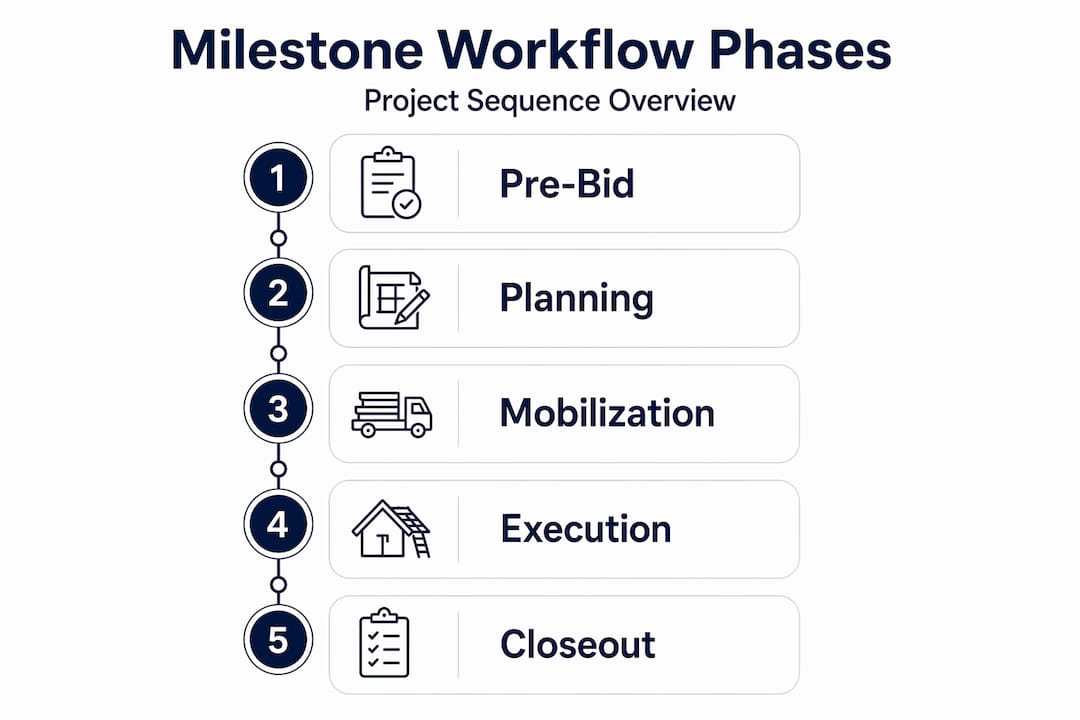
The roofing workflow process typically spans five phases: pre-bid and estimation, planning and procurement, mobilization and setup, execution and monitoring, and project closeout. Each phase contains its own set of milestones, and together they form the backbone of effective roofing project management. Without this structure, contractors default to managing by memory and verbal status updates, which is where projects start bleeding time and margin.
Core Phases and Milestone Categories
A well-structured roofing milestone schedule maps checkpoints to each project phase so nothing gets assumed or skipped.
The five essential phases look like this in practice:
- Pre-bid and estimation: Estimate approved, scope signed, contract executed
- Planning and procurement: Permits secured, materials ordered, crew scheduled
- Mobilization and setup: Materials delivered to site, safety plan confirmed, site access established
- Execution and monitoring: Tear-off complete, deck inspection passed, underlayment installed, primary roofing system installed, flashing and trim complete
- Project closeout: Final walkthrough conducted, punch list cleared, warranty registered, final invoice issued
Notice that milestones like “permits secured” and “deck inspection passed” do more than mark progress. They create legal and regulatory checkpoints that protect you if a dispute arises later. The typical durations attached to these events give you realistic scheduling targets: permit approval alone runs seven to fourteen days, material delivery one to two weeks, and the installation phase five to ten days depending on system complexity.
Mapping milestones to phases also clarifies which ones carry contractual weight versus which ones are purely operational. Both matter, but they serve different audiences. Your client cares about “permits secured” and “final walkthrough.” Your field supervisor cares about “deck inspection passed” and “underlayment installed.”
Defining Milestones That Actually Work
The most common mistake contractors make when building a milestone schedule is treating milestones like tasks. Writing “install underlayment” as a milestone is wrong. “Underlayment installed and inspector-verified” is a milestone. One describes activity. The other describes a verifiable outcome.
Milestones should be defined as outcome or approval points and managed with dependencies. A well-structured schedule typically carries eight to twenty milestones. Fewer than eight and you lose visibility into where problems are developing. More than twenty and the schedule becomes noise, with so many checkpoints that none of them carries real authority.
Dependency mapping is where most commercial roofing milestone schedules fail. Every milestone should have a clearly identified predecessor. “Underlayment installation can begin” has a predecessor: “Deck inspection passed.” You cannot run these in parallel without risking a failed inspection that forces you to tear out work already done.
Pro Tip: Separate your “anchor milestones” from your operational workflow gates. Anchor milestones carry contractual or regulatory significance, like permit approval or owner acceptance. Operational gates, like material release or substrate inspection, govern your internal sequencing. Mixing them together obscures accountability.
Here is what distinguishes a functional milestone from a vague status marker:
- It describes a completed condition, not an ongoing activity
- It has a single, identifiable predecessor that must be verified before it can be reached
- It can be confirmed with physical evidence: a photo, a signed form, an inspection report
- It ties to either a contractual obligation or a physical readiness condition that determines whether the next phase can begin
Milestone readiness is validated by whether the next workflow step can proceed without violating sequencing rules, not merely whether work appears done. That distinction keeps your schedule honest under delivery pressure.
Aligning Milestones With The Critical Path
Knowing your milestones is one thing. Knowing which ones control your finish date is what separates contractors who finish on time from those who scramble through the final week.
The critical path in commercial roofing runs through tear-off, deck inspection and repair, underlayment installation, and the primary roofing system installation. These activities have no float. A one-day delay on any of them pushes your completion date by a day. Flashing, trim, and accessory installation often run on parallel paths with schedule float, meaning they can absorb minor delays without affecting the end date.
Here is a practical comparison that clarifies how critical path milestones differ from float-absorbing ones:
- Deck inspection passed
- Critical Path: Yes
- Float Available: None
- Impact of Delay: Pushes completion date directly
- Underlayment installed
- Critical Path: Yes
- Float Available: None
- Impact of Delay: Blocks primary system installation
- Flashing complete
- Critical Path: No
- Float Available: Moderate
- Impact of Delay: Can overlap with final inspection prep
- Warranty registration
- Critical Path: No
- Float Available: Several days
- Impact of Delay: Administrative task, not field-blocking
Once you know which milestones sit on the critical path, you build your milestone gates around them. A milestone gate is a formal stop: no crew advances to the next phase until the gate milestone is confirmed. This sounds bureaucratic but it prevents the scenario where a crew starts installation on a deck that hasn’t cleared inspection, only to discover rot or structural damage that requires complete tear-out.
Use schedule buffers strategically. Rather than padding every milestone, add a buffer after the highest-risk critical path milestone. For most commercial replacements, that is the deck repair phase, where scope uncertainty is highest.
Build a regular update cadence into your workflow. Weekly schedule updates with formal baseline comparisons at each major milestone keep your plan relevant and give you early warning when a delay is developing. A milestone that is two days behind plan on week two is manageable. The same milestone four days behind on week five is a crisis.
Follow this sequence to build schedule discipline into each project:
- Identify all critical path milestones before mobilization
- Set baseline target dates for each one during the planning phase
- Confirm predecessor completion before authorizing any downstream work
- Update milestone status weekly and compare against baseline
- Trigger a schedule recovery review whenever a critical path milestone slips by more than two days
Change Orders and Closeout Milestones
Change orders kill projects quietly. The work gets done, the client didn’t authorize it in writing, and you are left arguing over an invoice for work you cannot prove was approved. The fix is treating change order approval as a formal milestone gate.
The change order process should be built around a simple one-page form that captures the description of additional scope, cost impact, schedule impact, and client signature. Site supervisors initiate it. No additional work starts until that form is signed. That signature is the milestone. Until it is reached, the gate is closed.
For closeout, photo logs, checklists, and warranty registration are not administrative afterthoughts. They are gated milestones that protect the value you created on the job. Skipping them is where roofing projects lose money after the physical work is complete.
Your closeout milestone sequence should include:
- Final walkthrough completed with owner or owner representative present
- Punch list items documented and resolved, with photo evidence for each
- Warranty documentation registered with the manufacturer
- As-built documentation submitted to the client
- Final invoice issued and delivery confirmed
- Signed certificate of completion obtained
Pro Tip: Integrate timestamped, geotagged photos into every closeout milestone. They serve as your primary defense in warranty disputes, lien releases, and inspection disagreements. A photo without a timestamp and location is nearly worthless in a dispute.
Rushed closeouts are where contractors lose margin after doing excellent field work. The administrative milestones at the end of a project are the ones that convert your labor and materials into a clean, billable, defensible deliverable.
Using Milestones for Proactive Oversight
Milestone tracking only works if someone is actually tracking. Knowing your schedule exists is not the same as managing it.
Milestone schedules paired with a weekly update cadence give you a mechanism to detect deviations before they compound. The practice is straightforward: every week, compare where each milestone stands against the baseline date you set during planning. Any deviation triggers a documented reason and a revised forecast. No deviation gets ignored.
Clear communication around milestone status serves three audiences differently:
- Field crews need to know which predecessor milestone must be confirmed before they begin the next task
- Clients need periodic milestone status reports that confirm the project is on track without requiring them to understand task-level detail
- Your office team needs to know when billing milestones are approaching so invoices can be prepared and issued without delay
Milestone schedules give governance bodies a way to track project health without wading into task-level detail. For clients, that is a genuine service. For you, it builds the kind of trust that produces repeat work and referrals.
Tracking labor hours against milestone phases gives you a second layer of oversight. If labor hours in the execution phase are running significantly above the estimate before the primary installation milestone is reached, you have a budget problem developing. Catching it at the midpoint of execution is recoverable. Catching it at closeout is not.
How Terial Supports Milestone-Driven Project Management
The gap between a well-designed milestone schedule and one that actually gets used usually comes down to fragmentation. When estimating, scheduling, field documentation, change orders, and invoicing each live in separate tools, no one has a complete picture at any milestone gate. That is the problem Terial was built to eliminate.
With Terial, your field service workflows connect directly to your project schedule, so crews capture milestone confirmations, geotagged photos, and checklist completions from the field in real time. Automated invoicing triggers from milestone completions rather than waiting for an office team to manually initiate billing. Change orders move through approval with digital signatures and automatic schedule updates.
If your milestone workflow is currently living in a spreadsheet that nobody updates, explore what Terial does for commercial roofing contractors who want one connected system instead of five disconnected ones.
FAQ
What is a milestone schedule in roofing?
A milestone schedule is a structured sequence of binary checkpoints mapped to roofing project phases, where each checkpoint confirms a verifiable outcome before the next phase begins. It differs from a task list because milestones mark completed conditions, not ongoing activities.
How many milestones should a commercial roofing project have?
Most commercial roofing projects carry between eight and twenty milestones. Fewer than eight reduces your visibility into where delays are developing, while more than twenty dilutes the authority and focus each checkpoint carries.
What is a milestone gate in a roofing workflow?
A milestone gate is a formal stop point in the project where no downstream work is authorized until the current milestone is confirmed complete. Common examples include deck inspection passed before underlayment begins, and signed change order before additional scope work starts.
How do change orders connect to milestone workflows?
Change order approval functions as a milestone gate: the signed authorization is the milestone, and no additional work proceeds until that gate is reached. This protects both your margin and your client relationship by preventing scope disputes.
How often should milestone schedules be updated?
Weekly updates comparing current milestone status against the original baseline are the standard cadence for commercial roofing projects. Formal baseline comparisons at each major milestone gate enable early detection of schedule deviations before they affect the completion date.
Recommended
- The Integration Stack a $5M+ Commercial Roofer Should Build First
- How Manual Processes Limit Roofing Scalability
- Terial | Workflow Automation for Commercial Roofers
- How to Track Labor Hours for Maximum Project Profit


More articles



Book a personalized demo
Get a 30-minute demo tailored to how you run your commercial roofing business

“Making the switch to Terial has greatly exceeded my expectations and has already had a meaningful impact on our team’s productivity. Terial has significantly reduced the amount of time required to complete many of our day-to-day operational tasks, allowing our team to focus more on serving our customers.”

