
How Roofing Operations Handle Subcontractor Compliance
Discover how roofing operations handle subcontractor compliance to ensure safety, protect against liabilities, and streamline projects effectively.

Subcontractor compliance in roofing operations is the systematic process of verifying, monitoring, and enforcing the safety, insurance, and licensing requirements of every subcontractor on a commercial roofing project. Without it, general contractors absorb liability for injuries, insurance lapses, and OSHA violations they did not cause. The stakes are concrete: a single lapsed certificate of insurance (COI) can void indemnification agreements and expose a GC to seven-figure claims. Roofing operations managers who understand how roofing operations handle subcontractor compliance treat it as a continuous process, not a one-time checkbox at contract signing.
How Roofing Operations Handle Subcontractor Compliance: Core Components
Effective subcontractor compliance management starts before a sub sets foot on the roof. The industry term for this entry point is prequalification, and it functions as a hard gate. Subcontractors with an Experience Modification Rate (EMR) above 1.25 are typically disqualified from commercial project bidding. The EMR reflects a sub’s historical workers’ compensation claims relative to industry peers. A safe benchmark is EMR at or below 1.00, with a Total Recordable Incident Rate (TRIR) below 3.0.
A complete prequalification package covers more than safety scores. Operations managers should require the following before awarding any subcontract:
- Licenses and certifications: State contractor license, trade-specific certifications, and roofing endorsements
- Insurance documents: COIs with proper endorsements, additional insured status, and policy limits matching the prime contract
- OSHA 300 logs: Three years of incident records to validate the EMR letter
- Written safety program: A documented safety plan specific to roofing operations
- Worker-level certifications: OSHA 10 or OSHA 30 cards and equipment operator certificates for each crew member
A complete prequalification package also includes financial references and bonding capacity for larger scopes. Contractual flow-down clauses then bind subcontractors to every obligation in the prime contract, including owner-imposed safety standards and reporting requirements. Verification does not stop at mobilization. The standard cadence calls for a full document review at mobilization, every 90 days on long projects, and immediately upon any insurance policy expiration.
How Do Roofing Operations Verify Insurance and Safety Compliance?
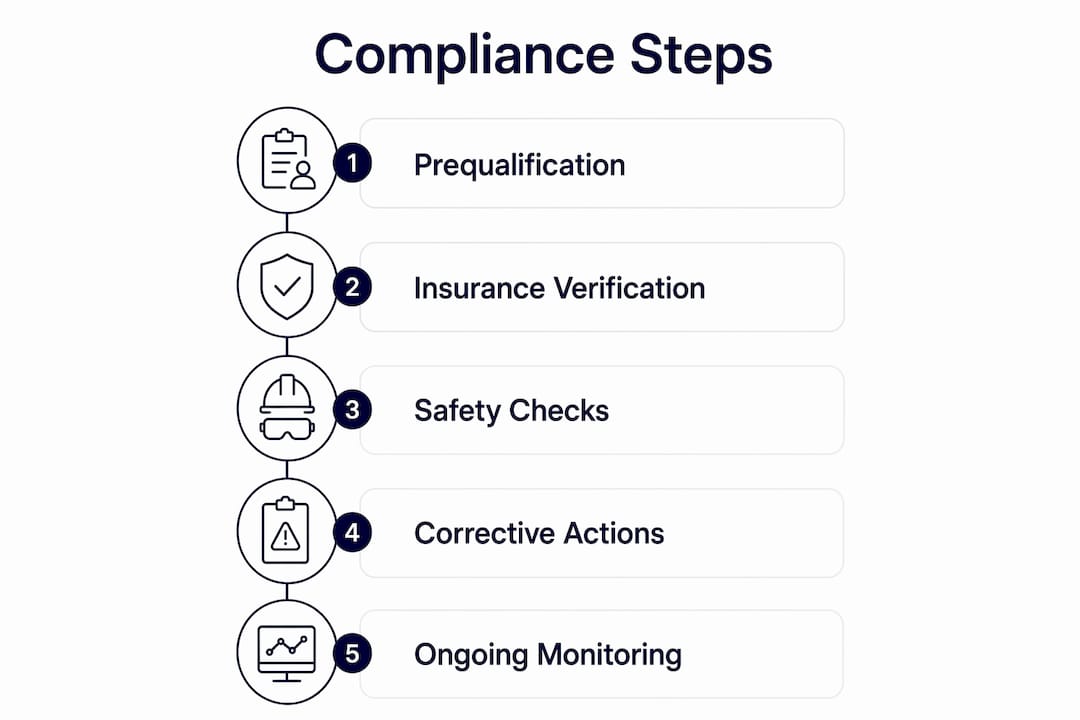
Ongoing verification is where most compliance programs break down. Collecting documents at the start of a project is not enough. A mandatory 3-stage review at mobilization, every 90 days, and upon insurance expiry is the standard that controls mid-term coverage lapses, which cause most lien claims and indemnification disputes.
The most effective monitoring programs use automated alerts at 30, 14, 7, and 1 day before any policy expiration. That cadence gives the sub time to renew and gives the GC time to act if renewal does not happen. Here is the verification process that leading roofing operations follow:
- Collect the COI and read every line. Confirm the policy number, effective dates, coverage limits, and named insured. A COI that lists the wrong entity is worthless.
- Verify endorsements directly. Specialized endorsements like CG 20 37 for completed operations are often missing and are critical for roofing risks. Hot work exclusions in commercial general liability (CGL) policies must be removed by endorsement for any torch or bitumen work.
- Confirm additional insured status. Call the issuing agent or use a verification portal to authenticate the COI. Simple possession of a COI is not enough. Verification portals and direct issuer calls catch discrepancies that paper review misses.
- Track worker-level certifications separately. OSHA 10 and OSHA 30 cards expire or go missing. Maintain a roster tied to each sub’s crew and update it at every mobilization.
- Suspend site access for lapses. A sub whose insurance has lapsed cannot work. Enforce this without exception. The cost of a one-day work stoppage is far lower than the cost of an uninsured incident.
When an OSHA citation occurs, respond within 24–72 hours with a written corrective action notice, documented verification of corrections, and a formal response to the citation. Proper documentation protects the GC from multi-employer citations and expanded liability.
Pro Tip: For projects involving Owner Controlled Insurance Programs (OCIPs) or Contractor Controlled Insurance Programs (CCIPs), require subs to provide proof of enrollment plus separate auto and excess liability coverage. These coverages are almost always carved out of wrap-up programs and create silent gaps if not tracked independently.
What Contractual and Legal Frameworks Support Compliance Enforcement?
Contracts are the enforcement backbone of any roofing subcontractor management program. Without the right clauses, a GC has limited legal recourse when a sub falls out of compliance. The following provisions belong in every subcontract:
- Flow-down clauses: These bind the sub to every obligation in the prime contract and owner-imposed standards. Flow-down clauses prevent the GC from becoming the de facto insurer of a sub’s errors or omissions.
- Right-to-audit clauses: These give the GC direct access to the sub’s payroll records, safety logs, and insurance files at any time during the project. Audits catch problems before they become claims.
- Safety performance clauses: These define specific thresholds, such as a TRIR above 5.0 or a repeat OSHA citation, that trigger suspension or termination of the subcontract.
- Lien waiver procedures: Conditional and unconditional lien waivers should be tied to compliance documentation. A sub that cannot produce a current COI does not receive a progress payment.
- Indemnification and joint-defense clauses: These shift defense costs and liability back to the sub when the sub’s work or workers cause an incident. Joint-defense clauses coordinate legal strategy when both parties face a claim.
Understanding builders risk and soft costs coverage also matters here. When a compliance failure causes a project delay, soft costs coverage can offset losses that standard liability policies do not reach. Operations managers should review this coverage alignment annually against actual endorsements, not just face policy limits.
How Can Technology Improve Subcontractor Compliance Management?
Manual compliance tracking fails at scale. A roofing operation running five simultaneous commercial projects with three to eight subs each cannot manage 40+ expiration dates, worker certifications, and safety logs on a spreadsheet without errors. Automation platforms reduce administrative overhead by 40–60% when managing subcontractor compliance through centralized document verification and automated alerts.
The table below shows what a technology-supported compliance workflow looks like compared to a manual one:
Centralized portals let subs upload their own documents, which shifts the administrative burden off the GC’s office team. The system validates documents on upload and flags deficiencies immediately. That instant feedback loop cuts onboarding time significantly and removes the back-and-forth email chains that delay mobilization.
Pro Tip: When evaluating roofing contractor technology for compliance management, prioritize platforms that integrate directly with licensing databases and insurance verification services. Manual re-entry of certificate data is where errors enter the system.
Terial’s platform connects field crews and office teams in real time, which means compliance status is visible to everyone who needs it. Automated alerts, digital document storage, and audit trail generation are built into the same system that handles scheduling, invoicing, and change orders. That integration eliminates the fragmentation that causes compliance gaps.
What Are the Common Challenges in Roofing Subcontractor Compliance?
Even well-run operations run into predictable compliance problems. Knowing where the gaps appear is the first step to closing them.
- Hidden subcontracting chains: Most GCs miss verifying tier 2 subcontractors, which creates unmitigated risk from invisible labor layers. Require written approval for any lower-tier sub and mandate the same prequalification standards down the chain.
- OCIP and CCIP misconfigurations: Subs enrolled in wrap-up programs often assume all coverage is provided. Auto liability and excess liability are almost always excluded. Require separate certificates for these lines on every enrolled project.
- Worker-level certification gaps: A sub’s company-level OSHA 30 certification does not mean every worker on the crew holds an OSHA 10 card. Track individual certifications, not just company-level credentials.
- Document renewal delays: Subs frequently let policies lapse during slow seasons and scramble to renew when a new project starts. Build renewal deadlines into the subcontract and tie payment releases to current documentation.
- Engagement and communication breakdowns: Compliance enforcement works best when subs understand the requirements before they sign. Walk through the compliance checklist at the pre-construction meeting. Subs who understand the rules follow them more consistently than those who receive a document dump at contract execution.
Effective subcontractor management for commercial roofing treats compliance as a shared responsibility, not a policing function. When subs see that the GC’s system makes compliance easy, renewal rates improve and enforcement actions decrease.
Terial Supports Compliance Workflows for Roofing Operations
Fragmented tools create compliance gaps. When insurance certificates live in email, worker certifications sit in a filing cabinet, and expiration dates are tracked on a spreadsheet, something always falls through. Terial’s workflow automation platform was built specifically for commercial roofing contractors to eliminate that fragmentation. Centralized document management, automated expiration alerts, OSHA certification tracking, and audit trail generation all operate within the same system your field crews already use for scheduling and time tracking. The result is a compliance program that runs in the background without requiring a dedicated administrator to hold it together. See how Terial’s field service application connects compliance documentation to active project workflows.
Key Takeaways
Roofing operations that treat subcontractor compliance as a continuous, documented process reduce liability exposure, prevent work stoppages, and protect project profitability from start to closeout.
FAQ
What Is Subcontractor Prequalification in Roofing?
Subcontractor prequalification is the process of evaluating a sub’s insurance, safety record, licenses, and financial stability before awarding a contract. Subs with an EMR above 1.25 are typically disqualified from commercial roofing projects.
How Often Should Roofing GCs Review Subcontractor Compliance?
The standard cadence is at project mobilization, every 90 days for long projects, and immediately upon any insurance policy expiration. Automated alerts at 30, 14, 7, and 1 day before expiry support this schedule.
What Endorsements Are Required on a Roofing Subcontractor’s COI?
At minimum, the COI must include additional insured status, CG 20 37 for completed operations, and an endorsement removing hot work exclusions for any torch or bitumen work.
What Happens When a Subcontractor’s Insurance Lapses on an Active Project?
The sub must be suspended from site access until current coverage is confirmed. Work performed during a lapse period is uninsured, which voids indemnification protections and exposes the GC to direct liability.
How Do OCIPs Affect Subcontractor Compliance Requirements?
Subs enrolled in an OCIP must provide proof of enrollment plus separate certificates for auto and excess liability coverage, since these lines are typically excluded from wrap-up programs.
Recommended
- Automated Reporting for Roofing Operations Leaders
- Why Roofing Operating Partners Prioritize Field Software Adoption
- How Roofing Service Data Drives New Contracts
- Mobile Work Order Completion for Roofing Contractors



Book a personalized demo
Get a 30-minute demo tailored to how you run your commercial roofing business

“Making the switch to Terial has greatly exceeded my expectations and has already had a meaningful impact on our team’s productivity. Terial has significantly reduced the amount of time required to complete many of our day-to-day operational tasks, allowing our team to focus more on serving our customers.”

