
Build Roofing Company Operational Infrastructure Fast
Ready to grow your business? Learn how to build roofing company operational infrastructure effectively for streamlined success and greater margins.

Most commercial roofing contractors don’t lose jobs because of poor craftsmanship. They lose margin, time, and growth potential because they never built the operational backbone to run a real business. When you try to build roofing company operational infrastructure on the fly, you end up with three people calling the same customer, estimates sitting in someone’s inbox, and a founder who can’t take a week off without things falling apart. This guide is for contractors ready to change that. You’ll get a clear path from scattered processes to a system that runs without you holding it together.
Key Takeaways
- Start with prerequisites: Define your service scope and legal requirements before choosing any software or building any workflow.
- Map workflows before buying tools: Design your process chain from intake to closeout first, then select tools that fit the map.
- Integration beats fragmentation: Disconnected software stacks create data silos that cost you more than the tools save.
- Measure what matters: Track job profitability, team productivity, and customer satisfaction on a regular cadence, not just at year end.
- Reduce founder dependency: Process-driven companies command significantly higher valuation multiples than founder-dependent ones.
Build Roofing Company Operational Infrastructure: The Foundations
Before you touch a software subscription or write a single SOP, you need to get four things clear. Skipping this step is why most infrastructure projects stall after 60 days.
Define your service scope precisely. Are you doing new construction, re-roofing, service and maintenance, or all three? Each requires different crew structures, estimating logic, and scheduling rhythms. Trying to build one workflow that handles all three without intentional design creates the bottlenecks you were trying to eliminate.
Get your business plan done with real numbers. A solid operational framework for roofing needs a financial foundation. Know your break-even, your target gross margin by service type, and how many crews you need to hit your revenue goal. Without this, you’re designing a machine without knowing what it needs to produce.
Here’s what your foundational checklist should cover before you build anything:
- Contractor license and bonding requirements in your state (these directly affect what work you can bid)
- General liability insurance, which typically runs $3,000 to $8,000 per year, and workers’ compensation, which runs $7,500 to $15,000 per year depending on payroll size
- Defined roles across at least three departments: sales, operations, and field
- A chart of accounts set up in your accounting software before any project data flows in
- A clear decision about whether you’re running residential, commercial, or both, since these require completely different infrastructure
Contractor license
- Why it matters:
- Determines which contracts you are legally allowed to sign.
- Impacts which markets and jurisdictions you can operate in.
Insurance coverage
- Why it matters:
- Affects crew deployment and project eligibility.
- Often required for subcontractor agreements and client contracts.
Defined organizational structure
- Why it matters:
- Clarifies ownership of each workflow and process.
- Establishes accountability across the business.
Financial baseline
- Why it matters:
- Provides the benchmark for measuring operational performance.
- Defines the KPIs used to evaluate infrastructure improvements.
Technology hardware
- Why it matters:
- Ensures field crews have reliable devices on job sites.
- Enables consistent adoption of digital tools and workflows.
Pro Tip: Before selecting any software platform, get your organizational chart and role descriptions written first. Software should map to your structure, not the other way around.
The technology baseline matters more than most contractors admit. Field crews need smartphones or tablets with reliable app access. Office staff need a shared file system and a single source of truth for job data. If your team is still texting photos into a group chat and emailing estimates from personal accounts, no amount of software will fix it without first fixing the behavior expectations behind those habits.
How to Establish Integrated Operational Systems
Operational maturity in a commercial roofing business is not about having more tools. It’s about having fewer, better-connected ones. As one industry framework puts it, “the file is the product” and the roof is simply the fulfillment. Every workflow you build should create a clean, auditable record from first contact to final invoice.
Here is a practical sequence for building that connected system:
- Map your workflow before you buy anything. Draw the full process from the moment a lead comes in to the moment you collect final payment. Mark every handoff point between departments. These handoffs are where things fall apart in a fragmented operation.
- Standardize your intake process. Every new lead should enter through one channel with a consistent set of data fields captured. If your sales team is logging leads in three different places, your pipeline data is already unreliable.
- Choose tools that talk to each other. Your CRM, estimating tool, job management system, and accounting software need to share data in real time. Stacking disconnected vendors creates silos that force manual re-entry, which introduces errors and slows every department down.
- Write SOPs for every repeatable task. This is the unglamorous work that separates scalable roofing companies from ones that are permanently founder-dependent. Your SOP doesn’t need to be 20 pages. It needs to tell a new hire exactly what to do, in what order, and who to notify when it’s done.
- Build accountability checkpoints into the workflow. After each major stage, whether that’s contract signed, materials ordered, work completed, or invoice sent, someone specific is responsible for confirming it happened and logging it. No confirmation, no moving forward.
- Train your crews on the digital tools, not just the work. Field adoption is the most common failure point in roofing operations. If your crew isn’t capturing photos, logging hours, and confirming job status in the app, your office team is flying blind. Make field tool usage a condition of employment, not a suggestion.
Pro Tip: When you run your first SOP training session, record it. Use that recording for onboarding every new hire afterward. You just bought back hours of repeated training time.
Learning how to manage roofing projects at a systems level, rather than a job-by-job level, is what separates contractors doing $3 million from those doing $10 million with the same number of headaches.
Common Pitfalls When Scaling Roofing Operations
You will hit resistance. Knowing where the problems tend to come from gives you a chance to get ahead of them.
The most expensive mistake contractors make when building effective roofing teams is adding software without removing anything. Every new tool that doesn’t replace an existing one adds another login, another data silo, and another training burden. The roofing industry is deeply fragmented, and vendors who sell you point solutions know you’ll stack them on top of whatever else you’re running. Fight that instinct. Every tool you add should kill at least one you’re already using.
Change resistance from staff is real and often underestimated. People who have been doing things a certain way for years will slow-walk adoption of new systems if they don’t understand why the change matters to them personally. Don’t lead with “we’re implementing new software.” Lead with “here’s what’s going to get easier for you starting next month."
Here are the most common infrastructure pitfalls and how to address them:
- Data duplication. When the same job lives in your CRM, your estimating tool, and a spreadsheet, you have three versions of the truth. Pick one system as the record of authority and enforce it.
- Skipping the audit trail. Experienced contractors know that a defensible record from intake to closeout protects you in insurance disputes, warranty claims, and client disagreements. If it isn’t logged, it didn’t happen.
- Building for today’s crew size. Design your workflows for two to three times your current crew count. If your process only works with five people, you’ll rebuild it from scratch at fifteen.
- Ignoring KPI standardization. Without agreed-upon definitions for job profitability, cycle time, and close rate, every manager is measuring something different and your reporting is useless.
Scaling from a founder-centric to a process-centric company is the most important transition a roofing business will make. It doesn’t happen by accident, and it doesn’t happen fast. But every week you delay it is a week you’re capping your own growth.
The hardest part of this transition is letting go. Founders who built their companies on relationships and personal oversight often feel like systematizing is removing what made them successful. It’s actually the opposite. Systems protect the customer experience your reputation was built on and let it happen consistently without you in the room.
Measuring Whether Your Infrastructure is Actually Working
Building the system is step one. Knowing if it’s working is step two. Too many contractors invest in infrastructure and then never close the feedback loop.
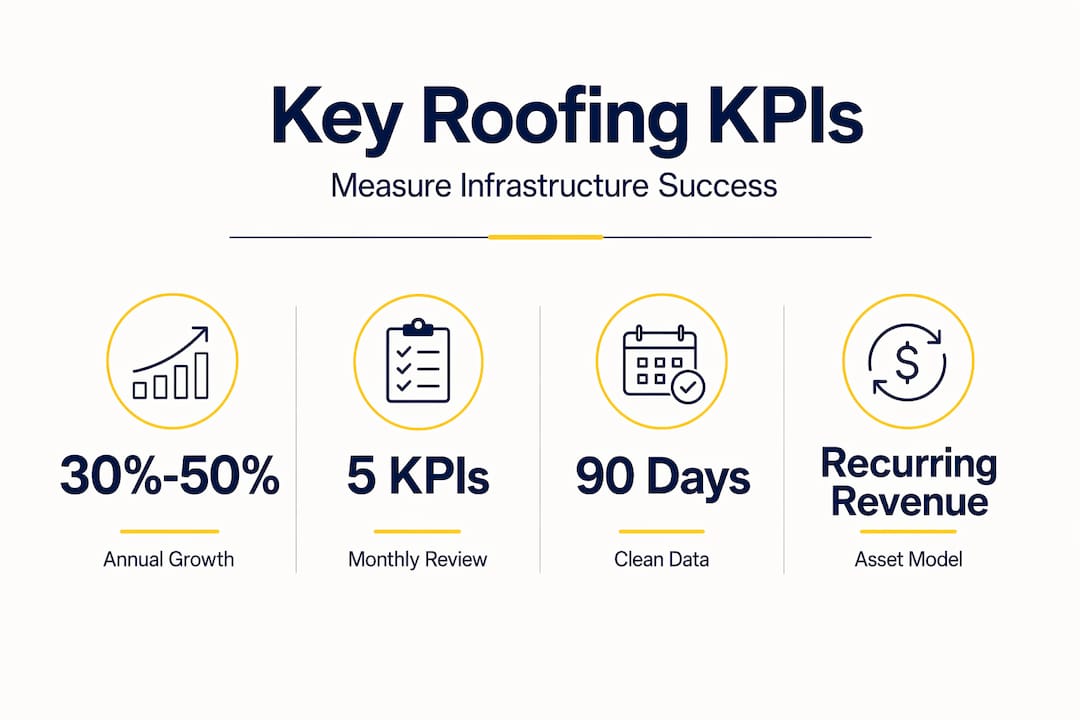
Pro Tip: Run a monthly ops review for 30 minutes with your department leads. Review the same five KPIs every time. Consistency in what you measure matters more than the sophistication of the metrics.
Start with these core metrics, tracked weekly or biweekly:
Job gross margin by service type
- What it tells you:
- Whether your estimating process is accurate.
- Whether job costs are being tracked correctly across different services.
Average days from signed contract to project start
- What it tells you:
- Whether your scheduling process is efficient.
- Whether procurement and pre-construction workflows are creating delays.
Invoice-to-payment cycle time
- What it tells you:
- Whether your billing process is slowing cash flow.
- How quickly revenue is converted into cash.
Field hours logged vs. hours estimated
- What it tells you:
- Whether labor estimates match actual project execution.
- Where estimating assumptions may need adjustment.
Customer satisfaction score per project
- What it tells you:
- Whether service delivery aligns with customer expectations.
- How consistently projects are meeting the promises made during the sales process.
Once you have 90 days of clean data from your integrated system, patterns become obvious. You’ll see which project types consistently over-run on labor, which crews are most productive, and which sales rep has the worst margin on won jobs. That’s the kind of intelligence that institutional-grade KPI reporting gives you when your operational infrastructure is functioning correctly.
Continuous improvement works on a simple cycle: measure, identify the gap, fix the root cause, and re-measure. Set a quarterly calendar reminder to run a full operational audit. Review your SOPs, check whether your workflows match how people are actually working, and update documentation. This is not a one-time build. It’s a living system.
The payoff is significant. Companies that combine digital marketing with infrastructure investment can see 30 to 50% year-one revenue growth and EBITDA margin improvements of two to four percentage points. That’s not a marketing claim. That’s what happens when your operations stop leaking.
Treating your commercial properties as long-term assets through a roof asset management model also creates recurring revenue streams that make your business more predictable and more valuable to any future buyer or investor.
How Terial Helps You Build That System
If you’ve recognized your business in any part of this article, the next question is what to actually use to build the operational infrastructure you need. Terial is built specifically for commercial roofing contractors who are tired of managing operations across five disconnected tools. It’s not a CRM, a service app, or a project management platform bolted onto a generic SaaS template. It’s an operating system built for roofing, designed alongside contractors who faced exactly the problems described in this guide.
With Terial, your sales pipeline, field service, scheduling, change orders, and invoicing all live in one real-time system. Field crews actually use it because it’s built for job sites, not office desks. Invoices go out in under a minute. Cost overruns surface before they become margin disasters.
Explore Terial’s full platform to see how it unifies your operational workflows, or go deeper into the service management features built for commercial roofing service departments. If you want to see it in action against your specific workflow challenges, request a demo directly from the site.
FAQ
What is operational infrastructure in a roofing company?
Operational infrastructure refers to the connected systems, workflows, and processes that run your business from lead intake through final payment. It includes your staffing structure, software tools, SOPs, and reporting cadence.
How do I reduce founder dependency in my roofing business?
Write SOPs for every repeatable task, assign clear ownership to each workflow stage, and use integrated software so information doesn’t live in one person’s head or inbox. Process-driven companies consistently achieve higher valuations than those built around a single owner.
What software do commercial roofing contractors need?
At minimum, you need connected tools for CRM, estimating, job management, field communication, and accounting. The key is integration. Separate platforms that don’t share data in real time create duplication and errors that slow your entire operation.
How long does it take to build operational infrastructure?
The foundational layer, including workflow mapping, role definition, and tool selection, takes 60 to 90 days with focused effort. Full adoption by field crews and reliable reporting typically takes another quarter. Continuous improvement is ongoing.
What KPIs should roofing companies track?
Focus on job gross margin by service type, invoice-to-payment cycle time, field hours versus estimated hours, and customer satisfaction scores per project. These four metrics surface the most common operational gaps in commercial roofing businesses.
Recommended
- Terial | Workflow Automation for Commercial Roofers
- The Integration Stack a $5M+ Commercial Roofer Should Build First
- How Manual Processes Limit Roofing Scalability
- Why Residential-First Roofing Software Fails on Commercial Jobs


More articles



Book a personalized demo
Get a 30-minute demo tailored to how you run your commercial roofing business

“Making the switch to Terial has greatly exceeded my expectations and has already had a meaningful impact on our team’s productivity. Terial has significantly reduced the amount of time required to complete many of our day-to-day operational tasks, allowing our team to focus more on serving our customers.”

